
Pulp Fiction, 1954 · page 62 of 162
Authentic Science Fiction Monthly No. 41 — page 62: what you’re looking at
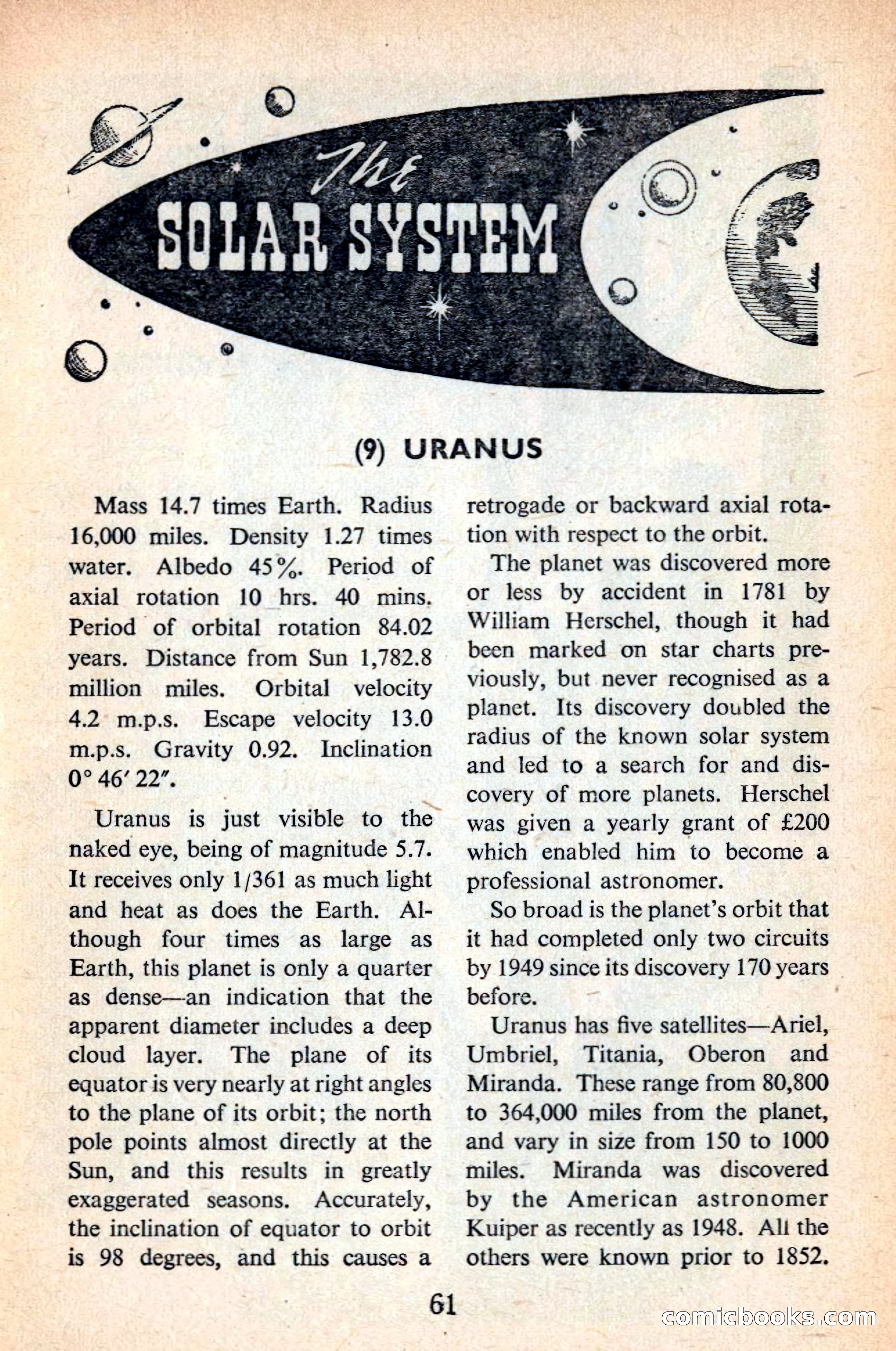
A restored page from Pulp Fiction, 1954. Page through the whole issue in the reader above.
📄 Transcribed text from this page (OCR, searchable)
Machine-transcribed from the original scan — historical spelling and the odd misread are preserved.
NOLAR ” ( ’ ’ * 3 " ‘ SYSTEM (9) URANUS Mass 14.7 times Earth. Radius 16,000 miles. Density 1.27 times water. Albedo 45%. Period of axial rotation 10 hrs. 40 mins. Period of orbital rotation 84.02 years. Distance from Sun 1,782.8 million miles. Orbital velocity 4.2 m.p.s. Escape velocity 13.0 m.p.s. Gravity 0.92. Inclination 0° 46’ 22”. Uranus is just visible to the’ naked eye, being of magnitude 5.7. It receives only 1/361 as much light and heat as does the Earth. Al- though four times as large as Earth, this planet is only a quarter as dense—an indication that the apparent diameter includes a deep cloud layer. The plane of its equator is very nearly at right angles to the plane of its orbit; the north pole points almost directly at the Sun, and this results in greatly exaggerated seasons. Accurately, the inclination of equator to orbit is 98 degrees, and this causes a 61 retrogade or backward axial rota- tion with respect to the orbit. The planet was discovered more or less by accident in 1781 by William Herschel, though it had been marked on star charts pre- viously, but never recognised as a planet. Its discovery doubled the radius of the known solar system and led to a search for and dis- covery of more planets. Herschel was given a yearly grant of £200 which enabled him to become a professional astronomer. So broad is the planet’s orbit that it had completed only two circuits by 1949 since its discovery 170 years before. Uranus has five satellites—Ariel, Umbriel, Titania, Oberon and Miranda. These range from 80,800 to 364,000 miles from the planet, and vary in size from 150 to 1000 miles. Miranda was discovered by the American astronomer Kuiper as recently as 1948. Ali the others were known prior to 1852. connicloooks.comn