
Pulp Fiction, 1954 · page 23 of 162
Authentic Science Fiction Monthly No. 41 — page 23: what you’re looking at
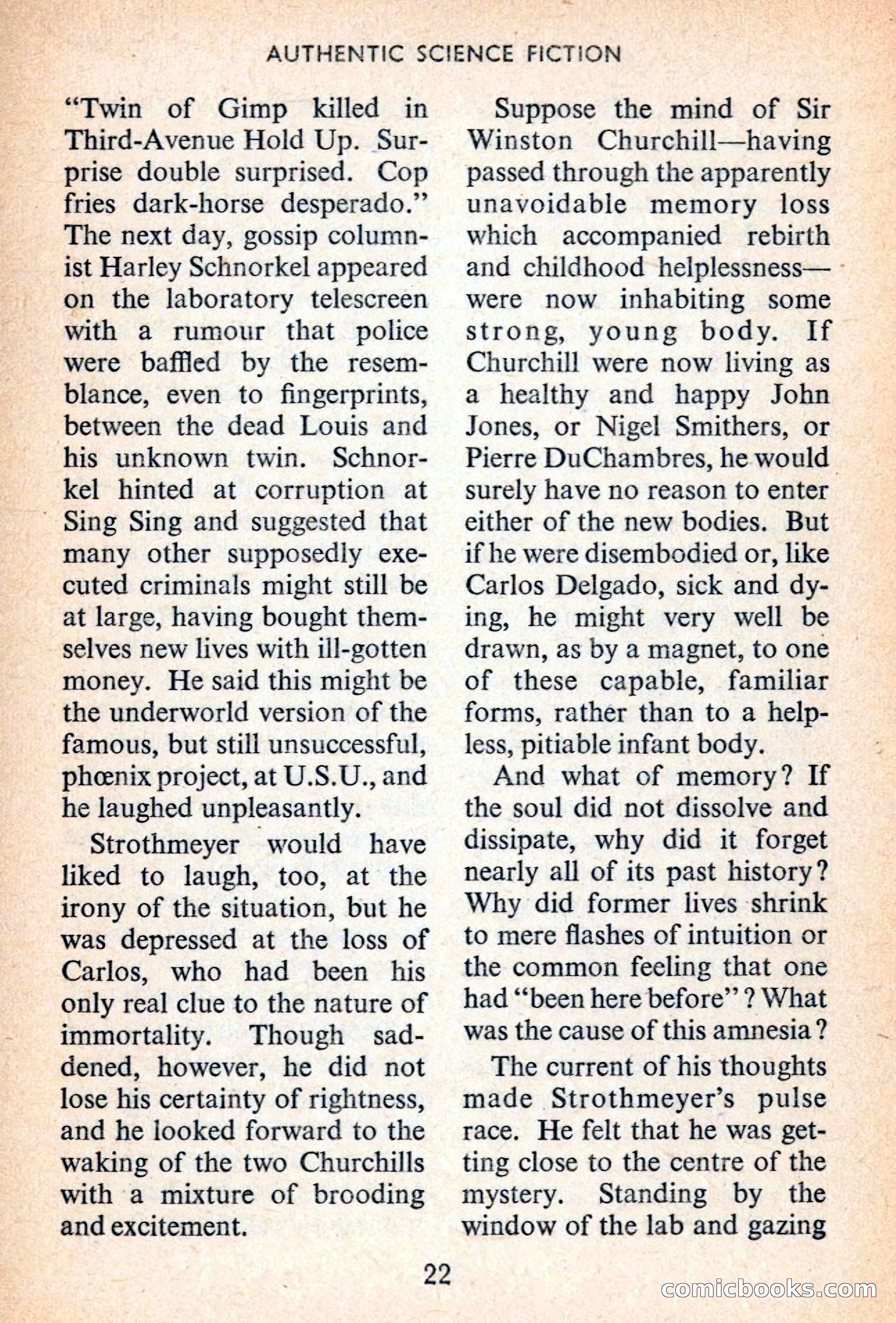
A restored page from Pulp Fiction, 1954. Page through the whole issue in the reader above.
📄 Transcribed text from this page (OCR, searchable)
Machine-transcribed from the original scan — historical spelling and the odd misread are preserved.
AUTHENTIC SCIENCE FICTION “Twin of Gimp killed in Third-Avenue Hold Up. Sur- prise double surprised. Cop fries dark-horse desperado.” The next day, gossip column- ist Harley Schnorkel appeared on the laboratory telescreen with a rumour that police were baffled by the resem- blance, even to fingerprints, between the dead Louis and his unknown twin. Schnor- kel hinted at corruption at - Sing Sing and suggested that many other supposedly exe- cuted criminals might still be at large, having bought them- selves new lives with ill-gotten money. He said this might be the underworld version of the famous, but still unsuccessful, pheenix project, at U.S.U., and he laughed unpleasantly. Strothmeyer would have liked to laugh, too, at the irony of the situation, but he was depressed at the loss of Carlos, who had been his only real clue to the nature of immortality. Though sad- dened, however, he did not lose his certainty of rightness, and he looked forward to the waking of the two Churchills with a mixture of brooding and excitement. 22 Suppose the mind of Sir Winston Churchill—having passed through the apparently unavoidable memory loss which accompanied rebirth and childhood helplessness— - were now inhabiting some strong, young body. If Churchill were now living as a healthy and happy John Jones, or Nigel Smithers, or Pierre DuChambres, he would surely have no reason to enter either of the new bodies. But if he were disembodied or, like Carlos Delgado, sick and dy- ing, he might very well be drawn, as by a magnet, to one of these capable, familiar forms, rather than to a help- less, pitiable infant body. And what of memory? If the soul did not dissolve and dissipate, why did it forget nearly all of its past history? Why did former lives shrink to mere flashes of intuition or the common feeling that one had “‘been here before’’ ? What was the cause of this amnesia? The current of his thoughts made Strothmeyer’s pulse race. He felt that he was get- ting close to the centre of the mystery. Standing by the window of the lab and gazing commicloooks.comn