
Pulp Fiction, 1952 · page 7 of 59
Authentic Science Fiction, No. 23 — page 7: what you’re looking at
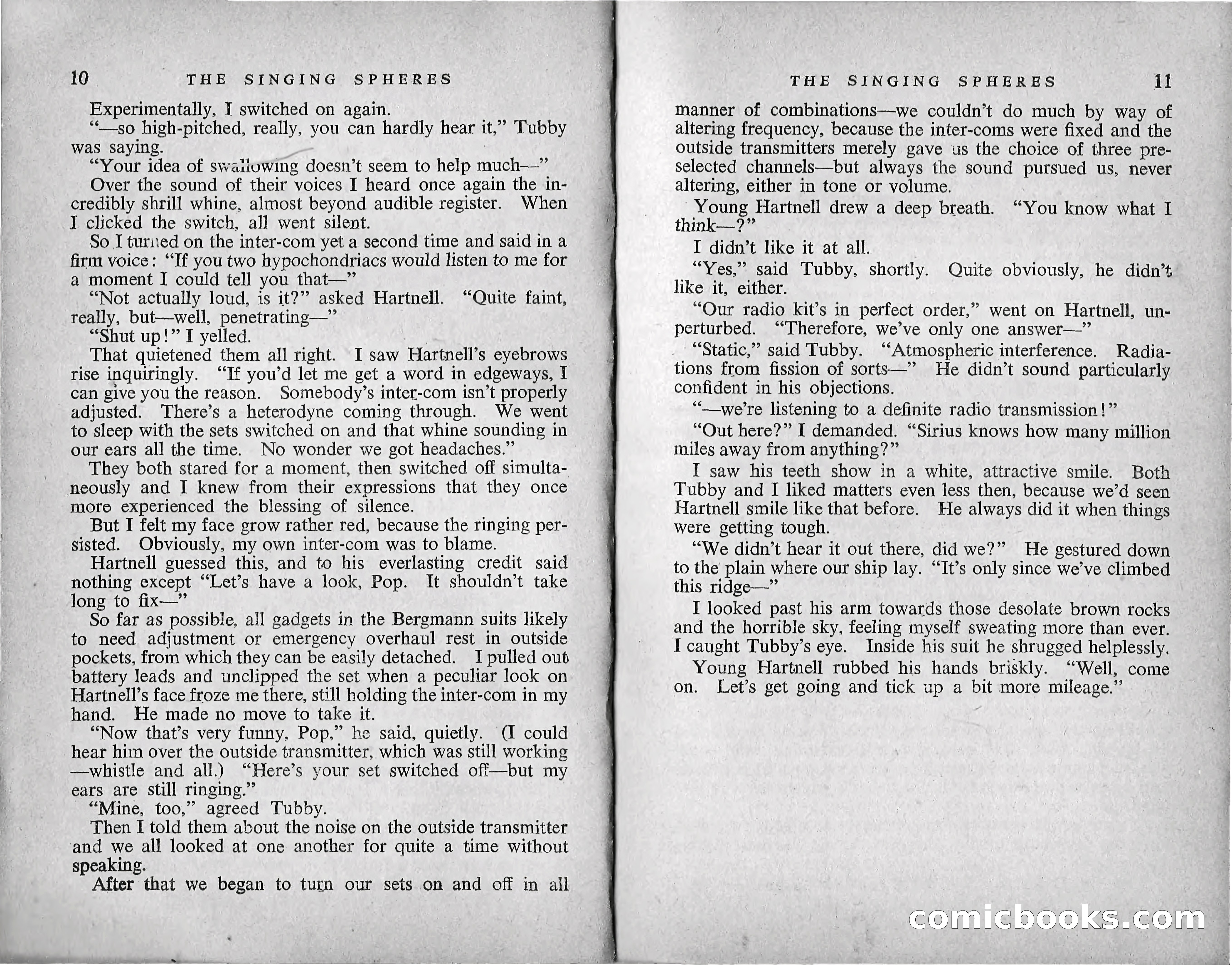
A restored page from Pulp Fiction, 1952. Page through the whole issue in the reader above.
📄 Transcribed text from this page (OCR, searchable)
Machine-transcribed from the original scan — historical spelling and the odd misread are preserved.
10 THE SINGING SPHERES Experimentally, I switched on again. ‘“__so high-pitched, really, you can hardly hear it,” Tubby was saying. “Your idea of swariowing doesn’t seem to help much—” Over the sound of their voices I heard once again the in- credibly shrill whine, almost beyond audible register. When I clicked the switch, all went silent. So I turited on the inter-com yet a second time and said in a firm voice: “If you two hypochondriacs would listen to me for a moment I could tell you that—” “Not actually loud, is it?” asked Hartnell. “Quite faint, really, but—well, penetrating—”’ “Shut up!” T yelled. | That quietened them all right. I saw Hartnell’s eyebrows rise inquiringly. “If you’d let me get a word in edgeways, I can give you the reason. Somebody’s inter-com isn’t properly adjusted. There’s a heterodyne coming through. We went to sleep with the sets switched on and that whine sounding in our ears all the time. No wonder we got headaches.” They both stared for a moment, then switched off simulta- neously and I knew from their expressions that they once more experienced the blessing of silence. But I felt my face grow rather red, because the ringing per- sisted. Obviously, my own inter-com was to blame. Hartnell guessed this, and to his everlasting credit said nothing except “Let’s have a look, Pop. It shouldn’t take long to fix—” So far as possible, all gadgets in the Bergmann suits likely to need adjustment or emergency overhaul rest in outside pockets, from which they can be easily detached. I pulled out battery leads and unclipped the set when a peculiar look on Hartnell’s face froze me there, still holding the inter-com in my hand. He made no move to take it. “Now that’s very funny, Pop,” he said, quietly. (I could hear him over the outside transmitter, which was still working —whistle and all.) “Here’s your set switched off—but my ears are still ringing.” “Mine, too,” agreed Tubby. Then I told them about the noise on the outside transmitter and we all looked at one another for quite a time without speaking. After that we began to turn our sets on and off in all THE SINGING SPHERES il manner of combinations—we couldn’t do much by way of altering frequency, because the inter-coms were fixed and the outside transmitters merely gave us the choice of three pre- selected channels—but always the sound pursued us, never altering, either in tone or volume. Young Hartnell drew a deep breath. “You know what I think—?” I didn’t like it at all. “Yes,” said Tubby, shortly. Quite obviously, he didn’t like it, either. “Our radio kit’s in perfect order,” went on Hartnell, un- perturbed. “Therefore, we’ve only one answer—” “Static,” said Tubby. “Atmospheric interference. Radia- tions from fission of sorts—” confident in his objections. “we're listening to a definite radio transmission!” “Out here?” I demanded. “Sirius knows how many million miles away from anything?” I saw his teeth show in a white, attractive smile. Both Tubby and I liked matters even less then, because we’d seen Hartnell smile like that before. He always did it when things were getting tough. “We didn’t hear it out there, did we?” He gestured down to the plain where our ship lay. “It’s only since we’ve climbed this ridge—” I looked past his arm towards those desolate brown rocks and the horrible sky, feeling myself sweating more than ever. I caught Tubby’s eye. Inside his suit he shrugged helplessly. Young Hartnell rubbed his hands briskly. “Well, come on. Let’s get going and tick up a bit more mileage.” He didn’t sound particularly Ebooks. co =) (E(@)