
Pulp Fiction, 1952 · page 5 of 59
Authentic Science Fiction, No. 23 — page 5: what you’re looking at
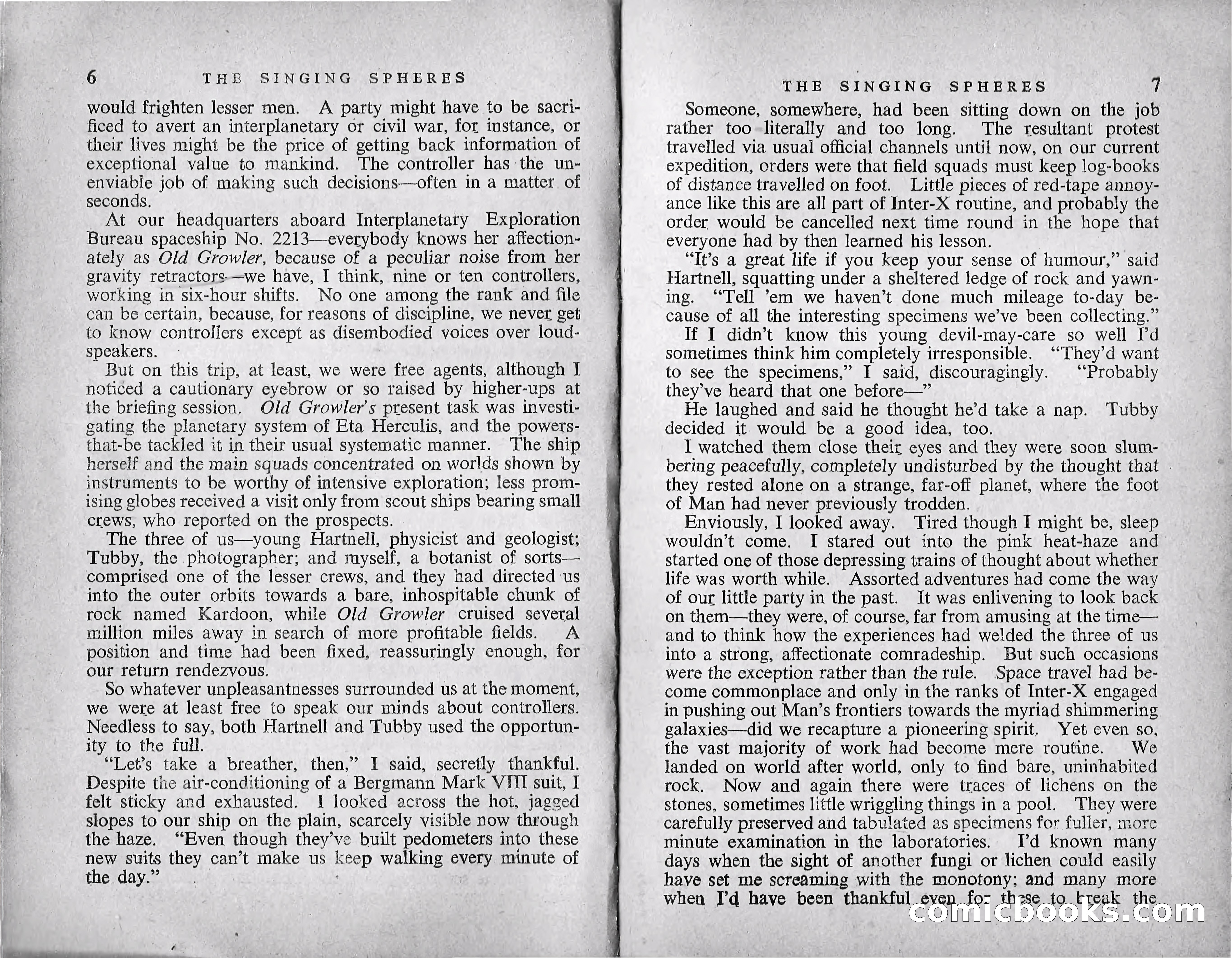
A restored page from Pulp Fiction, 1952. Page through the whole issue in the reader above.
📄 Transcribed text from this page (OCR, searchable)
Machine-transcribed from the original scan — historical spelling and the odd misread are preserved.
6 THE SINGING SPHERES would frighten lesser men. A party might have to be sacri- ficed to avert an interplanetary or civil war, for instance, or their lives might be the price of getting back information of exceptional value to mankind. The controller has the un- enviable job of making such decisions—often in a matter of seconds. At our headquarters aboard Interplanetary Exploration Bureau spaceship No. 2213—everybody knows her affection- ately as Old Growler, because of a peculiar noise from her gravity retractors-—we have, I think, nine or ten controllers, working in six-hour shifts. No one among the rank and file can be certain, because, for reasons of discipline, we never get to know controllers except as disembodied voices over loud- speakers. But on this trip, at least, we were free agents, although I noticed a cautionary eyebrow or so raised by higher-ups at the briefing session. Old Growler’s present task was investi- gating the planetary system of Eta Herculis, and the powers- that-be tackled it in their usual systematic manner. The ship herself and the main squads concentrated on worlds shown by instruments to be worthy of intensive exploration; less prom- ising globes received a visit only from scout ships bearing small crews, who reported on the prospects. The three of us—young Hartnell, physicist and geologist; Tubby, the photographer; and myself, a botanist of sorts— comprised one of the lesser crews, and they had directed us into the outer orbits towards a bare, inhospitable chunk of rock named Kardoon, while Old Growler cruised several million miles away in search of more profitable fields. A position and time had been fixed, reassuringly enough, for our return rendezvous. So whatever unpleasantnesses surrounded us at the moment, we were at least free to speak our minds about controllers. Needless to say, both Hartnell and Tubby used the opportun- ity to the full. “Let’s take a breather, then,” I said, secretly thankful. Despite tiie air-conditioning of a Bergmann Mark VIII suit, I felt sticky and exhausted. I looked across the hot, jagged slopes to our ship on the plain, scarcely visible now through the haze. “Even though they’ve built pedometers into these new suits they can’t make us Keep walking every minute of the day.” | THE SINGING SPHERES 1] Someone, somewhere, had been sitting down on the job rather too literally and too long. The resultant protest travelled via usual official channels until now, on our current expedition, orders were that field squads must keep log-books of distance travelled on foot. Little pieces of red-tape annoy- ance like this are all part of Inter-X routine, and probably the order would be cancelled next time round in the hope that everyone had by then learned his lesson. “It’s a great life if you keep your sense of humour,” said Hartnell, squatting under a sheltered ledge of rock and yawn- ing. “Tell °em we haven’t done much mileage to-day be- cause of all the interesting specimens we’ve been collecting.” If I didn’t know this young devil-may-care so well Vd sometimes think him completely irresponsible. “They'd want to see the specimens,” I said, discouragingly. “Probably they’ve heard that one before—” He laughed and said he thought he'd take a nap. Tubby decided it would be a good idea, too. I watched them close their eyes and they were soon slum- bering peacefully, completely undisturbed by the thought that - they rested alone on a strange, far-off planet, where the foot of Man had never previously trodden. Enviously, I looked away. Tired though I might be, sleep wouldn’t come. I stared out into the pink heat-haze and started one of those depressing trains of thought about whether life was worth while. Assorted adventures had come the way of our little party in the past. It was enlivening to look back on them—they were, of course, far from amusing at the time— and to think how the experiences had welded the three of us into a strong, affectionate comradeship. But such occasions were the exception rather than the rule. Space travel had be- come commonplace and only in the ranks of Inter-X engaged in pushing out Man’s frontiers towards the myriad shimmering galaxies—did we recapture a pioneering spirit. Yet even so, the vast majority of work had become mefe routine. We landed on world after world, only to find bare, uninhabited rock. Now and again there were traces of lichens on the stones, sometimes little wriggling things in a pool. They were carefully preserved and tabulated as specimens for fuller, more minute examination in the laboratories. Id known many days when the sight of another fungi or lichen could easily have set me screaming with the monotony; and many more when I’d have been thankful Comi cbi ooks co