
Pulp Fiction, 1952 · page 35 of 59
Authentic Science Fiction, No. 23 — page 35: what you’re looking at
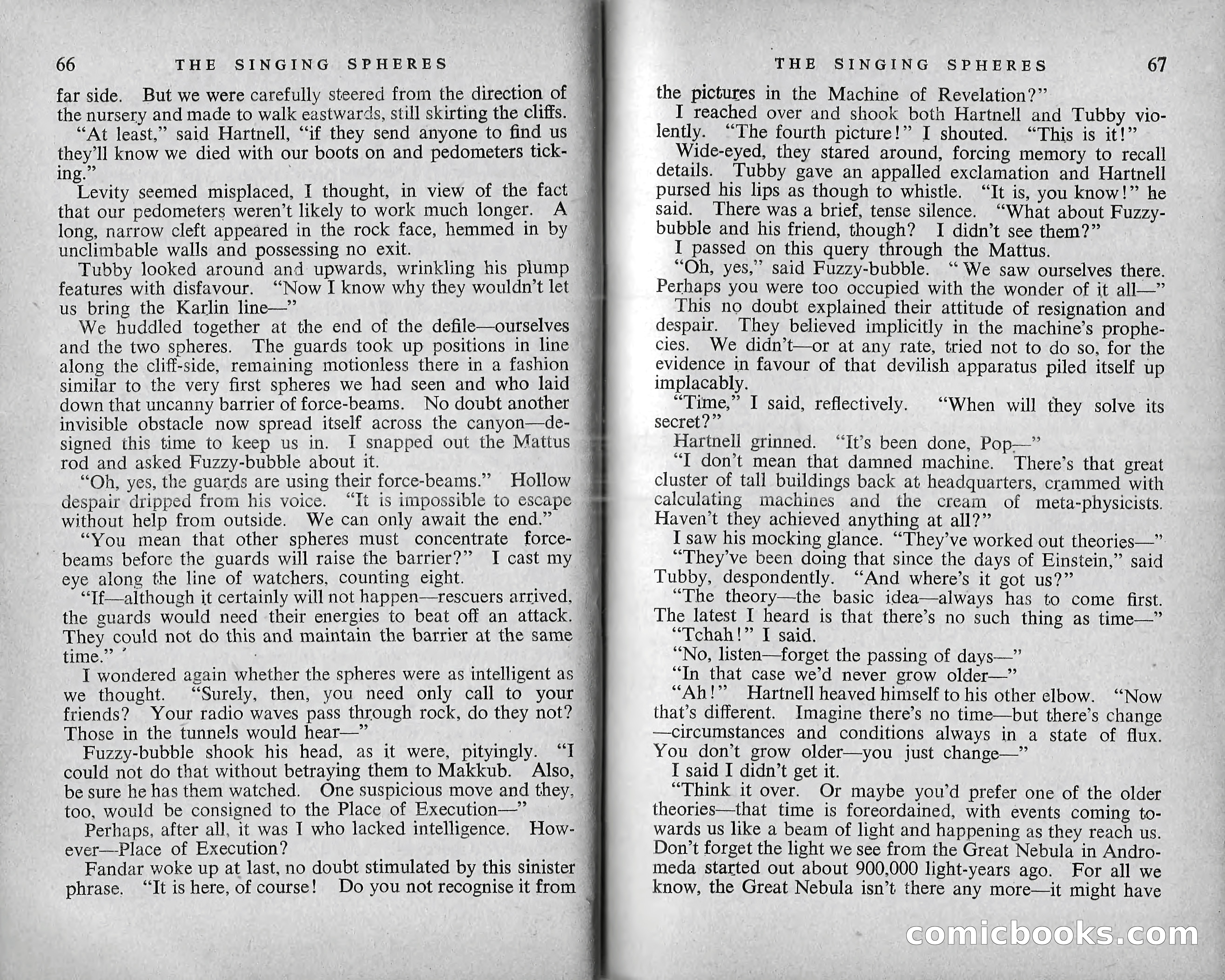
A restored page from Pulp Fiction, 1952. Page through the whole issue in the reader above.
📄 Transcribed text from this page (OCR, searchable)
Machine-transcribed from the original scan — historical spelling and the odd misread are preserved.
66 THE SINGING SPHERES far side. But we were carefully steered from the direction of the nursery and made to walk eastwards, still skirting the cliffs. “At least,” said Hartnell, “if they send anyone to find us they'll know we died with our boots on and pedometers tick- 1n BY ‘ Tie seemed misplaced, I thought, in view of the fact that our pedometers weren’t likely to work much longer. A long, narrow cleft appeared in the rock face, hemmed in by unclimbable walls and possessing no exit. Tubby looked around and upwards, wrinkling his plump features with disfavour. “Now I know why they wouldn't let us bring the Karlin line—” We huddled together at the end of the defile—ourselves and the two spheres. The guards took up positions in line along the cliff-side, remaining motionless there in a fashion similar to the very first spheres we had seen and who laid down that uncanny barrier of force-beams. invisible obstacle now spread itself across the canyon—de- signed this time to keep us in. I snapped out the Mattus rod and asked Fuzzy-bubble about it. “Oh, yes, the guards are using their force-beams.”’ despair dripped from his voice. a without help from outside. We can only await the end. “You mean that other spheres must concentrate force- Hollow beams before the guards will raise the barrier?” I cast my | eye along the line of watchers, counting eight. “Tf—although it certainly will not happen—rescuers arrived, the guards would need their energies to beat off an attack. 4 They could not do this and maintain the barrier at the same ~ time.”’ I wondered again whether the spheres were as intelligent as 7 “Surely, then, you need only call to your | friends? Your radio waves pass through rock, do they not? | we thought. Those in the tunnels would hear—” Fuzzy-bubble shook his head, as it were, pityingly. “I | could not do that without betraying them to Makkub. Also, be sure he has them watched. One suspicious move and they, too, would be consigned to the Place of Execution—” Perhaps, after all, it was I who lacked intelligence. ever—Place of Execution? Fandar woke up at last, no doubt stimulated by this sinister © Do you not recognise it from — phrase. “It is here, of course! No doubt another — “It is impossible to escape ™@ How- | THE SINGING SPHERES 67 the pictures in the Machine of Revelation?” I reached over and shook both Hartnell and Tubby vio- lently. “The fourth picture!” I shouted. “This is it!” Wide-eyed, they stared around, forcing memory to recall details. Tubby gave an appalled exclamation and Hartnell pursed his lips as though to whistle. “It is, you know!” he said. There was a brief, tense silence. “What about Fuzzy- bubble and his friend, though? I didn’t see them?” I passed on this query through the Mattus. “Oh, yes,” said Fuzzy-bubble. ‘“ We saw ourselves there. Perhaps you were too occupied with the wonder of it all—” This no doubt explained their attitude of resignation and despair. They believed implicitly in the machine’s prophe- cies. We didn’t—or at any rate, tried not to do so. for the evidence in favour of that devilish apparatus piled itself up implacably. “Time,” I said, reflectively. secret?” Hartnell grinned. “It’s been done, Pop—” “I don’t mean that damned machine. There’s that great cluster of tall buildings back at headquarters, crammed with calculating machines and the cream of meta-physicists. Haven't they achieved anything at all?” I saw his mocking glance. “They’ve worked out theories—” “They’ve been doing that since the days of Einstein,” said Tubby, despondently. “And where’s it got us?” “The theory—the basic idea—always has to come first. The latest I heard is that there’s no such thing as time—” “Tchah!” I said. “No, listen—forget the passing of days—” “In that case we’d never grow older—” “Ah!” Hartnell heaved himself to his other elbow. “Now that’s different. Imagine there’s no time—but there’s change —circumstances and conditions always in a state of flux. You don’t grow older—you just change—” I said I didn’t get it. “Think it over. Or maybe you’d prefer one of the older theories—that time is foreordained, with events coming to- wards us like a beam of light and happening as they reach us. Don’t forget the light we see from the Great Nebula in Andro- meda started out about 900,000 light-years ago. For all we know, the Great Nebula isn’t there any more—it might have “When will they solve its Gomilchbooks.co =}