
Pulp Fiction, 1952 · page 28 of 59
Authentic Science Fiction, No. 23 — page 28: what you’re looking at
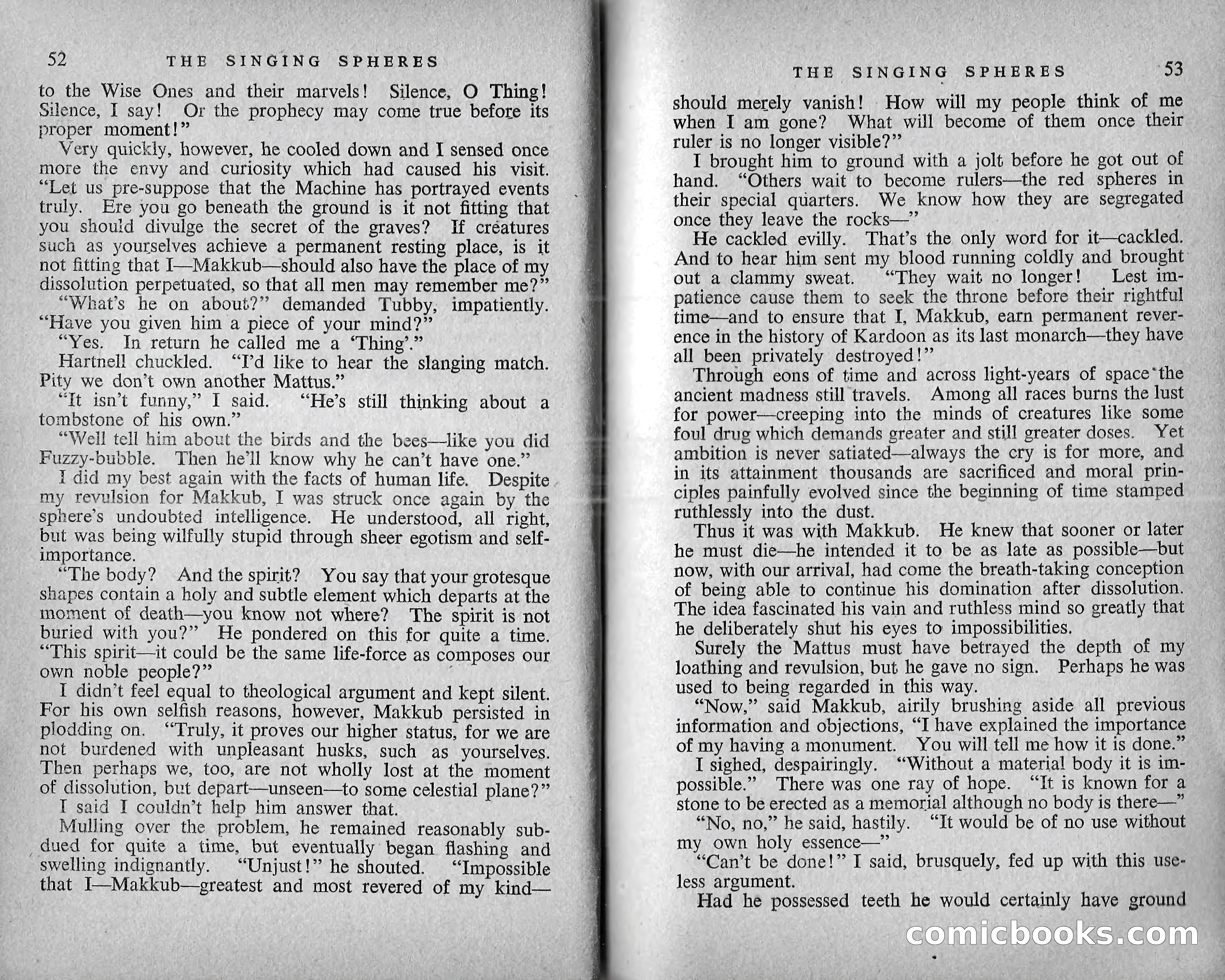
A restored page from Pulp Fiction, 1952. Page through the whole issue in the reader above.
📄 Transcribed text from this page (OCR, searchable)
Machine-transcribed from the original scan — historical spelling and the odd misread are preserved.
52 THE SINGING SPHERES to the Wise Ones and their marvels! Silence, O Thing! Sulence, I say! Or the prophecy may come true before its proper moment!” Very quickly, however, he cooled down and I sensed once more the envy and curiosity which had caused his visit. “Let us pre-suppose that the Machine has portrayed events truly. Ere you go beneath the ground is it not fitting that you should divulge the secret of the graves? If créatures Such as yourselves achieve a permanent resting place, is it not fitting that IL—_Makkub—should also have the place of my dissolution perpetuated, so that all men may remember me?” “What’s he on about?” demanded Tubby, impatiently. “Have you given him a piece of your mind?” “Yes. In return he called me a ‘Thing’.” Hartnell chuckled. “Id like to hear the slanging match. Pity we don’t own another Mattus.” “It isn’t funny,” I said. “He’s still thinking about a tombstone of his own.” “Well tell him about the birds and the bees—like you did Fuzzy-bubble. Then he'll know why he can’t have one.” i did my best again with the facts of human life. Despite my revulsion for Makkub, I was struck once again by the sphere’s undoubted intelligence. He understood, all right, but was being wilfully stupid through sheer egotism and self- importance. “The body? And the spirit? You say that your grotesque shapes contain a holy and subtle element which departs at the moment of death—you know not where? The spirit is not buried with you?” He pondered on this for quite a time. “This spirit—it could be the same life-force as composes our own noble people?” I didn’t feel equal to theological argument and kept silent. For his own selfish reasons, however, Makkub persisted in plodding on. “Truly, it proves our higher status, for we are not burdened with unpleasant husks, such as yourselves. Then perhaps we, too, are not wholly lost at the moment of dissolution, but depart—unseen—to some celestial plane?” T said I couldn’t help him answer that. Muling over the problem, he remained reasonably sub- _dued for quite a time, but eventually began flashing and swelling indignantly. “Unjust! he shouted. “Impossible that I—Makkub—greatest and most revered of my kind— THE SINGING SPHERES 33 should merely vanish! _How will my people think of me when I am gone? What will become of them once their ruler is no longer visible?”’ I brought him to ground with a jolt before he got out of hand. “Others wait to become rulers—the red spheres in their special quarters. We know how they are segregated once they leave the rocks—’ He cackled evilly. That’s the only word for it—cackled. And to hear him sent my blood running coldly and brought out a clammy sweat. “They wait no longer! Lest im- patience cause them to seek the throne before their rightful time—and to ensure that I, Makkub, earn permanent rever- ence in the history of Kardoon as its last monarch—they have all been privately destroyed!” Through eons of time and across light-years of space*the ancient madness still travels. Among all races burns the lust for power—creeping into the minds of creatures like some foul drug which demands greater and still greater doses. Yet ambition is never satiated—always the cry is for more, and in its attainment thousands are sacrificed and moral prin- ciples painfully evolved since the beginning of time stamped ruthlessly into the dust. Thus it was with Makkub. He knew that sooner or later he must die—he intended it to be as late as possible—but now, with our arrival, had come the breath-taking conception of being able to continue his domination after dissolution. The idea fascinated his vain and ruthless mind so greatly that he deliberately shut his eyes to impossibilities. Surely the Mattus must have betrayed the depth of my loathing and revulsion, but he gave no sign. Perhaps he was used to being regarded in this way. “Now,” said Makkub, airily brushing aside all previous jnformation and objections, “I have explained the importance of my having a monument. You will tell me how it is done.” I sighed, despairingly. “Without a material body it is im- possible.” There was one ray of hope. “It is known for a stone to be erected as a memorial although no body is there—” “No, no,” he said, hastily. “It would be of no use without my own holy essence—” “Can’t be done!” I said, brusquely, fed up with this use- less argument. | Had he possessed teeth he would certainly have ground comicbooks.com