
Pulp Fiction, 1952 · page 21 of 59
Authentic Science Fiction, No. 23 — page 21: what you’re looking at
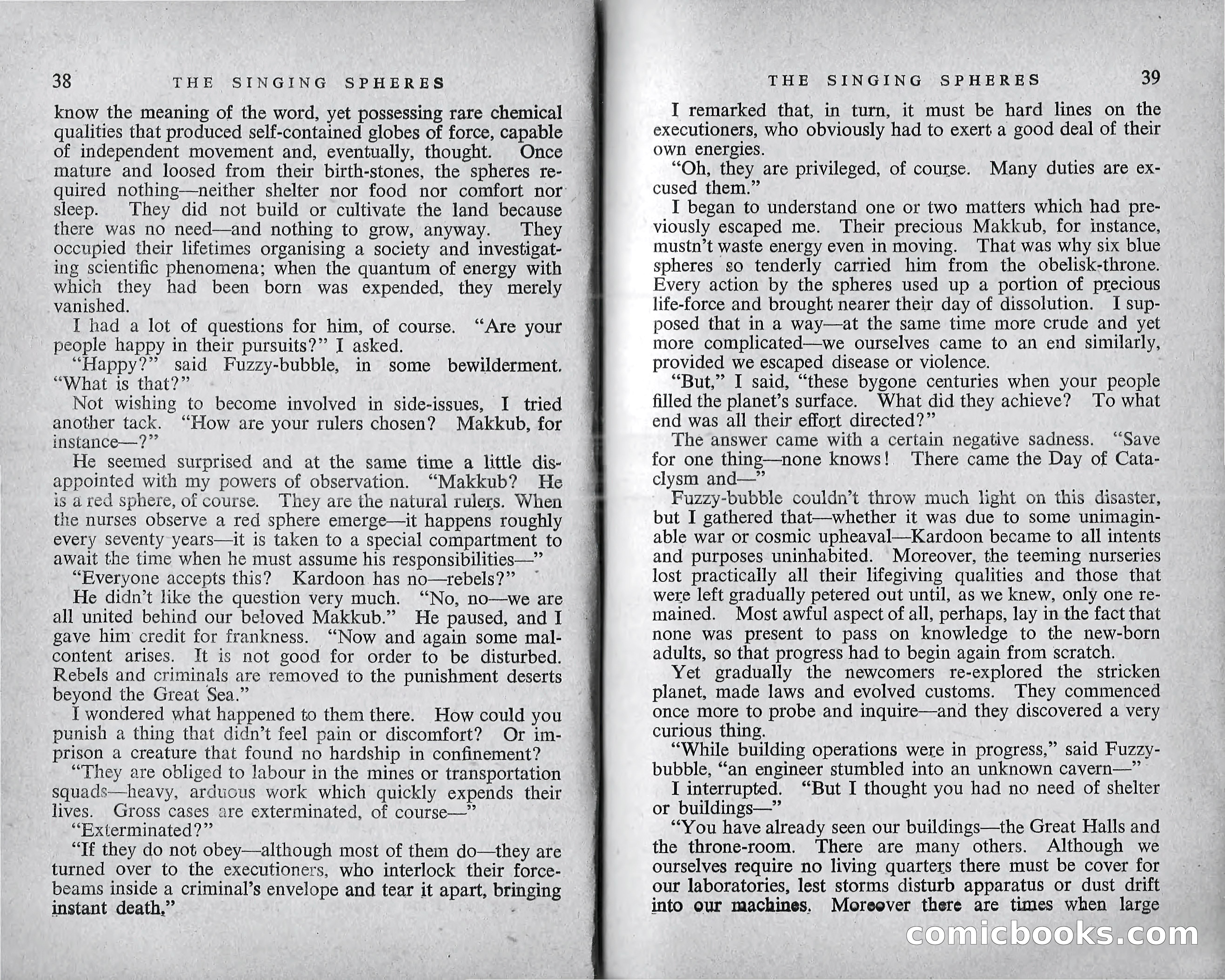
A restored page from Pulp Fiction, 1952. Page through the whole issue in the reader above.
📄 Transcribed text from this page (OCR, searchable)
Machine-transcribed from the original scan — historical spelling and the odd misread are preserved.
38 THE SINGING SPHERES know the meaning of the word, yet possessing rare chemical qualities that produced self-contained globes of force, capable of independent movement and, eventually, thought. Once mature and loosed from their birth-stones, the sphetes re- quired nothing—neither shelter nor food nor comfort nor sleep. They did not build or cultivate the land because there was no need—and nothing to grow, anyway. ‘They occupied their lifetimes organising a society and investigat- ing scientific phenomena; when the quantum of energy with which they had been born was expended, they merely vanished. I had a lot of questions for him, of course. people happy in their pursuits?” I asked. “Happy?” said Fuzzy-bubble, in some bewilderment. “What is that?” Not wishing to become involved in side-issues, I tried another tack. “How are your rulers chosen? Makkub, for instance—?” He seemed surprised and at the same time a little dis-~ appointed with my powers of observation. “Makkub? He is ared sphere, of course. They are the natural rulers. When the nurses observe a red sphere emerge—it happens roughly every seventy years—it is taken to a special compartment to await the time when he must assume his responsibilities—” “Everyone accepts this? Kardoon has no—tebels?” — He didn’t like the question very much. “No, 10—we are all united behind our beloved Makkub.” He paused, and I gave him credit for frankness. “Now and again some mal- content arises. It is not good for order to be disturbed. Rebels and criminals are removed to the punishment deserts beyond the Great Sea.” I wondered what happened to them there. How could you punish a thing that didn’t feel pain or discomfort? Or im- prison a creature that found no hardship in confinement? “They are obliged to labour in the mines or transportation squads—heavy, arduous work which quickly expends their lives. Gross cases are exterminated, of course—” “Exterminated?” “Tf they do not obey—although most of them do—they are turned over to the executioners, who interlock their force- beams inside a criminal’s envelope and tear it aan bringing instant death,” “Are your THE SINGING SPHERES 39 I remarked that, in turn, it must be hard lines on the executioners, who obviously had to exert a good deal of their own energies. “Oh, they are privileged, of course. cused them.” I began to understand one or two matters which had pre- viously escaped me. Their precious Makkub, for instance, mustn’t waste energy even in moving. That was why six blue spheres so tenderly carried him from the obelisk-throne. Every action by the spheres used up a portion of precious life-force and brought nearer their day of dissolution. I sup- posed that in a way—at the same time more crude and yet more complicated—we ourselves came to an end similarly, provided we escaped disease or violence. “But,” I said, “these bygone centuries when your people filled the planet’s surface. What did they achieve? To what end was all their effort directed?” The answer came with a certain negative sadness. “Save for one thing—none knows! ‘There came the Day of Cata- clysm and—” Fuzzy-bubble couldn’t throw much light on this disaster, but I gathered that—whether it was due to some unimagin- able war or cosmic upheaval—Kardoon became to all intents and purposes uninhabited. Moreover, the teeming nurseries lost practically all their lifegiving qualities and those that were left gradually petered out until, as we knew, only one re- mained. Most awful aspect of all, perhaps, lay in the fact that none was present to pass on knowledge to the new-born adults, so that progress had to begin again from scratch. Yet gradually the newcomers re-explored the stricken planet, made laws and evolved customs. They commenced once more to probe and inquire—and wl discovered a very curious thing. “While building operations were in progress,” said Fuzzy- bubble, “an engineer stumbled into an unknown cavern—” I interrupted. “But I thought you had no need of shelter or buildings—” “You have already seen our buildings—the Great Halls and the throne-room. There are many others. Although we ourselves require no living quarters there must be cover for our laboratories, lest storms disturb apparatus or dust drift into our machines. Moreover there are times when large Many duties are ex- Gomilcbooks.co