
Pulp Fiction, 1952 · page 15 of 59
Authentic Science Fiction, No. 23 — page 15: what you’re looking at
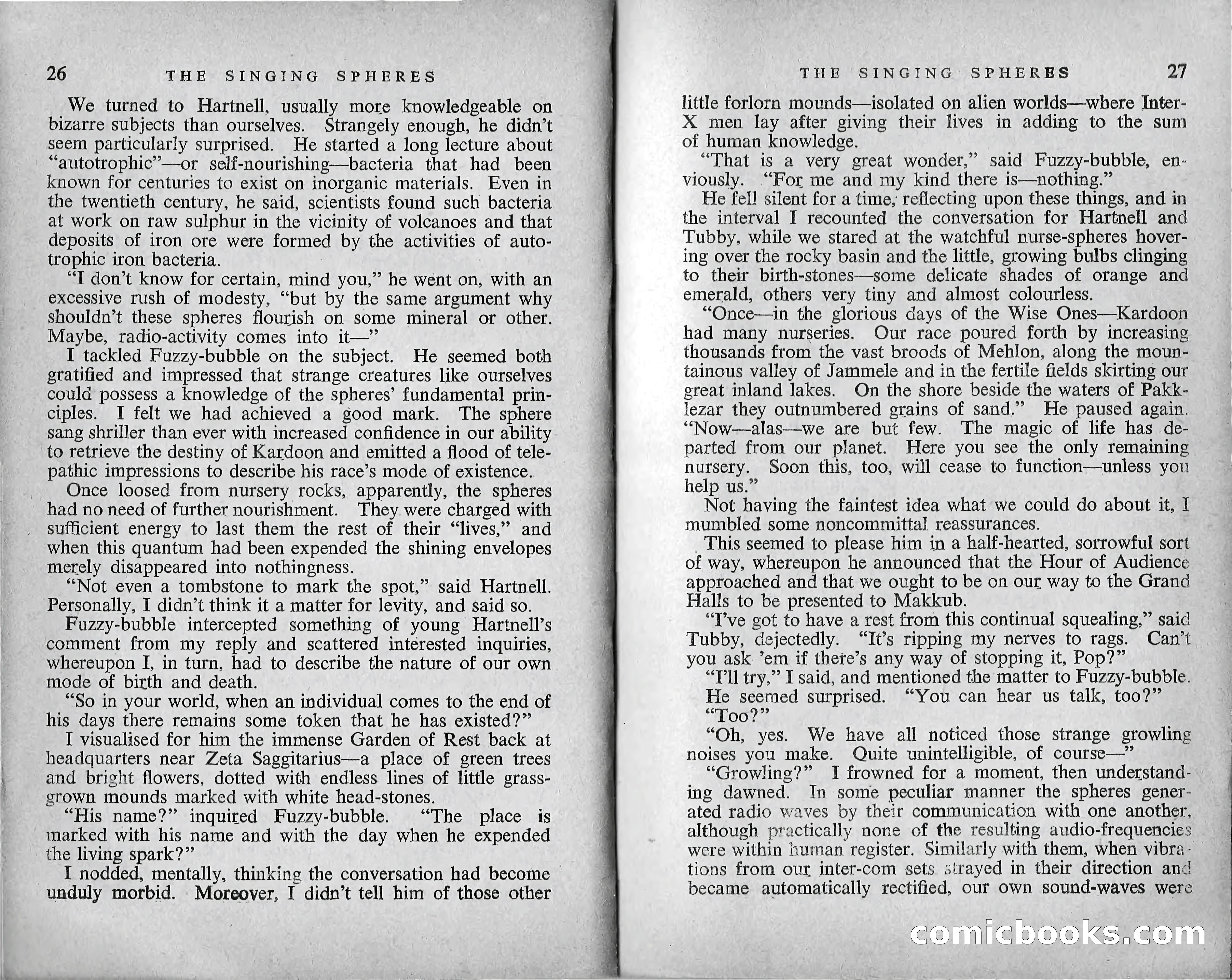
A restored page from Pulp Fiction, 1952. Page through the whole issue in the reader above.
📄 Transcribed text from this page (OCR, searchable)
Machine-transcribed from the original scan — historical spelling and the odd misread are preserved.
26 THE SINGING SPHERES We turned to Hartnell, usually more knowledgeable on bizarre subjects than ourselves. Strangely enough, he didn’t seem particular ly surprised. He started a long lecture about ~autotrophic’”’—or self-nourishing—bacteria that had been known for centuries to exist on inorganic materials. Even in the twentieth century, he said, scientists found such bacteria at work on raw sulphur in the vicinity of volcanoes and that deposits of iron ore were formed by the activities of auto- trophic iron bacteria. “T don’t know for certain, aia you,” he went on, with an excessive rush of modesty, “but by the same argument why shouldn’t these spheres flourish on some mineral or other. Maybe, radio-activity comes into 1t—” I tackled Fuzzy-bubble on the subject. He seemed both gratified and impressed that strange creatures like ourselves could possess a knowledge of the spheres’ fundamental prin- ciples. I felt we had achieved a good mark. The sphere sang shriller than ever with increased confidence in our ability to retrieve the destiny of Kardoon and emitted a flood of tele- pathic impressions to describe his race’s mode of existence. Once loosed from nursery rocks, apparently, the spheres had no need of further nourishment. They were charged with Sufficient energy to last them the rest of their “lives,” and when this quantum had been expended the shining envelopes — merely disappeared into nothingness. “Not even a tombstone to mark the spot,” said Hartnell. Personally, I didn’t think it a matter for levity, and said so. Fuzzy-bubble intercepted something of young Hartnell’s comment from my reply and scattered interested inquiries, whereupon I, in turn, had to describe the nature of our own mode of birth and death. “So in your world, when an individual comes to the end of his days there remains some token that he has existed?” I visualised for him the immense Garden of Rest back at headquarters near Zeta Saggitarius—a place of green trees and bright flowers, dotted with endless lines of little grass- grown mounds marked with white head-stones. “His name?’ inquired Fuzzy-bubble. “The place is marked with his name and with the day when he expended the living spark?” I nodded, mentally, thinking the conversation had become > unduly morbid. Moreover, I didn’t tell him of those other THE SINGING SPHERES 27 little forlorn mounds—isolated on alien worlds—where Inter- X men lay after giving their lives in adding to the sum of human knowledge. That is a very great wonder,” said Fuzzy- -bubble, en- viously. “For me and my kind there 1s—nothing.” He fell silent for a time, reflecting upon these things, and in the interval I recounted the conversation for Hartnell and Tubby, while we stared at the watchful nurse-spheres hover- ing over the rocky basin and the little, growing bulbs clinging to their birth-stones—some delicate shades of orange and emerald, others very tiny and almost colourless. “Once—in the glorious days of the Wise Ones—Kardoon had many nurseries. Our race poured forth by increasing thousands from the vast broods of Mehlon, along the moun- tainous valley of Jammele and in the fertile fields skirting our great inland lakes. On the shore beside the waters of Pakk- lezar they outnumbered grains of sand.” He paused again. ‘““‘Nloow—alas—we are but few. The magic of life has de- parted from our planet. Here you see the only remaining nursery. Soon this, too, will cease to functton—unless you help us.” Not having the faintest idea what we could do about it, I mumbled some noncommittal reassurances. _ This seemed to please him in a half-hearted, sorrowful sort of way, whereupon he announced that the Hour of Audience approached and that we ought to be on our way to the Grand Halls to be presented to Makkub. “I’ve got to have a rest from this continual squealing,” said Tubby, dejectedly. “It’s ripping my nerves to rags. Can't you ask ’em if there’s any way of stopping it, Pop?” “Tl try,” I said, and mentioned the matter to Fuzzy-bubble. He seemed surprised. “You can hear us talk, too?” “Too? 93 “Oh, yes. We have all noticed those strange growling noises you make. Quite unintelligible, of course—” “Growling?” I frowned for a moment, then understand- ing dawned. In some peculiar manner the spheres gener- ated radio waves by their communication with one another, although practically none of the resulting audio- frequencies were within human register. Similarly with them, when vibra- tions from our inter-com sets strayed in their direction and became automatically rectified, our own sound-waves were ecomicbooks.com