
Pulp Fiction, 1952 · page 11 of 59
Authentic Science Fiction, No. 23 — page 11: what you’re looking at
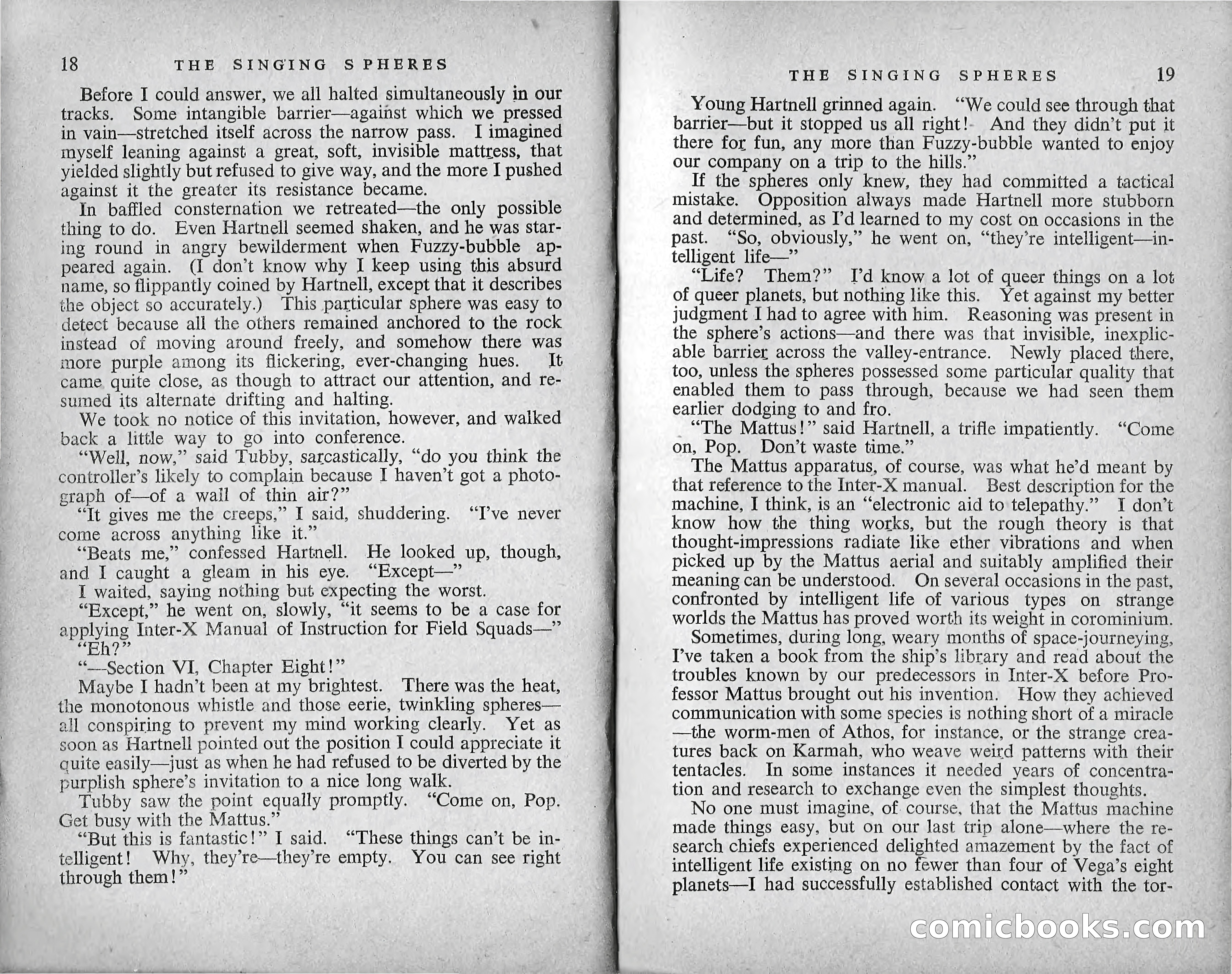
A restored page from Pulp Fiction, 1952. Page through the whole issue in the reader above.
📄 Transcribed text from this page (OCR, searchable)
Machine-transcribed from the original scan — historical spelling and the odd misread are preserved.
18 THE SINGING S PHERES Before I could answer, we all halted simultaneously in our tracks. Some intangible barrier—against which we pressed in vain—stretched itself across the narrow pass. I imagined myself leaning against a great, soft, invisible mattress, that yielded slightly but refused to give way, and the more I pushed against it the greater its resistance became. In baffled consternation we retreated—the only possible thing to do. Even Hartnell seemed shaken, and he was star- ing round in angry bewilderment when Fuzzy-bubble ap- peared again. (I don’t know why I keep using this absurd name, so flippantly coined by Hartnell, except that it describes the object so accurately.) ‘This particular sphere was easy to detect because all the others remained anchored to the rock instead of moving around freely, and somehow there was more purple among its flickering, ever-changing hues. It came. quite close, as though to attract our attention, and fe- sumed its alternate drifting and halting. We took no notice of this invitation, however, and walked back a little way to go into conference. “Well, now,” said Tubby, sarcastically, “do you think the controller’s likely to complain because I haven’t got a photo- eraph of—of a wail of thin air?” “It gives me the creeps,” I said, shuddering. “DPve never come across anything like it.” “Beats me,” confessed Hartnell. He looked up, though, and I caught a gleam in his eye. “Except—” I waited, saying nothing but expecting the worst. “Except,” he went on, slowly, “it seems to be a case for applying Inter-X Manual of Instruction for Field Squads—” “Rh? 2? *““___Section VI, Chapter Eight!” Maybe I hadn’t been at my brightest. ‘There was the heat, the monotonous whistle and those eerie, twinkling spheres— all conspiring to prevent my mind working clearly. Yet as soon as Hartnell pointed out the position I could appreciate it quite easily—just as when he had refused to be diverted by the purplish sphere’s invitation to a nice long walk. Tubby saw the point equally promptly. “Come on, Pop. Get busy with the Mattus.” “But this is fantastic!” I said. “These things can’t be in- telligent! Why, they’re—they’re empty. You can see right through them!” THE SINGING SPHERES 19 Young Hartnell grinned again. ‘‘We could see through that barrier—but it stopped us all right!- And they didn’t put it there for fun, any more than Fuzzy-bubbie wanted to enjoy our company on a trip to the hills.” If the spheres only knew, they had committed a tactical mistake. Opposition always made Hartnell more stubborn and determined, as I’d learned to my cost on occasions in the past. “So, obviously,” he went on, “they’re intelligent—in- telligent life—” “Life? Them?” Id know a lot of queer things on a lot of queer planets, but nothing like this. Yet against my better judgment I had to agree with him. Reasoning was present in the sphere’s actions—and there was that invisible, inexplic- able barrier across the valley-entrance. Newly placed there, too, unless the spheres possessed some particular quality that enabled them to pass through, because we had seen them earlier dodging to and fro. “The Mattus!” said Hartnell, a trifle impatiently. ‘Come on, Pop. Don’t waste time.” The Mattus apparatus, of course, was what he’d meant by that reference to the Inter-X manual. Best description for the machine, I think, is an “electronic aid to telepathy.” I don’t know how the thing works, but the rough theory is that thought-impressions radiate like ether vibrations and when picked up by the Mattus aerial and suitably amplified their meaning can be understood. On several occasions in the past, confronted by intelligent life of various types on strange worlds the Mattus has proved worth its weight in corominium. Sometimes, during long, weary months of space-journeying, I’ve taken a book from the ship’s library and read about the troubles known by our predecessors in Inter-X before Pro- fessor Mattus brought out his invention. How they achieved communication with some species is nothing short of a miracle —the worm-men of Athos, for instance, or the strange crea- tures back on Karmah, who weave weird patterns with their tentacles. In some instances it needed years of concentra- tion and research to exchange even the simplest thoughts. No one must imagine, of. course, that the Mattus machine made things easy, but on our Jast trip alone—where the re- search chiefs experienced delighted amazement by the fact of intelligent life existing on no fewer than four of Vega’s eight planets—I had successfully established contact with the tor- Gomichbooks. co