
Pulp Fiction, 1945 · page 6 of 68
Astounding Science Fiction (UK Edition) — page 6: what you’re looking at
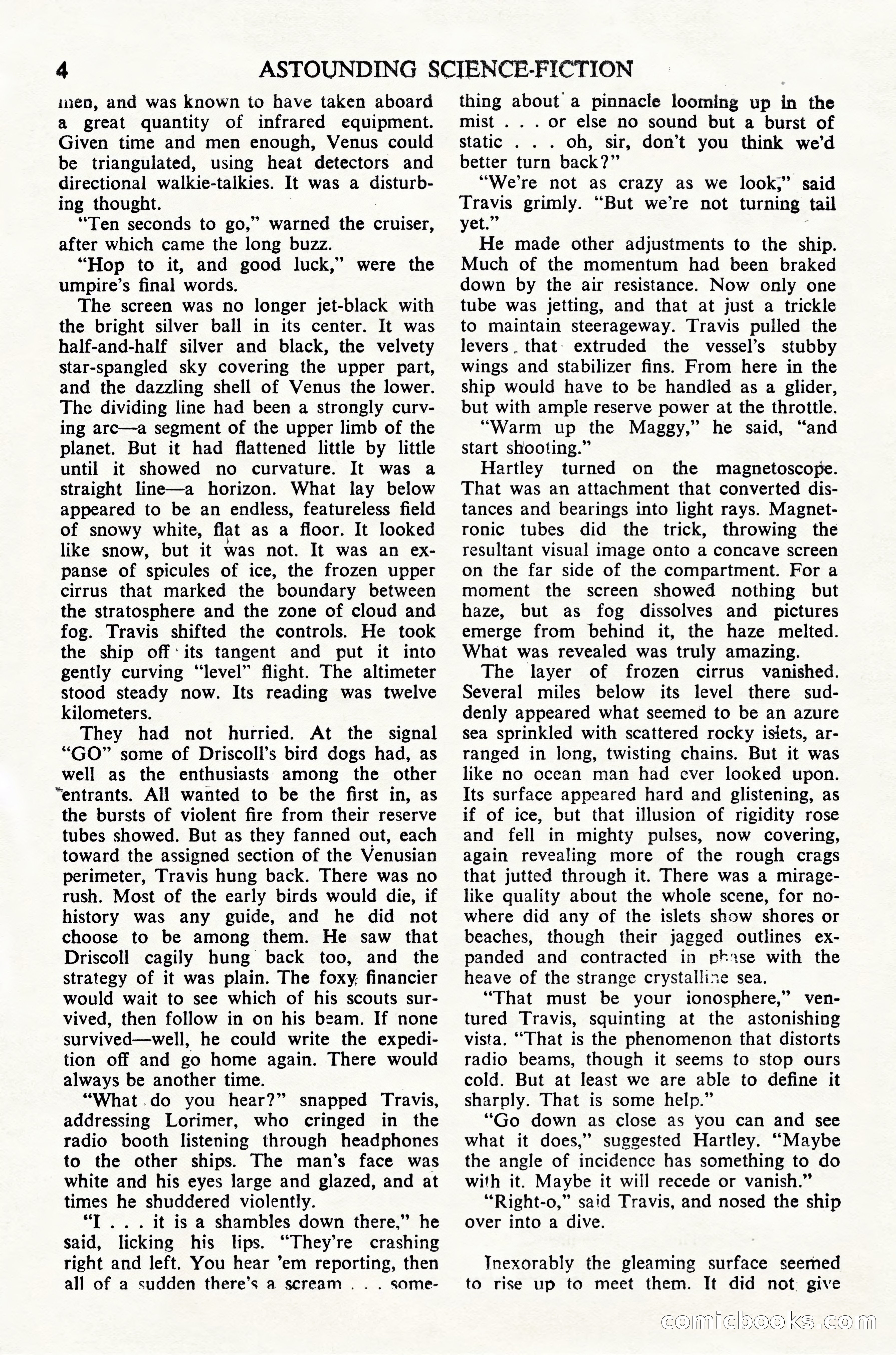
A restored page from Pulp Fiction, 1945. Page through the whole issue in the reader above.
📄 Transcribed text from this page (OCR, searchable)
Machine-transcribed from the original scan — historical spelling and the odd misread are preserved.
4 ASTOUNDING SCIENCE-FICTION ien, and was known to have taken aboard a great quantity of infrared equipment. Given time and men enough, Venus could be triangulated, using heat detectors and directional walkie-talkies. It was a disturb- ing thought. . “Ten seconds to go,” warned the cruiser, after which came the long buzz. “Hop to it, and good luck,” were the umpire’s final words. The screen was no longer jet-black with the bright silver ball in its center. It was half-and-half silver and black, the velvety star-spangled sky covering the upper part, and the dazzling shell of Venus the lower. The dividing line had been a strongly curv- ing arc—a segment of the upper limb of the planet. But it had flattened little by little until it showed no curvature. It was a straight line—a horizon. What lay below appeared to be an endless, featureless field of snowy white, flat as a floor. It looked like snow, but it was not. It was an ex- panse of spicules of ice, the frozen upper cirrus that marked the boundary between the stratosphere and the zone of cloud and fog. Travis shifted the controls. He took the ship off‘its tangent and put it into gently curving “level” flight. The altimeter stood steady now. Its reading was twelve kilometers. They had not hurried. At the signal “GO” some of Driscoll’s bird dogs had, as well as the enthusiasts among the other “entrants. All wanted to be the first in, as the bursts of violent fire from their reserve tubes showed. But as they fanned out, each toward the assigned section of the Venusian perimeter, Travis hung back. There was no rush. Most of the early birds would die, if history was any guide, and he did not choose to be among them. He saw that Driscoll cagily hung back too, and the strategy of it was plain. The foxy, financier would wait to see which of his scouts sur- vived, then follow in on his beam. If none survived—well, he could write the expedi- tion off and go home again. There would always be another time. “What .do you hear?” snapped Travis, addressing Lorimer, who cringed in the radio booth listening through headphones to the other ships. The man’s face was white and his eyes large and glazed, and at times he shuddered violently. “J... it is a shambles down there,” he said, licking his lips. “They’re crashing right and left. You hear ’em reporting, then all of a sudden there’s a scream... . some- thing about a pinnacle looming up in the mist . . . or else no sound but a burst of Static . . . oh, sir, don’t you think we'd better turn back?” “We're not as crazy as we look,” said Travis grimly. “But we’re not turning tail yet.” : He made other adjustments to the ship. Much of the momentum had been braked down by the air resistance. Now only one tube was jetting, and that at just a trickle to maintain steerageway. Travis pulled the levers . that: extruded the vessel’s stubby wings and stabilizer fins. From here in the ship would have to be handled as a glider, but with ample reserve power at the throttle. “Warm up the Maggy,” he said, “and start shooting.” Hartley turned on the magnetoscope. That was an attachment that converted dis- tances and bearings into light rays. Magnet- ronic tubes did the trick, throwing the resultant visual image onto a concave screen on the far side of the compartment. For a moment the screen showed nothing but haze, but as fog dissolves and pictures emerge from behind it, the haze melted. What was revealed was truly amazing. The layer of frozen cirrus vanished. Several miles below its level there sud- denly appeared what seemed to be an azure sea sprinkled with scattered rocky islets, ar- ranged in long, twisting chains. But it was like no ocean man had ever looked upon. Its surface appeared hard and glistening, as if of ice, but that illusion of rigidity rose and fell in mighty pulses, now covering, again revealing more of the rough crags that jutted through it. There was a mirage- like quality about the whole scene, for no- where did any of the islets show shores or beaches, though their jagged outlines ex- panded and contracted in pkse with the heave of the strange crystalline sea. “That must be your ionosphere,” ven- tured Travis, squinting at the astonishing vista. “That is the phenomenon that distorts radio beams, though it seems to stop ours cold. But at least we are able to define it sharply. That is some help.” “Go down as close as you can and see what it does,” suggested Hartley. “Maybe the angle of incidence has something to do with it. Maybe it will recede or vanish.” “Right-o,” said Travis, and nosed the ship over into a dive. Inexorably the gleaming surface seemed to rise up to meet them. It did not: give conmicbooao S (©)