
Pulp Fiction, 1945 · page 29 of 68
Astounding Science Fiction (UK Edition) — page 29: what you’re looking at
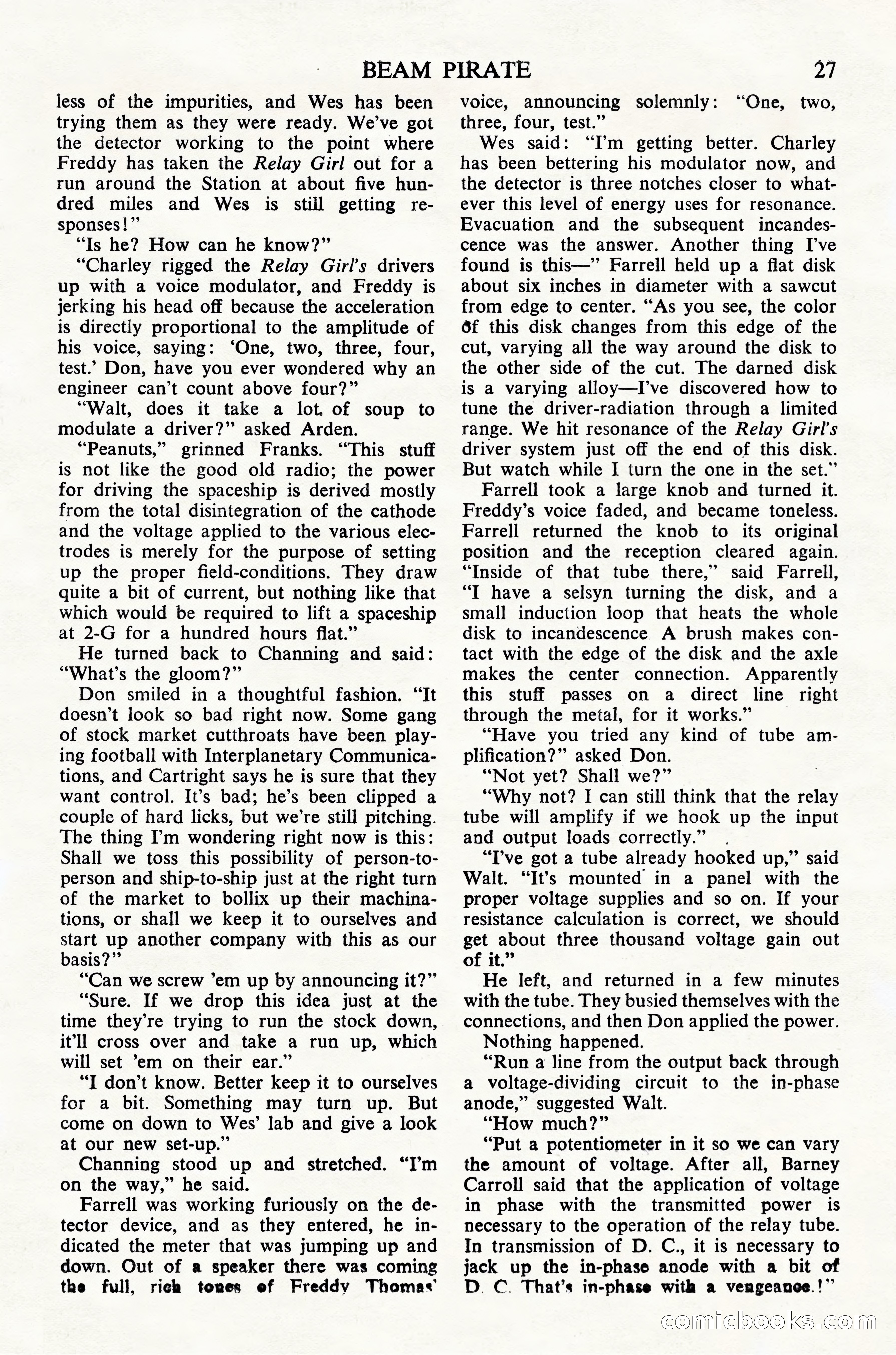
A restored page from Pulp Fiction, 1945. Page through the whole issue in the reader above.
📄 Transcribed text from this page (OCR, searchable)
Machine-transcribed from the original scan — historical spelling and the odd misread are preserved.
BEAM PIRATE less of the impurities, and Wes has been trying them as they were ready. We’ve got the detector working to the point where Freddy has taken the Relay Girl out for a run around the Station at about five hun- dred miles and Wes is still getting re- sponses!” “Is he? How can he know?” “Charley rigged the Relay Girl’s drivers up with a voice modulator, and Freddy is jerking his head off because the acceleration is directly proportional to the amplitude of his voice, saying: ‘One, two, three, four, test.” Don, have you ever wondered why an engineer can’t count above four?” “Walt, does it take a lot. of soup to modulate a driver?” asked Arden. “Peanuts,” grinned Franks. “This stuff is not like the good old radio; the power for driving the spaceship is derived mostly from the total disintegration of the cathode and the voltage applied to the various elec- trodes is merely for the purpose of setting up the proper field-conditions. They draw quite a bit of current, but nothing like that which would be required to lift a spaceship at 2-G for a hundred hours flat.” He turned back to Channing and said: “What’s the gloom?” Don smiled in a thoughtful fashion. “It doesn’t look so bad right now. Some gang of stock market cutthroats have been play- ing football with Interplanetary Communica- tions, and Cartright says he is sure that they want control. It’s bad; he’s been clipped a couple of hard licks, but we’re still pitching. The thing I’m wondering right now is this: Shall we toss this possibility of person-to- person and ship-to-ship just at the right turn of the market to bollix up their machina- tions, or shall we keep it to ourselves and start up another company with this as our basis?” “Can we screw ’em up by announcing it?” “Sure. If we drop this idea just at the time they’re trying to run the stock down, itll cross over and take a run up, which will set ’em on their ear.” “I don’t know. Better keep it to ourselves for a bit. Something may turn up. But come on down to Wes’ lab and give a look at our new set-up.” Channing stood up and stretched. “I’m on the way,” he said. Farrell was working furiously on the de- tector device, and as they entered, he in- dicated the meter that was jumping up and down. Out of a speaker there was coming the full, rich tones ef Freddy Thomas 27 voice, announcing solemnly: two, three, four, test.” Wes said: “I’m getting better. Charley has been bettering his modulator now, and the detector is three notches closer to what- ever this level of energy uses for resonance. Evacuation and the subsequent incandes- cence was the answer. Another thing I’ve found is this—’’ Farrell held up a flat disk about six inches in diameter with a sawcut from edge to center. “As you see, the color 6f this disk changes from this edge of the cut, varying all the way around the disk to the other side of the cut. The darned disk is a varying alloy—I’ve discovered how to tune the driver-radiation through a limited range. We hit resonance of the Relay Girl's driver system just off the end of this disk. But watch while I turn the one in the set.” Farrell took a large knob and turned it. Freddy’s voice faded, and became toneless. Farrell returned the knob to its original position and the reception cleared again. “Inside of that tube there,” said Farrell, “I have a selsyn turning the disk, and a small induction loop that heats the whole disk to incandescence A brush makes con- tact with the edge of the disk and the axle makes the center connection. Apparently this stuff passes on a direct line right through the metal, for it works.” ““Have you tried any kind of tube am- plification?” asked Don. “Not yet? Shall we?” “Why not? I can still think that the relay tube will amplify if we hook up the input and output loads correctly.” . “T’ve got a tube already hooked up,” said Walt. “It’s mounted in a panel with the proper voltage supplies and so on. If your resistance calculation is correct, we should get about three thousand voltage gain out of it.” He left, and returned in a few minutes with the tube. They busied themselves with the connections, and then Don applied the power. Nothing happened. “Run a line from the output back through a voltage-dividing circuit to the in-phase anode,” suggested Walt. “How much?” “Put a potentiometer in it so we can vary the amount of voltage. After all, Barney Carroll said that the application of voltage in phase with the transmitted power is necessary to the operation of the relay tube. In transmission of D. C., it 1s necessary to jack up the in-phase anode with a bit of D. C. That’s in-phase with a vengeanee.!” conmilcbooo “One, S CO