
Pulp Fiction, 1945 · page 22 of 68
Astounding Science Fiction (UK Edition) — page 22: what you’re looking at
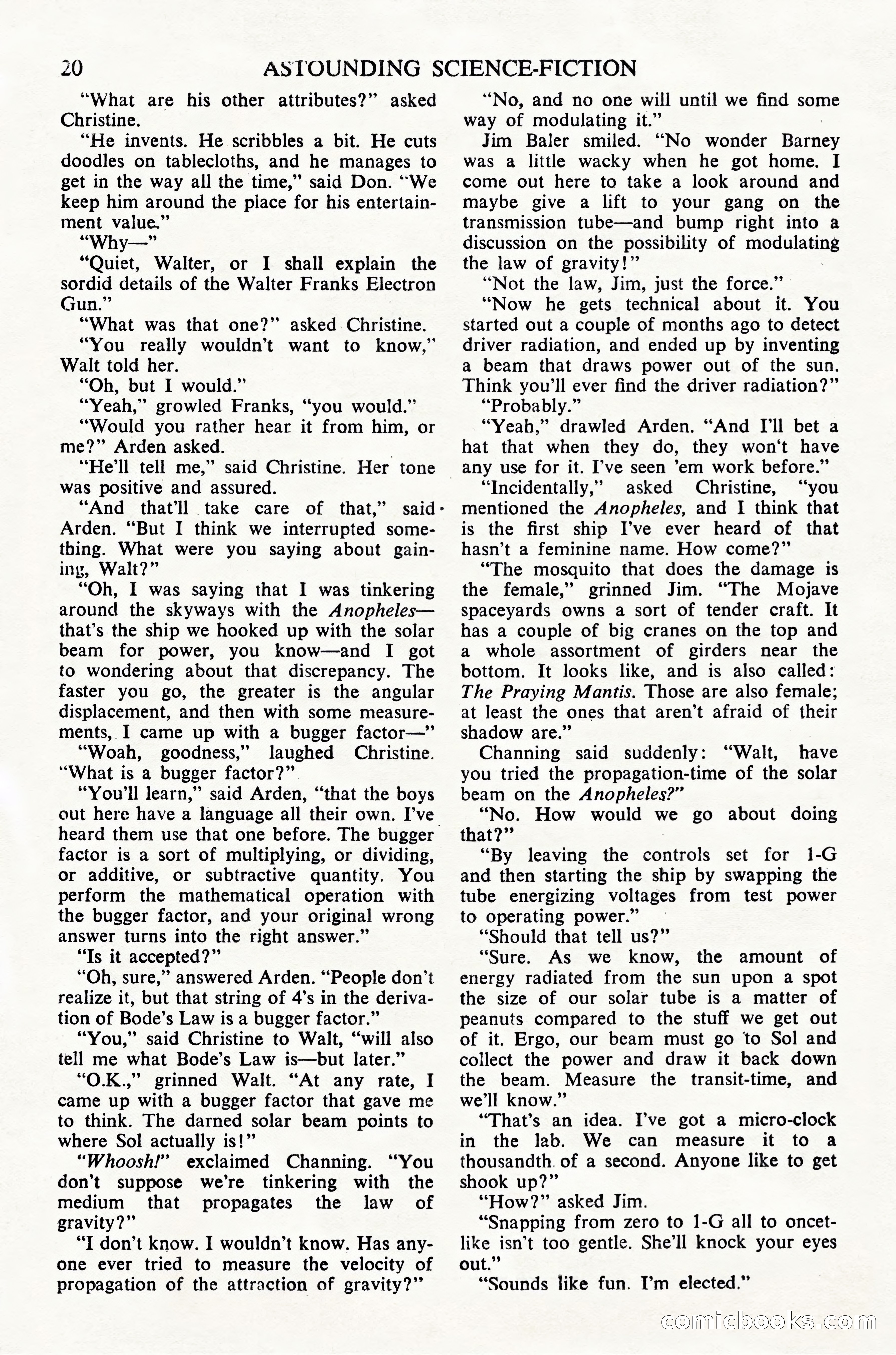
A restored page from Pulp Fiction, 1945. Page through the whole issue in the reader above.
📄 Transcribed text from this page (OCR, searchable)
Machine-transcribed from the original scan — historical spelling and the odd misread are preserved.
20 “What are his other attributes?’ asked Christine. “He invents. He scribbles a bit. He cuts doodles on tablecloths, and he manages to get in the way all the time,” said Don. “We keep him around the place for his entertain- ment value.” “Why—” “Quiet, Walter, or I shall explain the sordid details of the Walter Franks Electron Gun.” “What was that one?” asked Christine. “You really wouldn’t want to know,” Walt told her. “Oh, but I would.” “Yeah,” growled Franks, “you would.” “Would you rather hear it from him, or me?” Arden asked. “He'll tell me,’ said Christine. Her tone was positive and assured. “And that'll take care of that,” said Arden. “But I think we interrupted some- thing. What were you saying about gain- ing, Walt?” “Oh, I was saying that I was tinkering around the skyways with the Anopheles— that’s the ship we hooked up with the solar beam for power, you know—and I got to wondering about that discrepancy. The faster you go, the greater is the angular displacement, and then with some measure- ments, I came up with a bugger factor—” “Woah, goodness,’ laughed Christine. “What is a bugger factor?” “You'll learn,” said Arden, “that the boys out here have a language all their own. I’ve heard them use that one before. The bugger factor is a sort of multiplying, or dividing, or additive, or subtractive quantity. You perform the mathematical operation with the bugger factor, and your original wrong answer turns into the right answer.” “Is it accepted?” “Oh, sure,” answered Arden. “People don’t realize it, but that string of 4’s in the deriva- tion of Bode’s Law is a bugger factor.” “You,” said Christine to Walt, “‘will also tell me what Bode’s Law is—but later.” “O.K.,” grinned Walt. “At any rate, I came up with a bugger factor that gave me to think. The darned solar beam points to where Sol actually is!” “Whoosh!” exclaimed Channing. “You don’t suppose we're tinkering with the medium that propagates the law of gravity?” “I don’t know. I wouldn’t know. Has any- one ever tried to measure the velocity of propagation of the attraction of gravity?” ASTOUNDING SCIENCE-FICTION ‘““No, and no one will until we find some way of modulating it.” . Jim Baler smiled. “No wonder Barney was a little wacky when he got home. I come out here to take a look around and maybe give a lift to your gang on the transmission tube—and bump right into a discussion on the possibility of modulating the law of gravity!” “Not the law, Jim, just the force.” “Now he gets technical about it. You started out a couple of months ago to detect driver radiation, and ended up by inventing a beam that draws power out of the sun. Think you'll ever find the driver radiation?” “Probably.” “Yeah,” drawled Arden. “And I'll bet a hat that when they do, they won't have _any use for it. I’ve seen ’em work before.” “Incidentally,” asked Christine, “you mentioned the Anopheles, and I think that is the first ship I’ve ever heard of that hasn’t a feminine name. How come?” “The mosquito that does the damage 1s the female,” grinned Jim. “The Mojave spaceyards owns a sort of tender craft. It has a couple of big cranes on the top and a whole assortment of girders near the bottom. It looks like, and is also called: The Praying Mantis. Those are also female; at least the ones that aren’t afraid of their shadow are.” : Channing said suddenly: “Walt, have you tried the propagation-time of the solar beam on the Anopheles?” “No. How would we go about doing that?” “By leaving the controls set for 1-G and then starting the ship by swapping the tube energizing voltages from test power to operating power.” “Should that tell us?” “Sure. As we know, the amount of energy radiated from the sun upon a spot the size of our solar tube is a matter of peanuts compared to the stuff we get out of it. Ergo, our beam must go to Sol and collect the power and draw it back down the beam. Measure the transit-time, and we'll know.” “That’s an idea. I’ve got a micro-clock in the lab. We can measure it to a thousandth. of a second. Anyone like to get shook up?” “How?” asked Jim. “Snapping from zero to 1-G all to oncet- like isn’t too gentle. She’ll knock your eyes out.” “Sounds like fun. I’m elected.” Ccomicoool. (©