
Pulp Fiction, 1944 · page 50 of 68
Astounding Science Fiction (British Edition), August 1944 — page 50: what you’re looking at
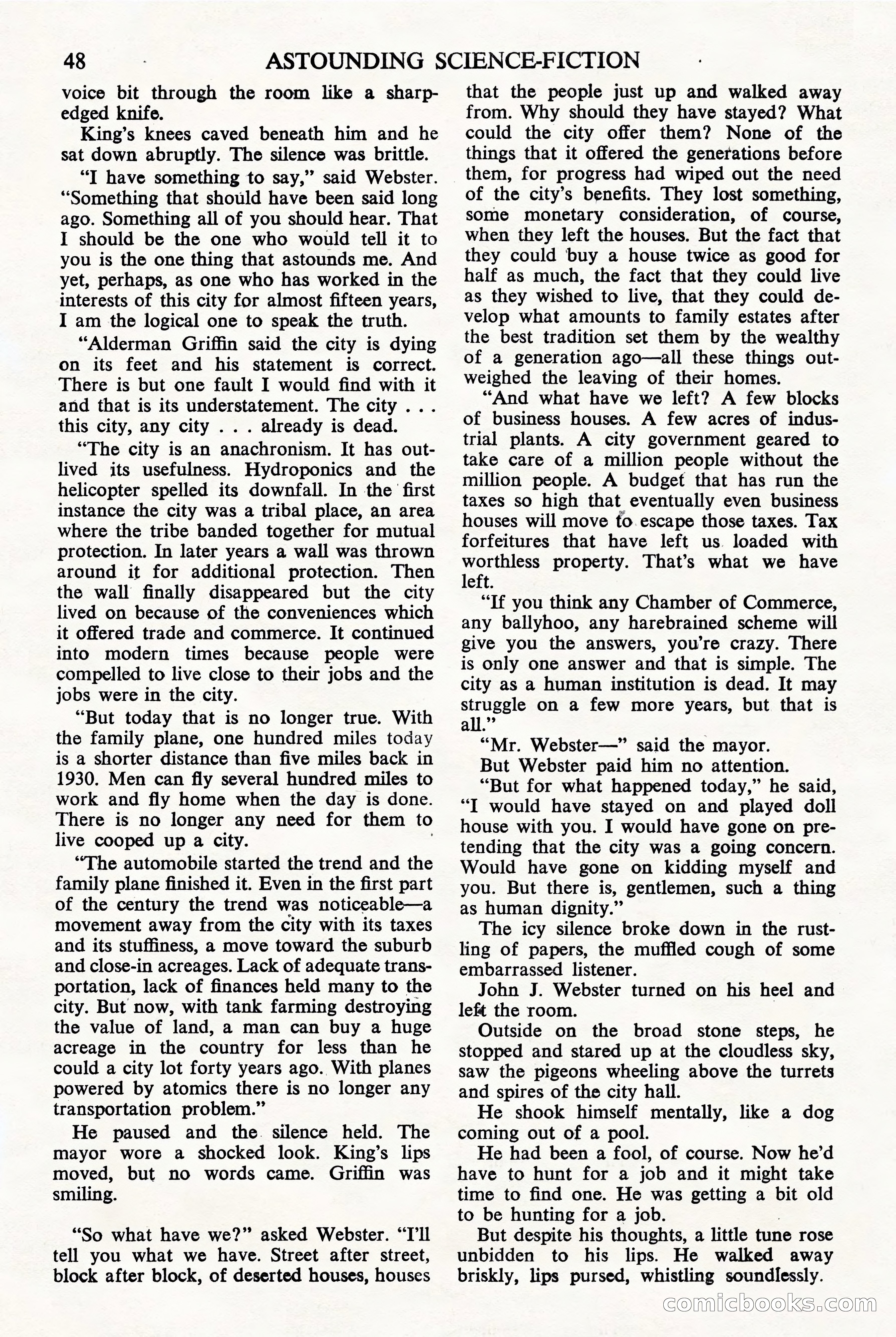
A restored page from Pulp Fiction, 1944. Page through the whole issue in the reader above.
📄 Transcribed text from this page (OCR, searchable)
Machine-transcribed from the original scan — historical spelling and the odd misread are preserved.
48 ASTOUNDING SCIENCE-FICTION voice bit through the room like a sharp- edged knife. King’s knees caved beneath him and he sat down abruptly. The silence was brittle. “IT have something to say,” said Webster. “Something that should have been said long ago. Something all of you should hear. That I should be the one who would tell it to you is the one thing that astounds me. And yet, perhaps, as one who has worked in the interests of this city for almost fifteen years, I am the logical one to speak the truth. “Alderman Griffin said the city is dying on its feet and his statement is correct. There is but one fault I would find with it and that is its understatement. The city... this city, any city . . . already is dead. “The city is an anachronism. It has out- lived its usefulness. Hydroponics and the helicopter spelled its downfall. In the ‘first instance the city was a tribal place, an area where the tribe banded together for mutual protection. In later years a wall was thrown around it for additional protection. Then the wall finally disappeared but the city lived on because of the conveniences which it offered trade and commerce. It continued into modern times because people were compelled to live close to their jobs and the jobs were in the city. “But today that is no longer true. With the family plane, one hundred miles today is a shorter distance than five miles back in 1930. Men can fly several hundred miles to work and fly home when the day is done. There is no longer any need for them to live cooped up a city. “The automobile started the trend and the family plane finished it. Even in the first part of the century the trend was noticeable—a movement away from the city with its taxes and its stuffiness, a move toward the suburb and close-in acreages. Lack of adequate trans- portation, lack of finances held many to the city. But now, with tank farming destroying the value of land, a man can buy a huge acreage in the country for less than he could a city lot forty years ago. With planes powered by atomics there is no longer any transportation problem.” He paused and the. silence held. The mayor wore a shocked look. King’s lips moved, but no words came. Griffin was smiling. “So what have we?” asked Webster. “T’ll tell you what we have. Street after street, block after block, of deserted houses, houses that the people just up and walked away from. Why should they have stayed? What could the city offer them? None of the things that it offered the generations before _them, for progress had wiped out the need of the city’s benefits. They lost something, some monetary consideration, of course, when they left the houses. But the fact that they could buy a house twice as good for half as much, the fact that they could live as they wished to live, that they could de- velop what amounts to family estates after the best tradition set them by the wealthy of a generation ago—all these things out- weighed the leaving of their homes. “And what have we left? A few blocks of business houses. A few acres of indus- trial plants. A city government geared to take care of a million people without the million people. A budget that has run the taxes so high that eventually even business houses will move to.escape those taxes. Tax forfeitures that have left us loaded with worthless property. That’s what we have left. “If you think any Chamber of Commerce, any ballyhoo, any harebrained scheme will give you the answers, you're crazy. There is only one answer and that is simple. The city as a human institution is dead. It may struggle on a few more years, but that is all.” “Mr. Webster—” said the mayor. But Webster paid him no attention. “But for what happened today,” he said, “I would have stayed on and played doll house with you. I would have gone on pre- tending that the city was a going concern. Would have gone on kidding myself and you. But there is, gentlemen, such a thing as human dignity.” The icy silence broke down in the rust- ling of papers, the muffled cough of some embarrassed listener. John J. Webster turned on his heel and left the room. Outside on the broad stone steps, he stopped and stared up at the cloudless sky, saw the pigeons wheeling above the turrets and spires of the city hall. He shook himself mentally, like a dog coming out of a pool. He had been a fool, of course. Now he’d have to hunt for a job and it might take time to find one. He was getting a bit old to be hunting for a job. But despite his thoughts, a little tune rose unbidden to his lips. He walked away briskly, lips pursed, whistling soundlessly. CoOMmiclsookks.€c©