
Pulp Fiction, 1944 · page 45 of 68
Astounding Science Fiction (British Edition), August 1944 — page 45: what you’re looking at
A restored page from Pulp Fiction, 1944. Page through the whole issue in the reader above.
📄 Transcribed text from this page (OCR, searchable)
Machine-transcribed from the original scan — historical spelling and the odd misread are preserved.
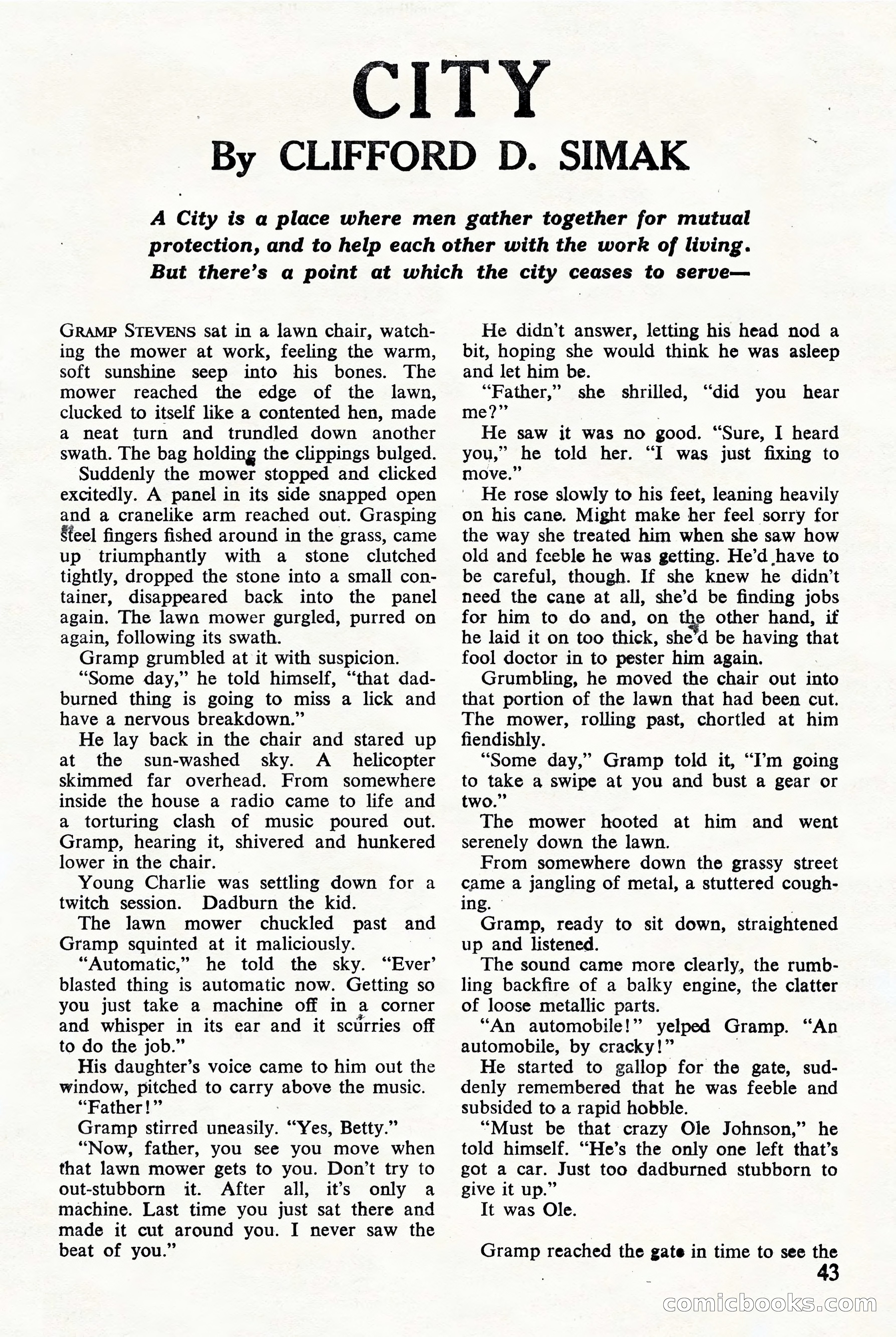
CITY By CLIFFORD D. SIMAK A City is a place where men gather together for mutual protection, and to help each other with the work of living. But there’s a point at which the city ceases to serve— GRAMP STEVENS Sat in a lawn chair, watch- ing the mower at work, feeling the warm, soft sunshine seep into his bones. The mower reached the edge of the lawn, clucked to itself like a contented hen, made a neat turn and trundled down another swath. The bag holding the clippings bulged. Suddenly the mower stopped and clicked excitedly. A panel in its side snapped open and a cranelike arm reached out. Grasping §feel fingers fished around in the grass, came up triumphantly with a stone clutched tightly, dropped the stone into a small con- tainer, disappeared back into the panel again. The lawn mower gurgled, purred on again, following its swath. Gramp grumbled at it with suspicion. “Some day,” he told himself, “that dad- burned thing is going to miss a lick and have a nervous breakdown.” He lay back in the chair and stared up at the sun-washed sky. A _ helicopter skimmed far overhead. From somewhere inside the house a radio came to life and a torturing clash of music poured out. Gramp, hearing it, shivered and hunkered lower in the chair. Young Charlie was settling down for a twitch session. Dadburn the kid. The lawn mower chuckled past and Gramp squinted at it maliciously. “Automatic,” he told the sky. “Ever’ blasted thing is automatic now. Getting so you just take a machine off in a corner and whisper in its ear and it scurries off to do the job.” His daughter’s voice came to him out the window, pitched to carry above the music. “Father!” Gramp stirred aaeaaily. “Yes, Betty.” “Now, father, you see you move when that lawn mower gets to you. Don’t try to out-stubborn it. After all, it’s only a machine. Last time you just sat there and made it cut around you. I never saw the beat of you.” He didn’t answer, letting his head nod a bit, hoping she would think he was asleep and let him be. “Father,” she shrilled, me?” He saw it was no good. “Sure, I heard you,” he told her. “I was just fixing to move.” He rose slowly to his feet, leaning heavily on his cane. Might make her feel sorry for the way she treated him when she saw how old and feeble he was getting. He’d have to be careful, though. If she knew he didn’t need the cane at all, she’d be finding jobs for him to do and, on the other hand, if he laid it on too thick, she’d be having that fool doctor in to pester him again. Grumbling, he moved the chair out into that portion of the lawn that had been cut. The mower, rolling past, chortled at him fiendishly. “Some day,” Gramp told it, “I’m going to take a swipe at you and bust a gear or two.” The mower hooted at him and went serenely down the lawn. From somewhere down the grassy street came a jangling of metal, a stuttered cough- ing. Cran ready to sit down, straightened up and listened. The sound came more clearly, the rumb- ling backfire of a balky engine, the clatter of loose metallic parts. “An automobile!” yelped Gramp. automobile, by cracky!” He started to gallop for the gate, sud- denly remembered that he was feeble and subsided to a rapid hobble. ““Must be that crazy Ole Johnson,” he told himself. “He’s the only one left that’s got a car. Just too dadburned stubborn to give it up.” It was Ole. “did you hear An Gramp reached the gate in time to see the 43 QO COMmiicsooks.€©