
Pulp Fiction, 1944 · page 41 of 68
Astounding Science Fiction (British Edition), August 1944 — page 41: what you’re looking at
A restored page from Pulp Fiction, 1944. Page through the whole issue in the reader above.
📄 Transcribed text from this page (OCR, searchable)
Machine-transcribed from the original scan — historical spelling and the odd misread are preserved.
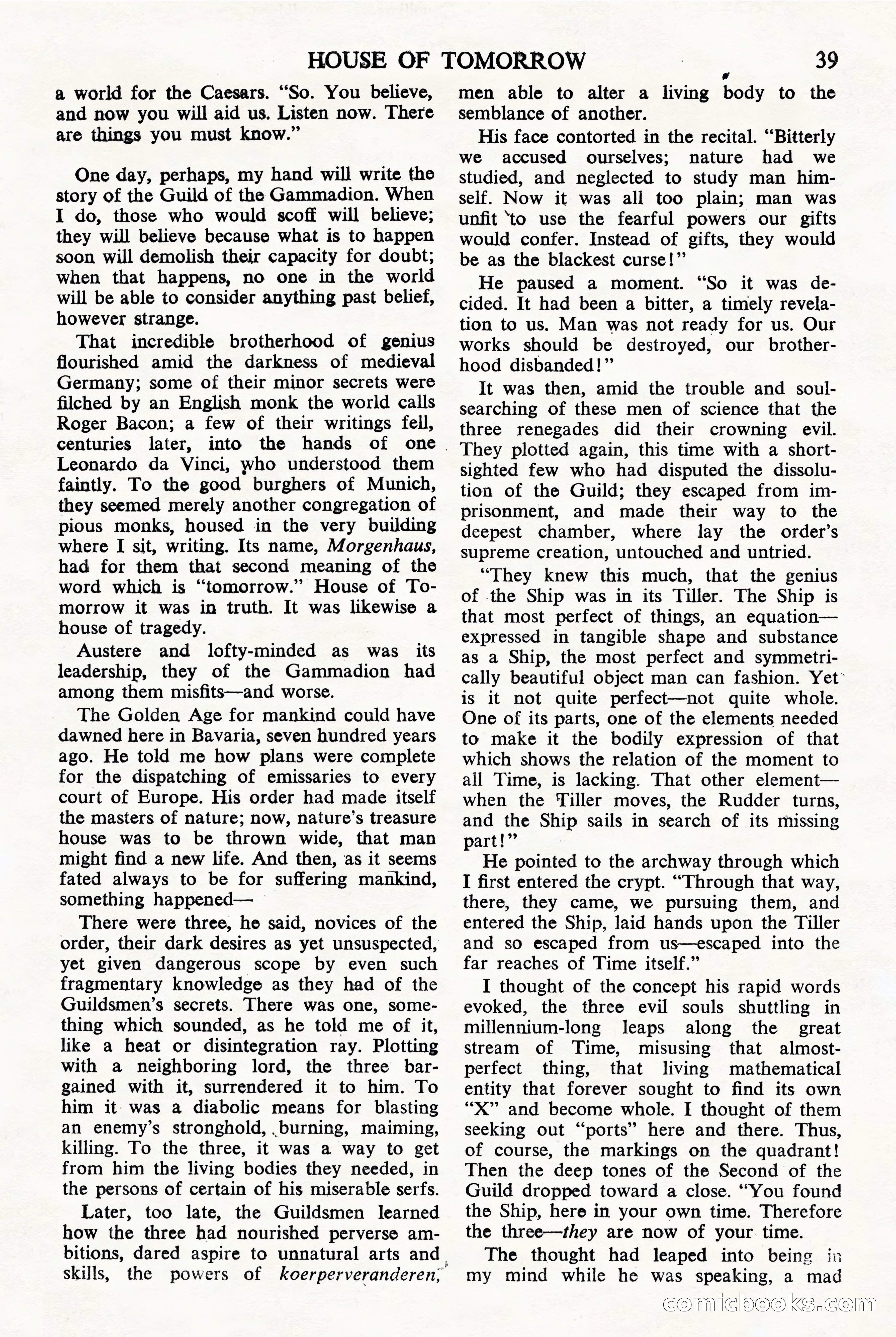
HOUSE OF TOMORROW a world for the Caesars. “So. You believe, and now you will aid us. Listen now. There are things you must know.” One day, perhaps, my hand will write the story of the Guild of the Gammadion. When I do, those who would scoff will believe; they will believe because what is to happen soon will demolish their capacity for doubt; when that happens, no one in the world will be able to consider anything past belief, however strange. That incredible brotherhood of genius flourished amid the darkness of medieval Germany; some of their minor secrets were filched by an English monk the world calls Roger Bacon; a few of their writings fell, centuries later, Leonardo da Vinci, who understood them faintly. To the good burghers of Munich, they seemed merely another congregation of pious monks, housed in the very building where I sit, writing. Its name, Morgenhaus, had for them that second meaning of the word which is “tomorrow.” House of To- morrow it was in truth. It was likewise a house of tragedy. Austere and lofty-minded as was its leadership, they of the Gammadion had among them misfits—and worse. The Golden Age for mankind could have dawned here in Bavaria, seven hundred years ago. He told me how plans were complete for the dispatching of emissaries to every court of Europe. His order had made itself the masters of nature; now, nature’s treasure house was to be thrown wide, that man might find a new life. And then, as it seems fated always to be for suffering mankind, something happened— — There were three, he said, novices of the order, their dark desires as yet unsuspected, yet given dangerous scope by even such fragmentary knowledge as they had of the Guildsmen’s secrets. There was one, some- thing which sounded, as he told me of it, like a heat or disintegration ray. Plotting with a neighboring lord, the three bar- gained with it, surrendered it to him. To him it: was a diabolic means for blasting an enemy’s stronghold, .burning, maiming, killing. To the three, it was a way to get from him the living bodies they needed, in the persons of certain of his miserable serfs. Later, too late, the Guildsmen learned how the three had nourished perverse am- bitions, dared aspire to unnatural arts and» skills, the powers of koerperveranderen, into the hands of one. 39 # men able to alter a living body to the semblance of another. His face contorted in the recital. “Bitterly we accused ourselves; nature had we studied, and neglected to study man him- self. Now it was all too plain; man was unfit ‘to use the fearful powers our gifts would confer. Instead of gifts, they would be as the blackest curse!” He paused a moment. “So it was de- cided. It had been a bitter, a timely revela- tion to us. Man was not ready for us. Our works should be destroyed, our brother- hood disbanded!” It was then, amid the trouble and soul- searching of these men of science that the three renegades did their crowning evil. They plotted again, this time with a short- sighted few who had disputed the dissolu- tion of the Guild; they escaped from im- prisonment, and made their way to the deepest chamber, where lay the order’s supreme creation, untouched and untried. “They knew this much, that the genius of the Ship was in its Tiller. The Ship is that most perfect of things, an equation— expressed in tangible shape and substance as a Ship, the most perfect and symmetri- cally beautiful object man can fashion. Yet” is it not quite perfect—not quite whole. One of its parts, one of the elements needed to make it the bodily expression of that which shows the relation of the moment to all Time, is lacking. That other element— when the Tiller moves, the Rudder turns, and the Ship sails in search of its missing part!” He pointed to the archway through which I first entered the crypt. “Through that way, there, they came, we pursuing them, and entered the Ship, laid hands upon the Tiller and so escaped from us—escaped into the far reaches of Time itself.” I thought of the concept his rapid words evoked, the three evil souls shuttling in millennium-long leaps along the great stream of Time, misusing that almost- perfect thing, that living mathematical entity that forever sought to find its own “X” and become whole. I thought of them seeking out “ports” here and there. Thus, of course, the markings on the quadrant! Then the deep tones of the Second of the Guild dropped toward a close. “You found the Ship, here in your own time. Therefore the three—they are now of your time. The thought had leaped into being in my mind while he was speaking, a mad Ccomuicbooks CO