
Pulp Fiction, 1944 · page 14 of 68
Astounding Science Fiction (British Edition), August 1944 — page 14: what you’re looking at
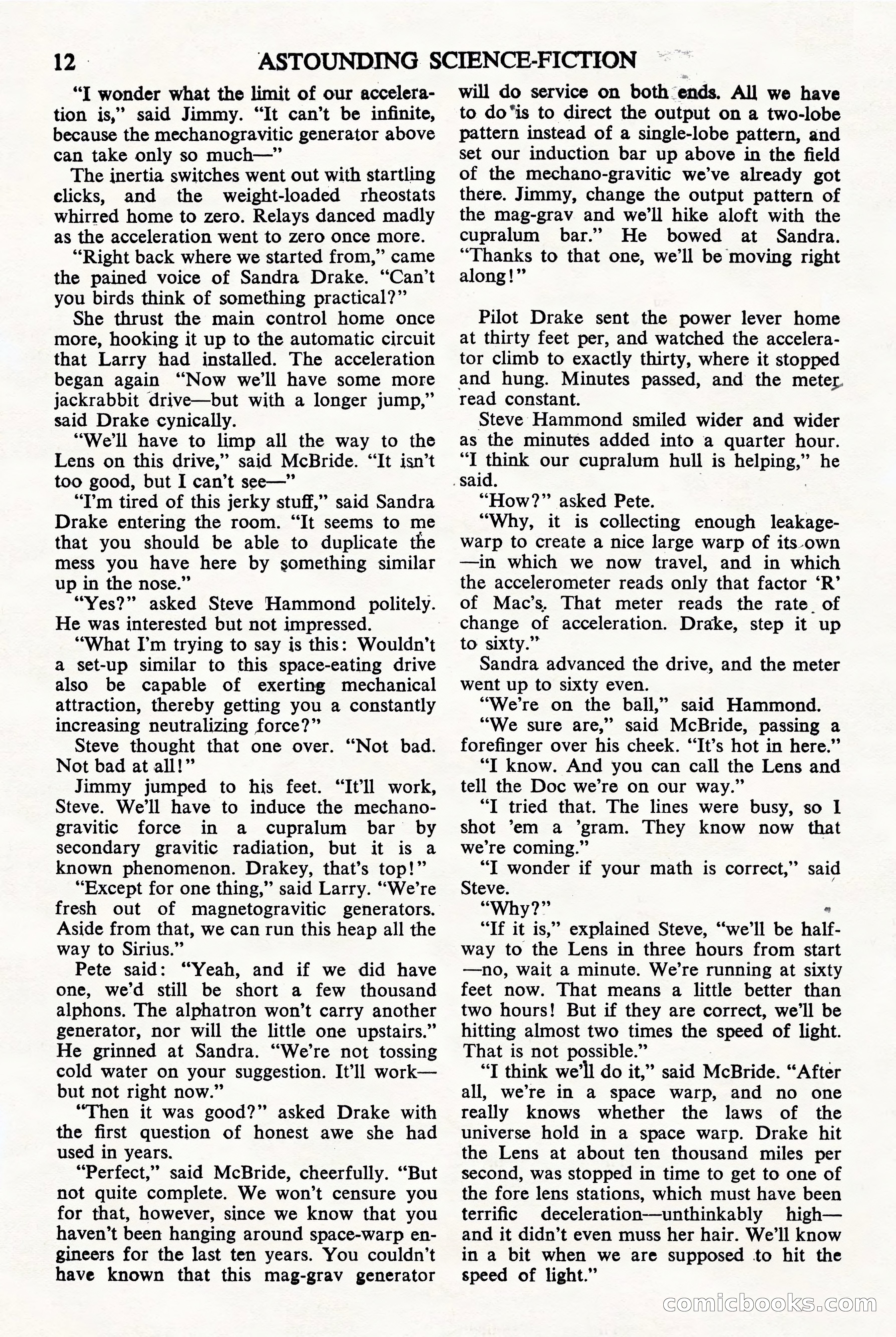
A restored page from Pulp Fiction, 1944. Page through the whole issue in the reader above.
📄 Transcribed text from this page (OCR, searchable)
Machine-transcribed from the original scan — historical spelling and the odd misread are preserved.
12 “I wonder what the limit of our accelera- tion is,’ said Jimmy. “It can’t be infinite, because the mechanogravitic generator above can take only so much—” The inertia switches went out with startling clicks, and the weight-loaded rheostats whirred home to zero. Relays danced madly as the acceleration went to zero once more. “Right back where we started from,” came the pained voice of Sandra Drake. “Can’t you birds think of something practical?” She thrust the main control home once more, hooking it up to the automatic circuit that Larry had installed. The acceleration began again “Now we'll have some more jackrabbit drive—but with a longer jump,” said Drake cynically. “We'll have to limp all the way to the Lens on this drive,” said McBride. “It isn’t too good, but I can’t see—” “T’m tired of this jerky stuff,” said Sandra Drake entering the room. “It seems to me that you should be able to duplicate the mess you have here by something similar up in the nose.” “Yes?” asked Steve Hammond politely. He was interested but not impressed. “What I’m trying to say is this: Wouldn’t a set-up similar to this space-eating drive also be capable of exerting mechanical attraction, thereby getting you a constantly increasing neutralizing force?” Steve thought that one over. Not bad at all!” Jimmy jumped to his feet. “It ll work, Steve. We'll have to induce the mechano- gravitic force in a cupralum bar by secondary gravitic radiation, but it is a known phenomenon. Drakey, that’s top!” “Except for one thing,” said Larry. ““We’re fresh out of magnetogravitic generators. Aside from that, we can run this heap all the way to Sirius.” Pete said: “Yeah, and if we did have one, we'd still be short a few thousand alphons. The alphatron won’t carry another generator, nor will the little one upstairs.” He grinned at Sandra. “We're not tossing cold water on your suggestion. It'll work— but not right now.” “Then it was good?” asked Drake with the first question of honest awe she had used in years. “Perfect,” said McBride, cheerfully. “But not quite complete. We won’t censure you for that, however, since we know that you haven’t been hanging around space-warp en- gineers for the last ten years. You couldn’t have known that this mag-grav generator “Not bad. ASTOUNDING SCIENCE-FICTION will do service on both ends. All we have to do“is to direct the output on a two-lobe pattern instead of a single-lobe pattern, and set our induction bar up above in the field of the mechano-gravitic we’ve already got there. Jimmy, change the output pattern of the mag-grav and we'll hike aloft with the cupralum bar.” He bowed at Sandra. “Thanks to that one, we'll be moving right '? along! Pilot Drake sent the power lever home at thirty feet per, and watched the accelera- tor climb to exactly thirty, where it stopped and hung. Minutes passed, and the meter. read constant. Steve Hammond smiled wider and wider as the minutes added into a quarter hour. “I think our cupralum hull is neDINE he Said. “How?” asked Pete. “Why, it is collecting enough leakage- warp to create a nice large warp of its-own —in which we now travel, and in which the accelerometer reads only that factor ‘R’ of Mac’s, That meter reads the rate of change of acceleration. Drake, step it up to sixty.” Sandra advanced the drive, and the meter went up to sixty even. “We're on the ball,” said Hammond. “We sure are,” said McBride, passing a forefinger over his cheek. “It’s hot in here.” “I know. And you can call the Lens and tell the Doc we’re on our way.” “I tried that. The lines were busy, so I shot ’°em a ’gram. They know now that we're coming.” “I wonder if your math is correct,” Steve. “Why?” a “If it is,’ explained Steve, “we'll be half- way to the Lens in three hours from start —no, wait a minute. We’re running at sixty feet now. That means a little better than two hours! But if they are correct, we'll be hitting almost two times the speed of light. That is not possible.” “I think we'll do it,” said McBride. “After all, we're in a space warp, and no one really knows whether the laws of the universe hold in a space warp. Drake hit the Lens at about ten thousand miles per second, was stopped in time to get to one of the fore lens stations, which must have been terrific deceleration—unthinkably high— and it didn’t even muss her hair. We'll know in a bit when we are supposed to hit the speed of light.” said comilcloo S CO