
Pulp Fiction, 1944 · page 8 of 68
Astounding Science Fiction (British Edition), April 1944 — page 8: what you’re looking at
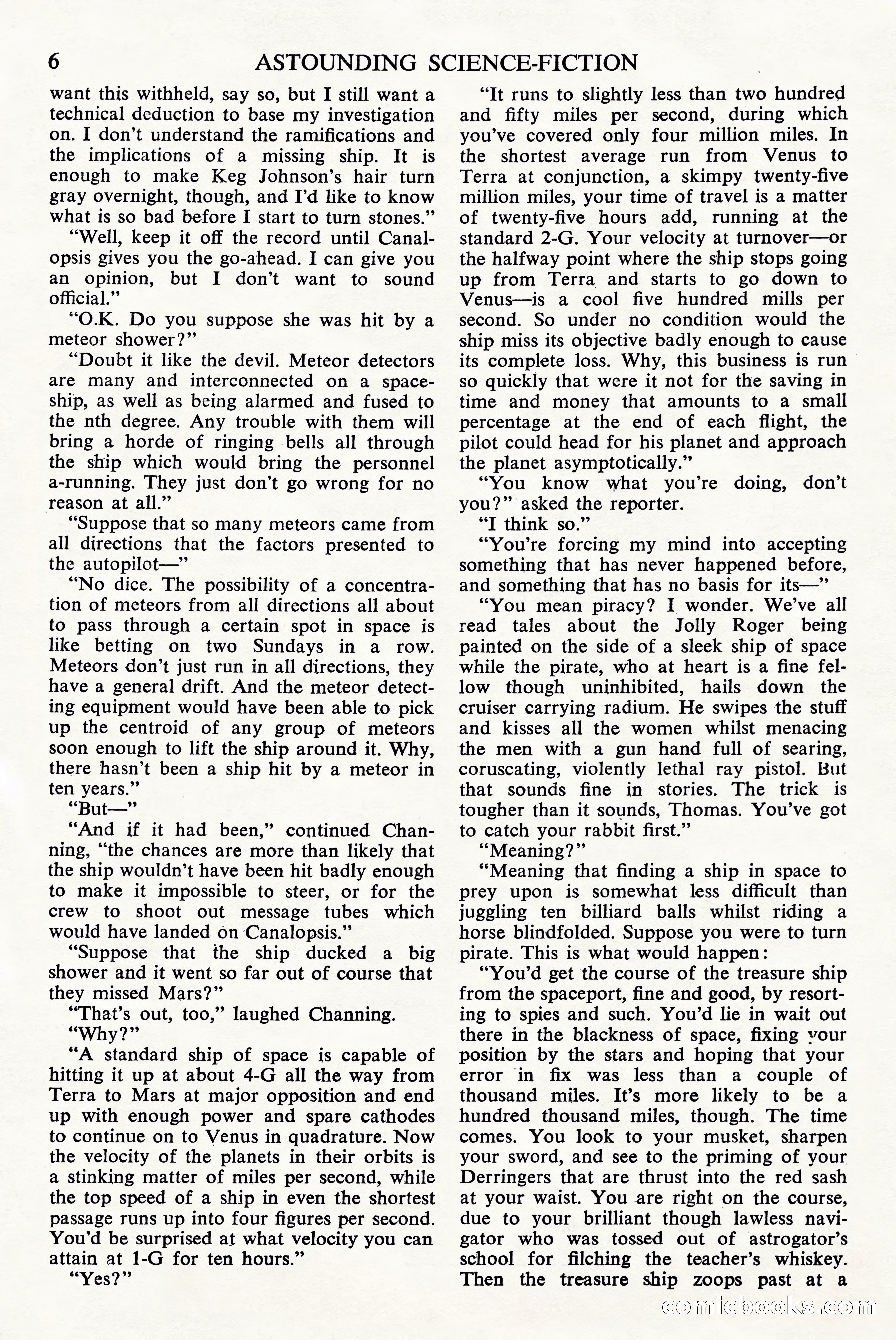
A restored page from Pulp Fiction, 1944. Page through the whole issue in the reader above.
📄 Transcribed text from this page (OCR, searchable)
Machine-transcribed from the original scan — historical spelling and the odd misread are preserved.
6 ASTOUNDING SCIENCE-FICTION want this withheld, say so, but I still want a technical deduction to base my investigation on. I don’t understand the ramifications and © the implications of a missing ship. It is enough to make Keg Johnson’s hair turn gray overnight, though, and I’d like to know what is so bad before I start to turn stones.” “Well, keep it off the record until Canal- Opsis gives you the go-ahead. I can give you an opinion, but I don’t want to sound official.” “O.K. Do you suppose she was hit by a meteor shower?” “Doubt it like the devil. Meteor detectors are many and interconnected on a space- ship, as well as being alarmed and fused to the nth degree. Any trouble with them will bring a horde of ringing bells all through the ship which would bring the personnel a-running. They just don’t go wrong for no Treason at all.” “Suppose that so many meteors came from all directions that the factors presented to the autopilot—” “No dice. The possibility of a concentra- tion of meteors from all directions all about to pass through a certain spot in space is like betting on two Sundays in a _ row. Meteors don’t just run in all directions, they have a general drift. And the meteor detect- ing equipment would have been able to pick up the centroid of any group of meteors soon enough to lift the ship around it. Why, there hasn’t been a ship hit by a meteor in ten years.” “But—” | “And if it had been,” continued Chan- ning, “the chances are more than likely that the ship wouldn’t have been hit badly enough to make it impossible to steer, or for the crew to shoot out message tubes which would have landed on Canalopsis.” “Suppose that the ship ducked a big shower and it went so far out of course that they missed Mars?” “That’s out, too,” laughed Channing. “Why?” ““A standard ship of space is capable of hitting it up at about 4-G all the way from Terra to Mars at major opposition and end up with enough power and spare cathodes to continue on to Venus in quadrature. Now the velocity of the planets in their orbits is a stinking matter of miles per second, while the top speed of a ship in even the shortest passage runs up into four figures per second. You'd be surprised at what velocity you can attain at 1-G for ten hours.” UYes?: “Tt runs to slightly less than two hundred and fifty miles per second, during which you’ve covered only four million miles. In the shortest average run from Venus to Terra at conjunction, a skimpy twenty-five million miles, your time of travel is a matter of twenty-five hours add, running at the standard 2-G. Your velocity at turnover—or the halfway point where the ship stops going up from Terra and starts to go down to Venus—is a cool five hundred mills per second. So under no condition would the ship miss its objective badly enough to cause its complete loss. Why, this business is run so quickly that were it not for the saving in time and money that amounts to a small percentage at the end of each flight, the pilot could head for his planet and approach the planet asymptotically.” “You know what you’re doing, don’t you?” asked the reporter. “T think so.” “You’re forcing my mind into accepting something that has never happened before, and something that has no basis for its—”’ “You mean piracy? I wonder. We’ve all read tales about the Jolly Roger being painted on the side of a sleek ship of space while the pirate, who at heart is a fine fel- low though uninhibited, hails down the cruiser carrying radium. He swipes the stuff and kisses all the women whilst menacing the men with a gun hand full of searing, coruscating, violently lethal ray pistol. But that sounds fine in stories. The trick is tougher than it sounds, Thomas. You’ve got to catch your rabbit first.” “Meaning?” “Meaning that finding a ship in space to prey upon is somewhat less difficult than juggling ten billiard balls whilst riding a horse blindfolded. Suppose you were to turn pirate. This is what would happen: “You'd get the course of the treasure ship from the spaceport, fine and good, by resort- ing to spies and such. You’d lie in wait out there in the blackness of space, fixing vour position by the stars and hoping that your error in fix was less than a couple of thousand miles. It’s more likely to be a hundred thousand miles, though. The time comes. You look to your musket, sharpen your sword, and see to the priming of your Derringers that are thrust into the red sash at your waist. You are right on the course, due to your brilliant though lawless navi- gator who was tossed out of astrogator’s school for filching the teacher’s whiskey. Then the treasure ship zoops past at a Ccomiclooks.c©