
Pulp Fiction, 1944 · page 64 of 68
Astounding Science Fiction (British Edition), April 1944 — page 64: what you’re looking at
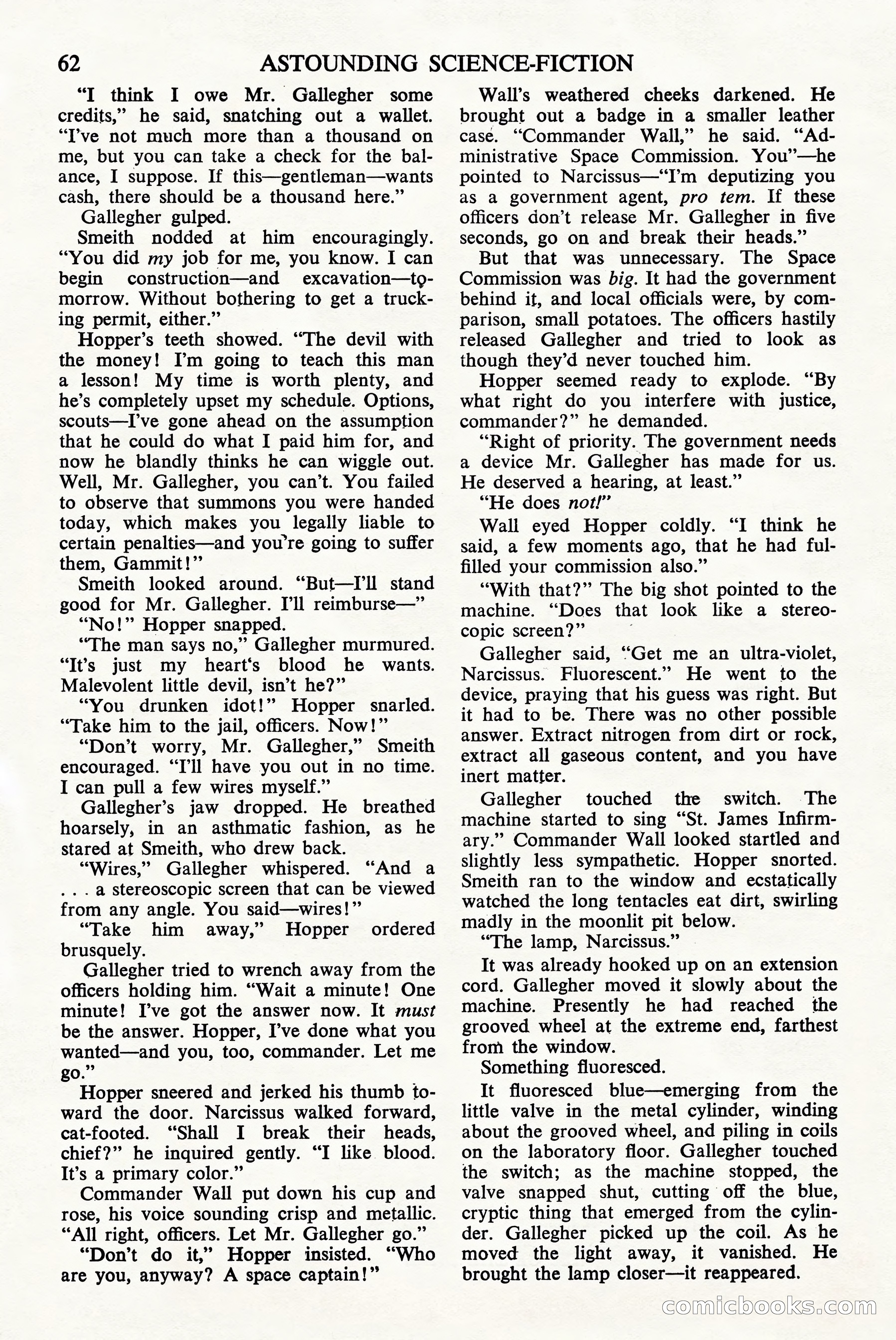
A restored page from Pulp Fiction, 1944. Page through the whole issue in the reader above.
📄 Transcribed text from this page (OCR, searchable)
Machine-transcribed from the original scan — historical spelling and the odd misread are preserved.
62 “I think I owe Mr. Gallegher some credits,” he said, snatching out a wallet. “T’ve not much more than a thousand on me, but you can take a check for the bal- ance, I suppose. If this—gentleman—wants cash, there should be a thousand here.” Gallegher gulped. Smeith nodded at him _ encouragingly. “You did my job for me, you know. I can begin construction—and excavation—to- morrow. Without bothering to get a truck- ing permit, either.” Hopper’s teeth showed. “The devil with the money! I’m going to teach this man a lesson! My time is worth plenty, and he’s completely upset my schedule. Options, scouts—I’ve gone ahead on the assumption that he could do what I paid him for, and now he blandly thinks he can wiggle out. Well, Mr. Gallegher, you can’t. You failed to observe that summons you were handed today, which makes you legally liable to certain penalties—and you're going to suffer them, Gammit!”’ Smeith looked around. “But—TIll stand good for Mr. Gallegher. Pll reimburse—” “No!” Hopper snapped. “The man says no,” Gallegher murmured. “It’s just my heart’s blood he wants. Malevolent little devil, isn’t he?” “You drunken idot!” Hopper snarled. “Take him to the jail, officers. Now!” “Don’t worry, Mr. Gallegher,” Smeith encouraged. “Ill have you out in no time. I can pull a few wires myself.” Gallegher’s jaw dropped. He breathed hoarsely, in an asthmatic fashion, as he stared at Smeith, who drew back. “Wires,” Gallegher whispered. “And a . . . a stereoscopic screen that can be viewed from any angle. You said—wires!”’ “Take him away,” Hopper brusquely. Gallegher tried to wrench away from the officers holding him. “Wait a minute! One minute! I’ve got the answer now. It must be the answer. Hopper, I’ve done what you wanted—and you, too, commander. Let me go.” Hopper sneered and jerked his thumb to- ward the door. Narcissus walked forward, cat-footed. “Shall I break their heads, chief?” he inquired gently. “I like blood. It’s a primary color.” Commander Wall put down his cup and rose, his voice sounding crisp and metallic. “All right, officers. Let Mr. Gallegher go.” “Don’t do it,” Hopper insisted. “Who are you, anyway? A space captain!” ordered ASTOUNDING SCIENCE-FICTION Wall’s weathered cheeks darkened. He brought out a badge in a smaller leather case. “CCommander Wall,” he said. “Ad- ministrative Space Commission. You’—he pointed to Narcissus—‘I’m deputizing you as a government agent, pro tem. If these officers don’t release Mr. Gallegher in five seconds, go on and break their heads.” But that was unnecessary. The Space Commission was big. It had the government behind it, and local officials were, by com- parison, small potatoes. The officers hastily released Gallegher and tried to look as though they’d never touched him. Hopper seemed ready to explode. “By what right do you interfere with justice, commander?” he demanded. “Right of priority. The government needs a device Mr. Gallegher has made for us. He deserved a hearing, at least.” “He does not!” Wall eyed Hopper coldly. “I think he said, a few moments ago, that he had ful- filled your commission also.” “With that?” The big shot pointed to the machine. “Does that look like a stereo- copic screen?” Gallegher said, ““Get me an ultra-violet, Narcissus. Fluorescent.” He went to the device, praying that his guess was right. But it had to be. There was no other possible answer. Extract nitrogen from dirt or rock, extract all gaseous content, and you have inert matter. Gallegher touched the switch. The machine started to sing “St. James Infirm- ary.” Commander Wall looked startled and slightly less sympathetic. Hopper snorted. Smeith ran to the window and ecstatically watched the long tentacles eat dirt, swirling madly in the moonlit pit below. “The lamp, Narcissus.” It was already hooked up on an extension cord. Gallegher moved it slowly about the machine. Presently he had reached the grooved wheel at the extreme end, farthest from the window. Something fluoresced. It fluoresced blue—emerging from the little valve in the metal cylinder, winding about the grooved wheel, and piling in coils on the laboratory floor. Gallegher touched the switch; as the machine stopped, the valve snapped shut, cutting off the blue, cryptic thing that emerged from the cylin- der. Gallegher picked up the coil. As he moved the light away, it vanished. He brought the lamp closer—it reappeared. comiclooks (©