
Pulp Fiction, 1944 · page 6 of 68
Astounding Science Fiction (British Edition), April 1944 — page 6: what you’re looking at
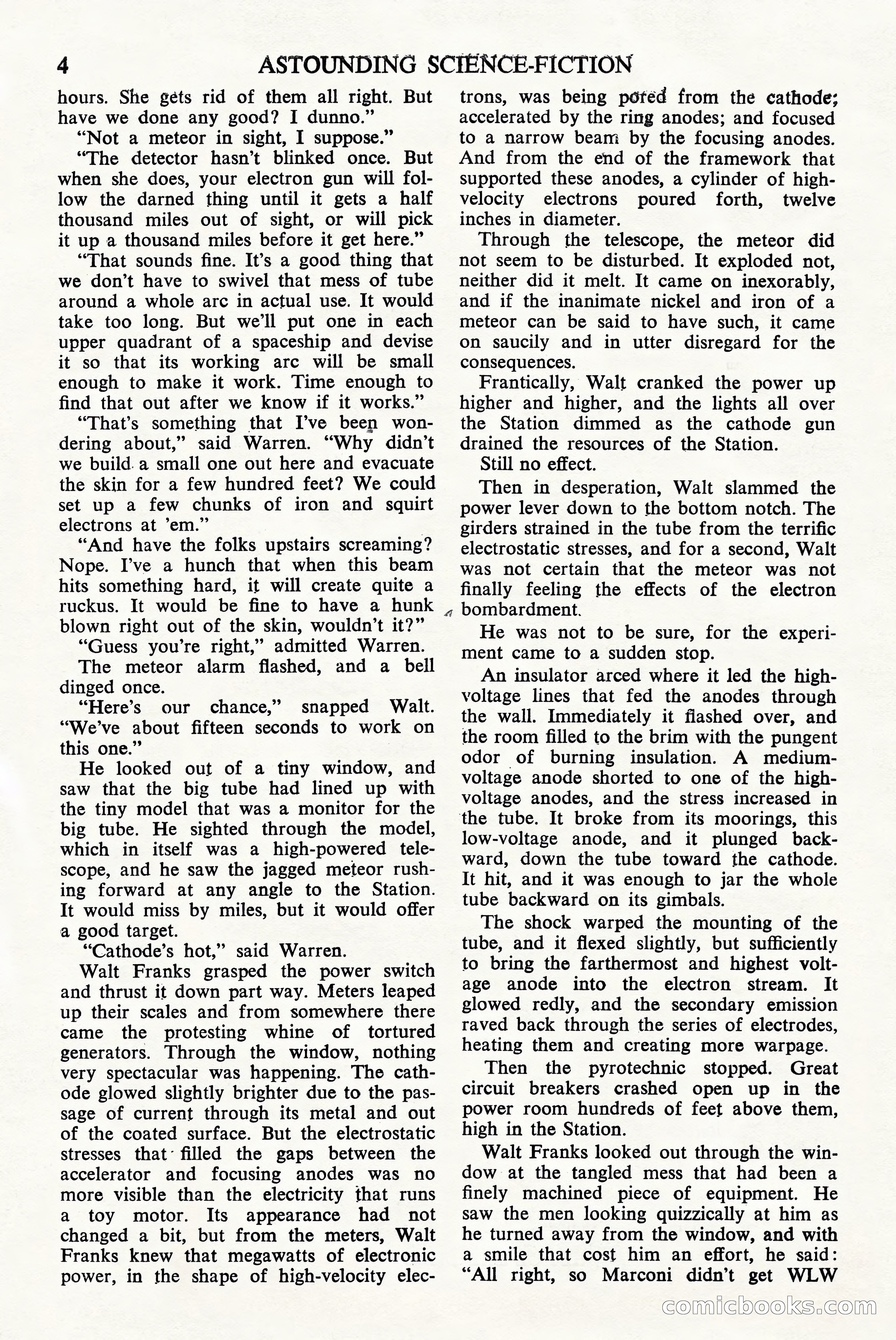
A restored page from Pulp Fiction, 1944. Page through the whole issue in the reader above.
📄 Transcribed text from this page (OCR, searchable)
Machine-transcribed from the original scan — historical spelling and the odd misread are preserved.
4 ASTOUNDING SCIENCE-FICTION hours. She gets rid of them all right. But have we done any good? I dunno.” “Not a meteor in sight, I suppose.” “The detector hasn’t blinked once. But when she does, your electron gun will fol- low the darned thing until it gets a half thousand miles out of sight, or will pick it up a thousand miles before it get here.” “That sounds fine. It’s a good thing that we don’t have to swivel that mess of tube around a whole arc in actual use. It would take too long. But we'll put one in each upper quadrant of a spaceship and devise it so that its working arc will be small enough to make it work. Time enough to find that out after we know if it works.” “That’s something that TPve been won- dering about,” said Warren. “Why didn’t we build. a small one out here and evacuate the skin for a few hundred feet? We could set up a few chunks of iron and squirt electrons at ’em.” | “And have the folks upstairs screaming? Nope. I’ve a hunch that when this beam hits something hard, it will create quite a ruckus. It would be fine to have a hunk blown right out of the skin, wouldn’t it?” “Guess you’re right,” admitted Warren. The meteor alarm flashed, and a bell dinged once. ‘“Here’s our chance,” snapped Walt. “We've about fifteen seconds to work on this one.” He looked out of a tiny window, and saw that the big tube had lined up with the tiny model that was a monitor for the big tube. He sighted through the model, which in itself was a high-powered tele- scope, and he saw the jagged meteor rush- ing forward at any angle to the Station. It would miss by miles, but it would offer a good target. “Cathode’s hot,” said Warren. Walt Franks grasped the power switch and thrust it down part way. Meters leaped up their scales and from somewhere there came the protesting whine of tortured generators. Through the window, nothing very spectacular was happening. The cath- ode glowed slightly brighter due to the pas- sage of current through its metal and out of the coated surface. But the electrostatic stresses that: filled the gaps between the accelerator and focusing anodes was no more visible than the electricity that runs a toy motor. Its appearance had not changed a bit, but from the meters, Walt Franks knew that megawatts of electronic power, in the shape of high-velocity elec- trons, was being poféd from the cathode; accelerated by the ring anodes; and focused to a narrow beam by the focusing anodes. And from the end of the framework that supported these anodes, a cylinder of high- velocity electrons poured forth, twelve inches in diameter. Through the telescope, the meteor did not seem to be disturbed. It exploded not, neither did it melt. It came on inexorably, and if the inanimate nickel and iron of a meteor can be said to have such, it came on saucily and in utter disregard for the consequences. Frantically, Walt cranked the power up higher and higher, and the lights all over the Station dimmed as the cathode gun drained the resources of the Station. Still no effect. Then in desperation, Walt slammed the power lever down to the bottom notch. The girders strained in the tube from the terrific electrostatic stresses, and for a second, Walt was not certain that the meteor was not finally feeling the effects of the electron bombardment. He was not to be sure, for the experi- ment came to a sudden stop. An insulator arced where it led the high- voltage lines that fed the anodes through the wall. Immediately it flashed over, and the room filled to the brim with the pungent odor of burning insulation. A medium- voltage anode shorted to one of the high- voltage anodes, and the stress increased in the tube. It broke from its moorings, this low-voltage anode, and it plunged back- ward, down the tube toward the cathode. It hit, and it was enough to jar the whole tube backward on its gimbals. The shock warped the mounting of the tube, and it flexed slightly, but sufficiently to bring the farthermost and highest volt- age anode into the electron stream. It glowed redly, and the secondary emission raved back through the series of electrodes, heating them and creating more warpage. Then the pyrotechnic stopped. Great circuit breakers crashed open up in the power room hundreds of feet above them, high in the Station. Walt Franks looked out through the win- dow at the tangled mess that had been a finely machined piece of equipment. He saw the men looking quizzically at him as he turned away from the window, and with a smile that cost him an effort, he said: “All right, so Marconi didn’t get WLW comiclooks C©