
Pulp Fiction, 1944 · page 58 of 68
Astounding Science Fiction (British Edition), April 1944 — page 58: what you’re looking at
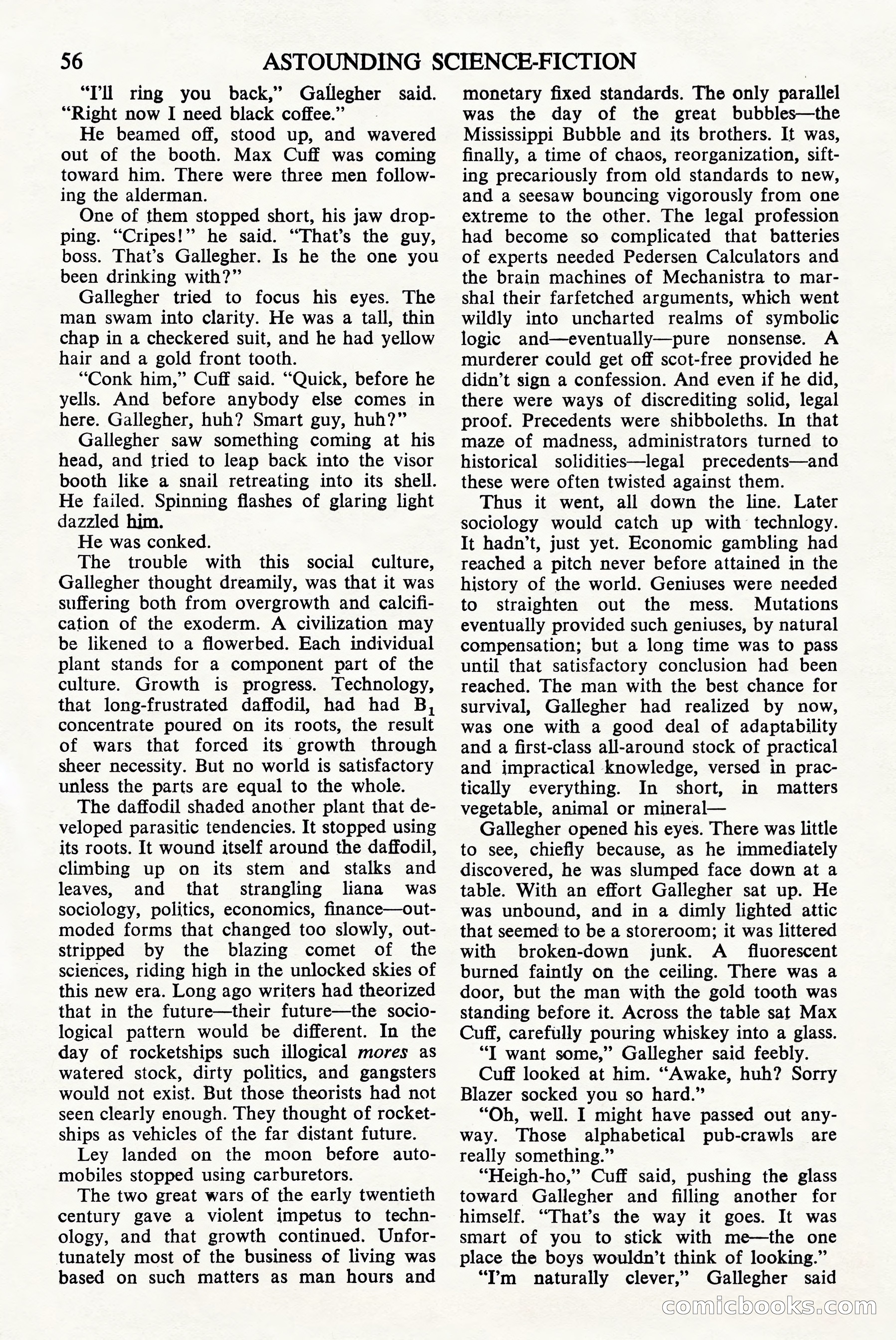
A restored page from Pulp Fiction, 1944. Page through the whole issue in the reader above.
📄 Transcribed text from this page (OCR, searchable)
Machine-transcribed from the original scan — historical spelling and the odd misread are preserved.
56 “Til ring you back,” Gallegher said. “Right now I need black coffee.” He beamed off, stood up, and wavered out of the booth. Max Cuff was coming toward him. There were three men follow- ing the alderman. One of them stopped short, his jaw drop- ping. “Cripes!’? he said. “That’s the guy, boss. That’s Gallegher. Is he the one you been drinking with?” Gallegher tried to focus his eyes. The man swam into clarity. He was a tall, thin chap in a checkered suit, and he had yellow hair and a gold front tooth. “Conk him,” Cuff said. “Quick, before he yells. And before anybody else comes in here. Gallegher, huh? Smart guy, huh?” Gallegher saw something coming at his head, and tried to leap back into the visor booth like a snail retreating into its shell. He failed. Spinning flashes of glaring light dazzled him. He was conked. The trouble with this social culture, Gallegher thought dreamily, was that it was suffering both from overgrowth and calcifi- cation of the exoderm. A civilization may be likened to a flowerbed. Each individual plant stands for a component part of the culture. Growth is progress. Technology, that long-frustrated daffodil, had had B, concentrate poured on its roots, the result of wars that forced its growth through sheer necessity. But no world is satisfactory unless the parts are equal to the whole. The daffodil shaded another plant that de- veloped parasitic tendencies. It stopped using its roots. It wound itself around the daffodil, climbing up on its stem and stalks and leaves, and that strangling liana was sociology, politics, economics, finance—out- moded forms that changed too slowly, out- stripped by the blazing comet of the sciences, riding high in the unlocked skies of this new era. Long ago writers had theorized that in the future—their future—the socio- logical pattern would be different. In the day of rocketships such illogical mores as watered stock, dirty politics, and gangsters would not exist. But those theorists had not seen clearly enough. They thought of rocket- ships as vehicles of the far distant future. Ley landed on the moon before auto- mobiles stopped using carburetors. The two great wars of the early twentieth century gave a violent impetus to techn- ology, and that growth continued. Unfor- tunately most of the business of living was based on such matters as man hours and ASTOUNDING SCIENCE-FICTION monetary fixed standards. The only parallel was the day of the great bubbles—the Mississippi Bubble and its brothers. It was, finally, a time of chaos, reorganization, sift- ing precariously from old standards to new, and a seesaw bouncing vigorously from one extreme to the other. The legal profession had become so complicated that batteries of experts needed Pedersen Calculators and the brain machines of Mechanistra to mar- shal their farfetched arguments, which went wildly into uncharted realms of symbolic logic and—eventually—pure nonsense. A murderer could get off scot-free provided he didn’t sign a confession. And even if he did, there were ways of discrediting solid, legal proof. Precedents were shibboleths. In that maze of madness, administrators turned to historical solidities—legal precedents—and these were often twisted against them. Thus it went, all down the line. Later sociology would catch up with technlogy. It hadn’t, just yet. Economic gambling had reached a pitch never before attained in the history of the world. Geniuses were needed to straighten out the mess. Mutations eventually provided such geniuses, by natural compensation; but a long time was to pass until that satisfactory conclusion had been reached. The man with the best chance for survival, Gallegher had realized by now, was one with a good deal of adaptability and a first-class all-around stock of practical and impractical knowledge, versed in prac- tically everything. In short, in matters vegetable, animal or mineral— Gallegher opened his eyes. There was little to see, chiefly because, as he immediately discovered, he was slumped face down at a table. With an effort Gallegher sat up. He was unbound, and in a dimly lighted attic that seemed to be a storeroom; it was littered with broken-down junk. A _ fluorescent burned faintly on the ceiling. There was a door, but the man with the gold tooth was standing before it. Across the table sat Max Cuff, carefully pouring whiskey into a glass. “IT want some,” Gallegher said feebly. Cuff looked at him. “Awake, huh? Sorry Blazer socked you so hard.” “Oh, well. I might have passed out any- way. Those alphabetical pub-crawls are really something.” ““Heigh-ho,” Cuff said, pushing the glass toward Gallegher and filling another for himself. “That’s the way it goes. It was smart of you to stick with me—the one place the boys wouldn’t think of looking.” “I’m naturally clever,” Gallegher said comiclooks (©)