
Pulp Fiction, 1944 · page 52 of 68
Astounding Science Fiction (British Edition), April 1944 — page 52: what you’re looking at
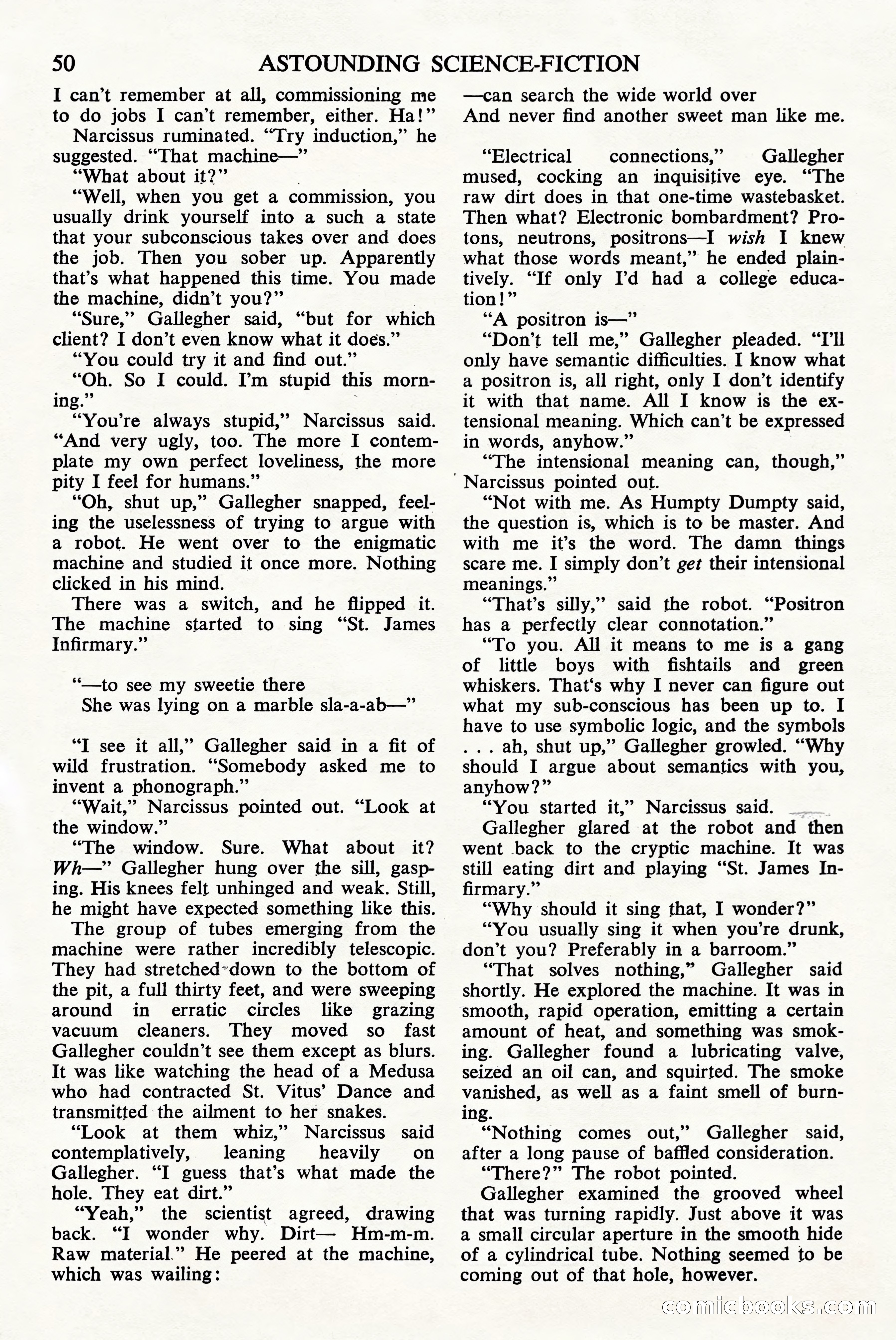
A restored page from Pulp Fiction, 1944. Page through the whole issue in the reader above.
📄 Transcribed text from this page (OCR, searchable)
Machine-transcribed from the original scan — historical spelling and the odd misread are preserved.
50 I can’t remember at all, commissioning me to do jobs I can’t remember, either. Ha!” Narcissus ruminated. “Try induction,” he suggested. “That machine—” “What about it?” “Well, when you get a commission, you usually drink yourself into a such a state that your subconscious takes over and does the job. Then you sober up. Apparently that’s what happened this time. You made the machine, didn’t you?” , “Sure,” Gallegher said, “but for which client? I don’t even know what it does.” “You could try it and find out.” “Oh. So I could. I’m stupid this morn- ing.” : “You're always stupid,’ Narcissus said. “And very ugly, too. The more I contem- plate my own perfect loveliness, the more pity I feel for humans.” “Oh, shut up,” Gallegher snapped, feel- ing the uselessness of trying to argue with a robot. He went over to the enigmatic machine and studied it once more. Nothing clicked in his mind. There was a switch, and he flipped it. The machine started to sing “St. James Infirmary.” ““__to see my sweetie there She was lying on a marble sla-a-ab—” “TI see it all,’ Gallegher said in a fit of wild frustration. “Somebody asked me to invent a phonograph.” “Wait,” Narcissus pointed out. “Look at the window.” “The window. Sure. What about it? Wh—” Gallegher hung over the sill, gasp- ing. His knees felt unhinged and weak. Still, he might have expected something like this. The group of tubes emerging from the machine were rather incredibly telescopic. They had stretched~down to the bottom of the pit, a full thirty feet, and were sweeping around in erratic circles like grazing vacuum cleaners. They moved so fast Gallegher couldn’t see them except as blurs. It was like watching the head of a Medusa who had contracted St. Vitus’ Dance and transmitted the ailment to her snakes. “Look at them whiz,” Narcissus said contemplatively, leaning heavily on Gallegher. “I guess that’s what made the hole. They eat dirt.” “Yeah,” the scientist agreed, drawing back. “I wonder why. Dirt— Hm-m-m. Raw material.” He peered at the machine, which was wailing: ASTOUNDING SCIENCE-FICTION —can search the wide world over And never find another sweet man like me. “Electrical connections,” Gallegher mused, cocking an inquisitive eye. “The raw dirt does in that one-time wastebasket. Then what? Electronic bombardment? Pro- tons, neutrons, positrons—I wish I knew what those words meant,” he ended plain- tively. “If only I’d had a college educa- tion!” “A positron is—” “Don’t tell me,” Gallegher pleaded. “Til only have semantic difficulties. I know what a positron is, all right, only I don’t identify it with that name. All I know is the ex- tensional meaning. Which can’t be expressed in words, anyhow.” : “The intensional meaning can, though,” "Narcissus pointed out. “Not with me. As Humpty Dumpty said, the question is, which is to be master. And with me it’s the word. The damn things scare me. I simply don’t get their intensional meanings.” “That’s silly,’ said the robot. “Positron has a perfectly clear connotation.” “To you. All it means to me is a gang of little boys with fishtails and green whiskers. That‘s why I never can figure out what my sub-conscious has been up to. I have to use symbolic logic, and the symbols . ah, shut up,” Gallegher growled. ““Why should I argue about semantics with you, anyhow?” “You started it,’ Narcissus said. Gallegher glared at the robot and then went back to the cryptic machine. It was still eating dirt and playing “St. James In- firmary.” “Why should it sing that, I wonder?” “You usually sing it when you’re drunk, don’t you? Preferably in a barroom.” “That solves nothing,” Gallegher said shortly. He explored the machine. It was in smooth, rapid operation, emitting a certain amount of heat, and something was smok- ing. Gallegher found a lubricating valve, seized an oil can, and squirted. The smoke vanished, as well as a faint smell of burn- ing. “Nothing comes out,” Gallegher said, after a long pause of baffled consideration. “There?” The robot pointed. Gallegher examined the grooved wheel that was turning rapidly. Just above it was a small circular aperture in the smooth hide of a cylindrical tube. Nothing seemed to be coming out of that hole, however. conicbooao <SHIGO)