
Pulp Fiction, 1944 · page 23 of 68
Astounding Science Fiction (British Edition), April 1944 — page 23: what you’re looking at
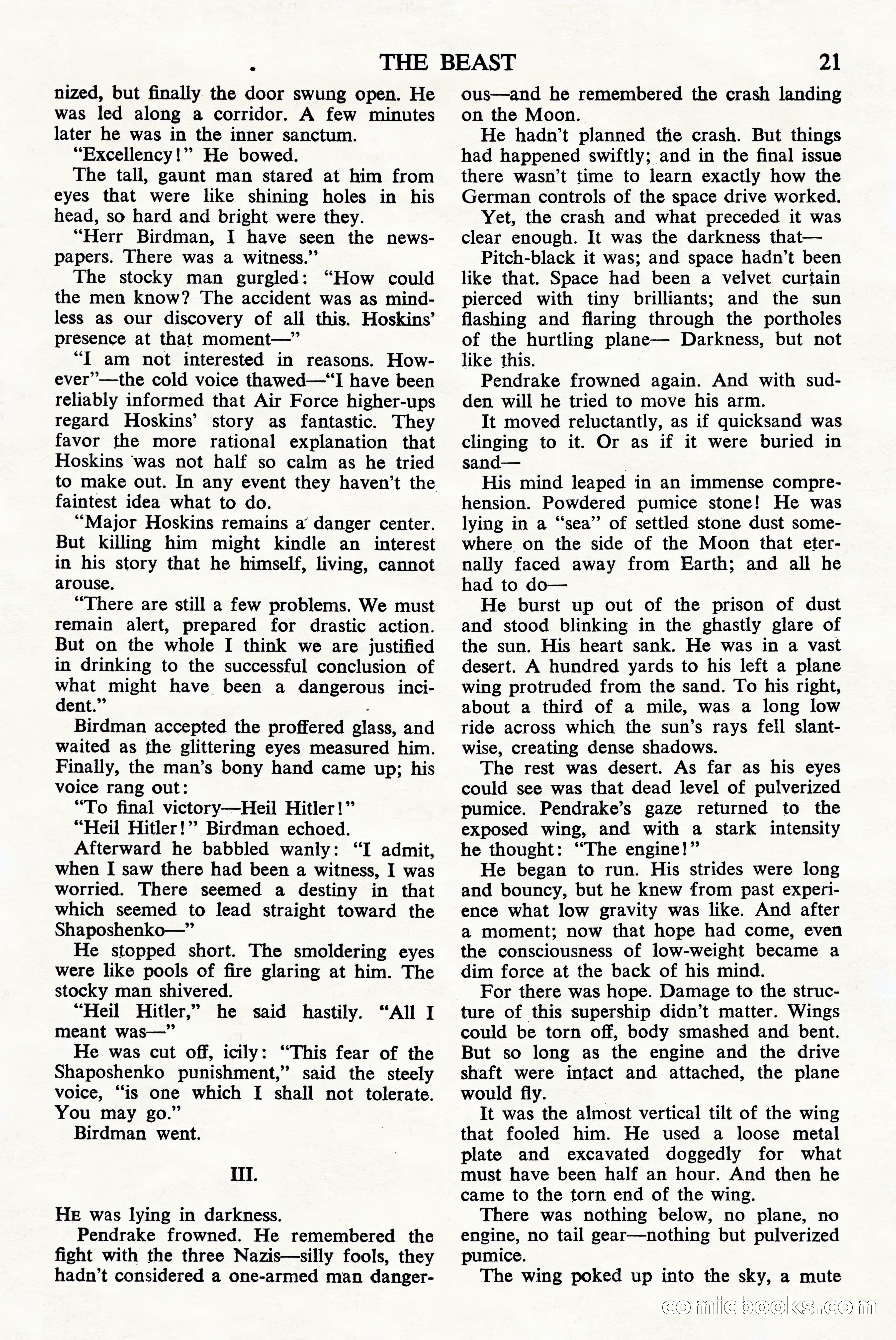
A restored page from Pulp Fiction, 1944. Page through the whole issue in the reader above.
📄 Transcribed text from this page (OCR, searchable)
Machine-transcribed from the original scan — historical spelling and the odd misread are preserved.
: THE BEAST nized, but finally the door swung open. He was led along a corridor. A few minutes later he was in the inner sanctum. “Excellency!’? He bowed. The tall, gaunt man stared at him from eyes that were like shining holes in his head, so hard and bright were they. “Herr Birdman, I have seen the news- papers. There was a witness.” The stocky man gurgled: “How could the men know? The accident was as mind- less as our discovery of all this. Hoskins’ presence at that moment—” “I am not interested in reasons. How- ever’—the cold voice thawed—“I have been reliably informed that Air Force higher-ups regard Hoskins’ story as fantastic. They favor the more rational explanation that Hoskins ‘was not half so calm as he tried to make out. In any event they haven’t the faintest idea what to do. ‘““Major Hoskins remains a danger center. But killing him might kindle an interest in his story that he himself, living, cannot arouse. “There are still a few problems. We must remain alert, prepared for drastic action. But on the whole I think we are justified in drinking to the successful conclusion of what might have been a dangerous inci- dent.” Birdman accepted the proffered glass, and waited as the glittering eyes measured him. Finally, the man’s bony hand came up; his voice rang out: “To final victory—Heil Hitler!” “Heil Hitler!” Birdman echoed. Afterward he babbled wanly: “I admit, when I saw there had been a witness, I was worried. There seemed a destiny in that which seemed to lead straight toward the Shaposhenko—” He stopped short. The smoldering eyes were like pools of fire glaring at him. The stocky man shivered. “Heil Hitler,” he said hastily. “All I meant was—” He was cut off, icily: “This fear of the Shaposhenko punishment,” said the steely voice, “is one which I shall not tolerate. You may go.” Birdman went. Hil. HE was lying in darkness. Pendrake frowned. He remembered the fight with the three Nazis—silly fools, they hadn’t considered a one-armed man danger- 21 ous—and he remembered the crash landing on the Moon. He hadn’t planned the crash. But things had happened swiftly; and in the final issue there wasn’t time to learn exactly how the German controls of the space drive worked. Yet, the crash and what preceded it was clear enough. It was the darkness that— Pitch-black it was; and space hadn’t been like that. Space had been a velvet curtain pierced with tiny brilliants; and the sun flashing and flaring through the portholes of the hurtling plane— Darkness, but not like this. Pendrake frowned again. And with sud- den will he tried to move his arm. It moved reluctantly, as if quicksand was clinging to it. Or as if it were buried in sand— His mind leaped in an immense compre- hension. Powdered pumice stone! He was lying in a “sea” of settled stone dust some- where on the side of the Moon that eter- nally faced away from Earth; and all he had to do— He burst up out of the prison of dust and stood blinking in the ghastly glare of the sun. His heart sank. He was in a vast desert. A hundred yards to his left a plane wing protruded from the sand. To his right, about a third of a mile, was a long low ride across which the sun’s rays fell slant- wise, creating dense shadows. The rest was desert. As far as his eyes could see was that dead level of pulverized pumice. Pendrake’s gaze returned to the exposed wing, and with a stark intensity he thought: “The engine!” He began to run. His strides were long and bouncy, but he knew from past experi- ence what low gravity was like. And after a moment; now that hope had come, even the consciousness of low-weight became a dim force at the back of his mind. For there was hope. Damage to the struc- ture of this supership didn’t matter. Wings could be torn off, body smashed and bent. But so long as the engine and the drive shaft were intact and attached, the plane would fly. It was the almost vertical tilt of the wing that fooled him. He used a loose metal plate and excavated doggedly for what must have been half an hour. And then he came to the torn end of the wing. There was nothing below, no plane, no engine, no tail gear—nothing but pulverized pumice. The wing poked up into the sky, a mute comiclooks (©