
Pulp Fiction, 1944 · page 20 of 68
Astounding Science Fiction (British Edition), April 1944 — page 20: what you’re looking at
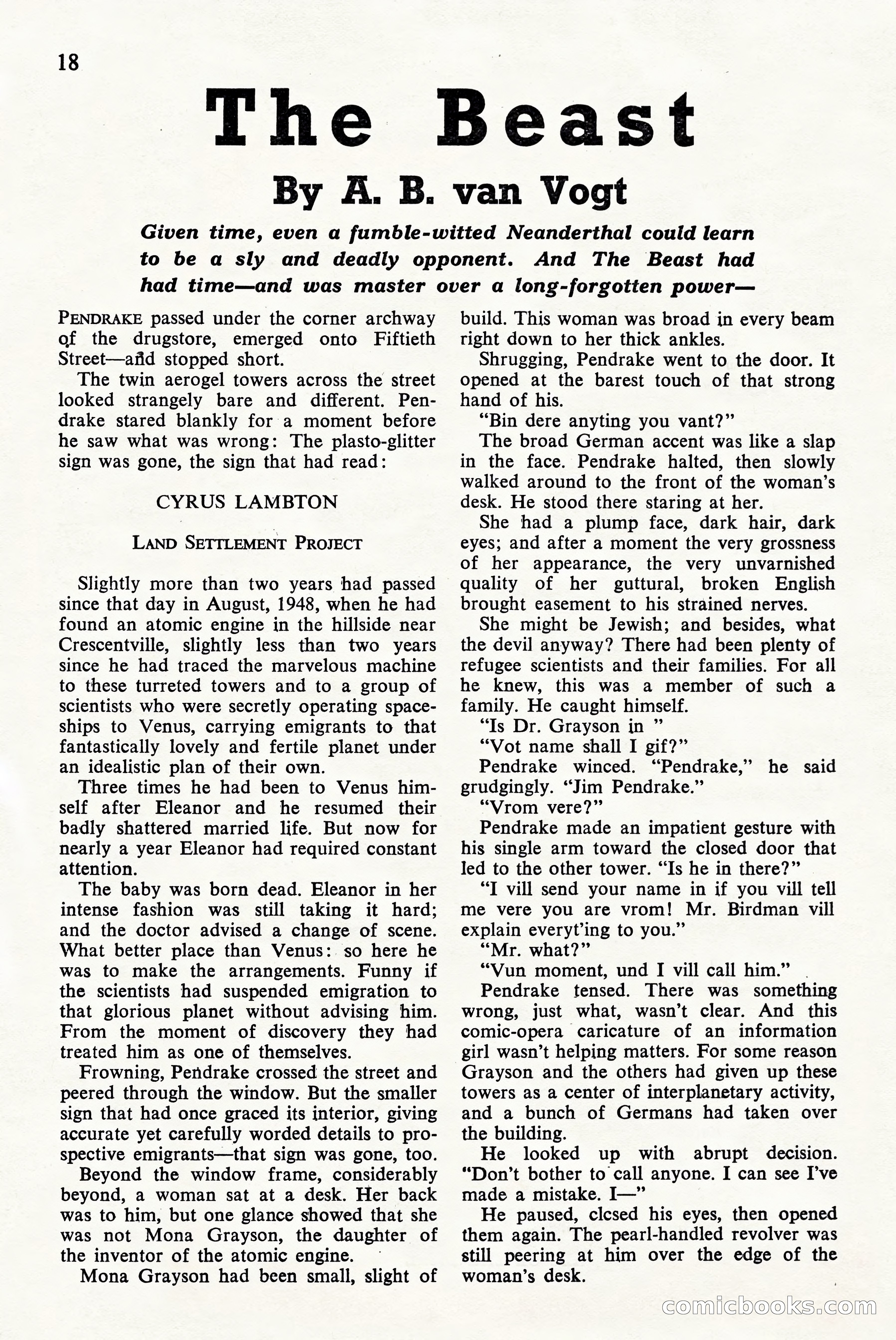
A restored page from Pulp Fiction, 1944. Page through the whole issue in the reader above.
📄 Transcribed text from this page (OCR, searchable)
Machine-transcribed from the original scan — historical spelling and the odd misread are preserved.
18 The Beast By A. B. van Vogt Given time, even a fumble-witted Neanderthal could learn to be a sly and deadly opponent. And The Beast had had time—and was master over a long-forgotten power— PENDRAKE passed under the corner archway of the drugstore, emerged onto Fiftieth Street—afid stopped short. The twin aerogel towers across the street looked strangely bare and different. Pen- drake stared blankly for a moment before he saw what was wrong: The plasto-glitter sign was gone, the sign that had read: CYRUS LAMBTON LAND SETTLEMENT PROJECT Slightly more than two years had passed since that day in August, 1948, when he had found an atomic engine in the hillside near Crescentville, slightly less than two years since he had traced the marvelous machine to these turreted towers and to a group of scientists who were secretly operating space- ships to Venus, carrying emigrants to that fantastically lovely and fertile planet under an idealistic plan of their own. Three times he had been to Venus him- self after Eleanor and he resumed their badly shattered married life. But now for nearly a year Eleanor had required constant attention. The baby was born dead. Eleanor in her intense fashion was still taking it hard; and the doctor advised a change of scene. What better place than Venus: so here he was to make the arrangements. Funny if the scientists had suspended emigration to that glorious planet without advising him. From the moment of discovery they had treated him as one of themselves. Frowning, Pendrake crossed the street and peered through the window. But the smaller sign that had once graced its interior, giving accurate yet carefully worded details to pro- spective emigrants—that sign was gone, too. Beyond the window frame, considerably beyond, a woman sat at a desk. Her back was to him, but one glance showed that she was not Mona Grayson, the daughter of the inventor of the atomic engine. — Mona Grayson had been small, slight of build. This woman was broad in every beam tight down to her thick ankles. Shrugging, Pendrake went to the door. It opened at the barest touch of that strong hand of his. “Bin dere anyting you vant?” The broad German accent was like a slap in the face. Pendrake halted, then slowly walked around to the front of the woman’s desk. He stood there staring at her. She had a plump face, dark hair, dark eyes; and after a moment the very grossness of her appearance, the very unvarnished quality of her guttural, broken English brought easement to his strained nerves. She might be Jewish; and besides, what the devil anyway? There had been plenty of refugee scientists and their families. For all he knew, this was a member of such a family. He caught himself. “Ts Dr. Grayson in ” “‘Vot name shall I gif?” Pendrake winced. ‘“Pendrake,” he said grudgingly. “Jim Pendrake.” “Vrom vere?” Pendrake made an impatient gesture with his single arm toward the closed door that Ied to the other tower. “Is he in there?” “T vill send your name in if you vill tell me vere you are vrom! Mr. Birdman vill explain everyting to you.” “Mr. what?” “Vun moment, und I vill call him.” Pendrake tensed. There was something wrong, just what, wasn’t clear. And this comic-opera caricature of an information girl wasn’t helping matters. For some reason Grayson and the others had given up these towers as a center of interplanetary activity, and a bunch of Germans had taken over the building. He looked up with abrupt decision. “Don’t bother to call anyone. I can see I’ve made a mistake. I—” He paused, clcsed his eyes, then opened them again. The pearl-handled revolver was still peering at him over the edge of the woman’s desk. oO comiclooks (©)