
Pulp Fiction, 1944 · page 13 of 68
Astounding Science Fiction (British Edition), April 1944 — page 13: what you’re looking at
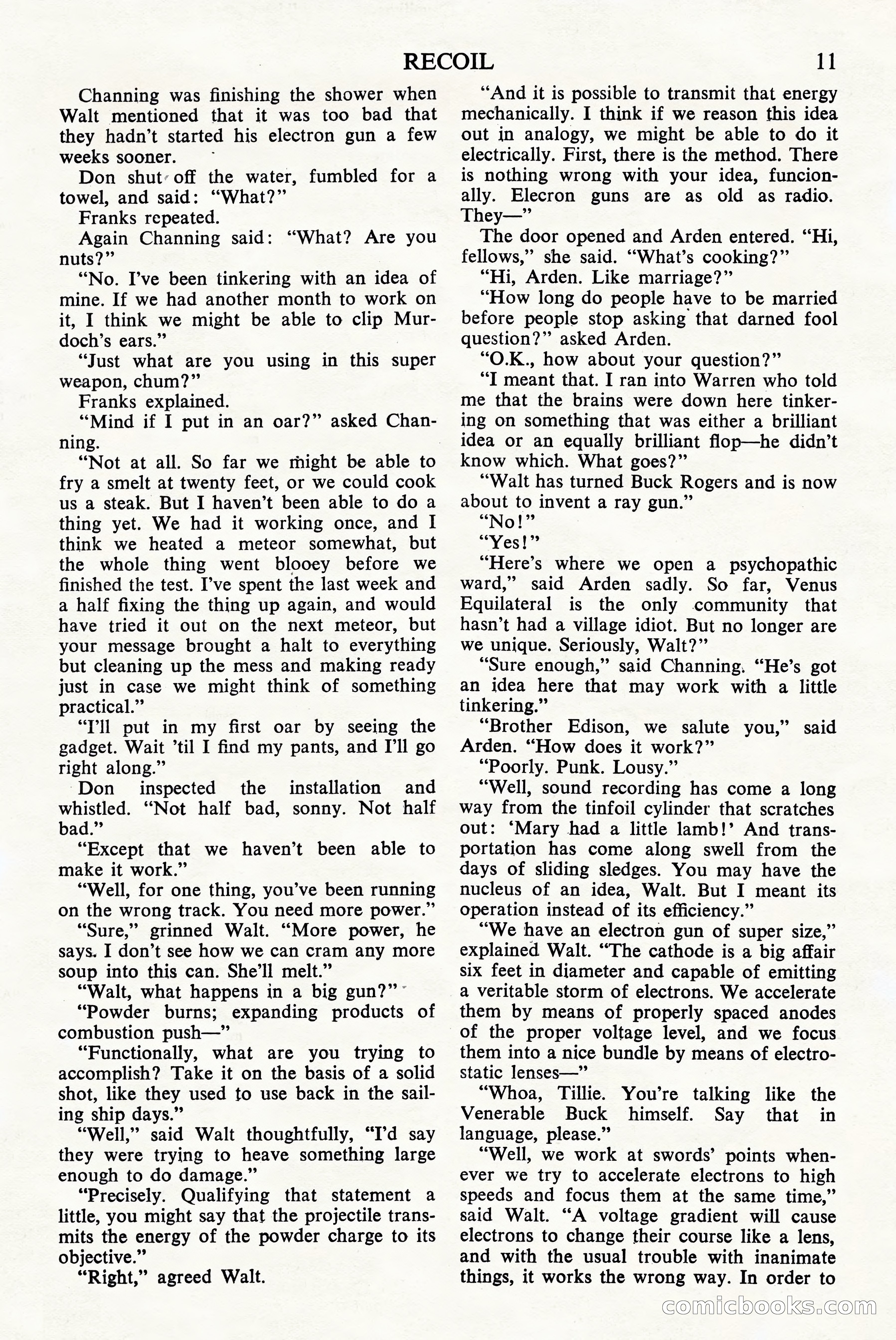
A restored page from Pulp Fiction, 1944. Page through the whole issue in the reader above.
📄 Transcribed text from this page (OCR, searchable)
Machine-transcribed from the original scan — historical spelling and the odd misread are preserved.
RECOIL 11 Channing was finishing the shower when Walt mentioned that it was too bad that they hadn’t started his electron gun a few weeks sooner. Don shut’ off the water, fumbled for a towel, and said: “What?” Franks repeated. Again Channing said: “What? Are you nuts?” “No. I’ve been tinkering with an idea of mine. If we had another month to work on it, I think we might be able to clip Mur- doch’s ears.” “Just what are you using in this super weapon, chum?” Franks explained. “Mind if I put in an oar?” asked Chan- ning. fry a smelt at twenty feet, or we could cook us a steak. But I haven’t been able to do a thing yet. We had it working once, and I think we heated a meteor somewhat, but the whole thing went blooey before we finished the test. I’ve spent the last week and a half fixing the thing up again, and would have tried it out on the next meteor, but your message brought a halt to everything but cleaning up the mess and making ready just in case we might think of something practical.” “T’ll put in my first oar by seeing the gadget. Wait ’til I find my pants, and I'll go right along.” ‘Don inspected the installation and whistled. “Not half bad, sonny. Not half bad.” “Except that we haven’t been able to make it work.” “Well, for one thing, you’ve been running on the wrong track. You need more power.” “Sure,” grinned Walt. “More power, he says. I don’t see how we can cram any more soup into this can. She’ll melt.” “Walt, what happens in a big gun?” ” “Powder burns; expanding products of combustion push—” “Functionally, what are you trying to accomplish? Take it on the basis of a solid shot, like they used to use back in the sail- ing ship days.” “Well,” said Walt thoughtfully, “I'd say they were trying to heave something large enough to do damage.” “Precisely. Qualifying that statement a little, you might say that the projectile trans- mits the energy of the powder charge to its objective.” “Right,” agreed Walt. “Not at all. So far we might be able to “And it is possible to transmit that energy mechanically. I think if we reason this idea out in analogy, we might be able to do it electrically. First, there is the method. There is nothing wrong with your idea, funcion- ally. Elecron guns are as old as radio. They—” The door opened and Arden entered. “Hi, fellows,” she said. ‘““What’s cooking?” “Hi, Arden. Like marriage?” “How long do people have to be married before people stop asking that darned fool question?” asked Arden. “O.K., how about your question?” “I meant that. I ran into Warren who told me that the brains were down here tinker- ing on something that was either a brilliant idea or an equally brilliant flop—he didn’t know which. What goes?” “Walt has turned Buck Rogers and is now about to invent a ray gun.” “No!” “Yes!” ““Here’s where we open a_ psychopathic ward,” said Arden sadly. So far, Venus Equilateral is the only community that hasn’t had a village idiot. But no longer are we unique. Seriously, Walt?”’ “Sure enough,” said Channing. “He’s got an idea here that may work with a little tinkering.” “Brother Edison, we salute you,” said Arden. “How does it work?” “Poorly. Punk. Lousy.” “Well, sound recording has come a long way from the tinfoil cylinder that scratches out: “Mary had a little lamb!’ And trans- portation has come along swell from the days of sliding sledges. You may have the nucleus of an idea, Walt. But I meant its operation instead of its efficiency.” “We have an electron gun of super size,” explained Walt. “The cathode is a big affair six feet in diameter and capable of emitting a veritable storm of electrons. We accelerate them by means of properly spaced anodes of the proper voltage level, and we focus them into a nice bundle by means of electro- static lenses—” “Whoa, Tillie. You’re talking like the Venerable Buck himself. Say that in language, please.” “Well, we work at swords’ points when- ever we try to accelerate electrons to high speeds and focus them at the same time,” said Walt. “A voltage gradient will cause electrons to change their course like a lens, and with the usual trouble with inanimate things, it works the wrong way. In order to oO CcomiclbooksS.€c©