
Pulp Fiction, 1944 · page 36 of 68
Astounding Science Fiction (UK Edition) — page 36: what you’re looking at
A restored page from Pulp Fiction, 1944. Page through the whole issue in the reader above.
📄 Transcribed text from this page (OCR, searchable)
Machine-transcribed from the original scan — historical spelling and the odd misread are preserved.
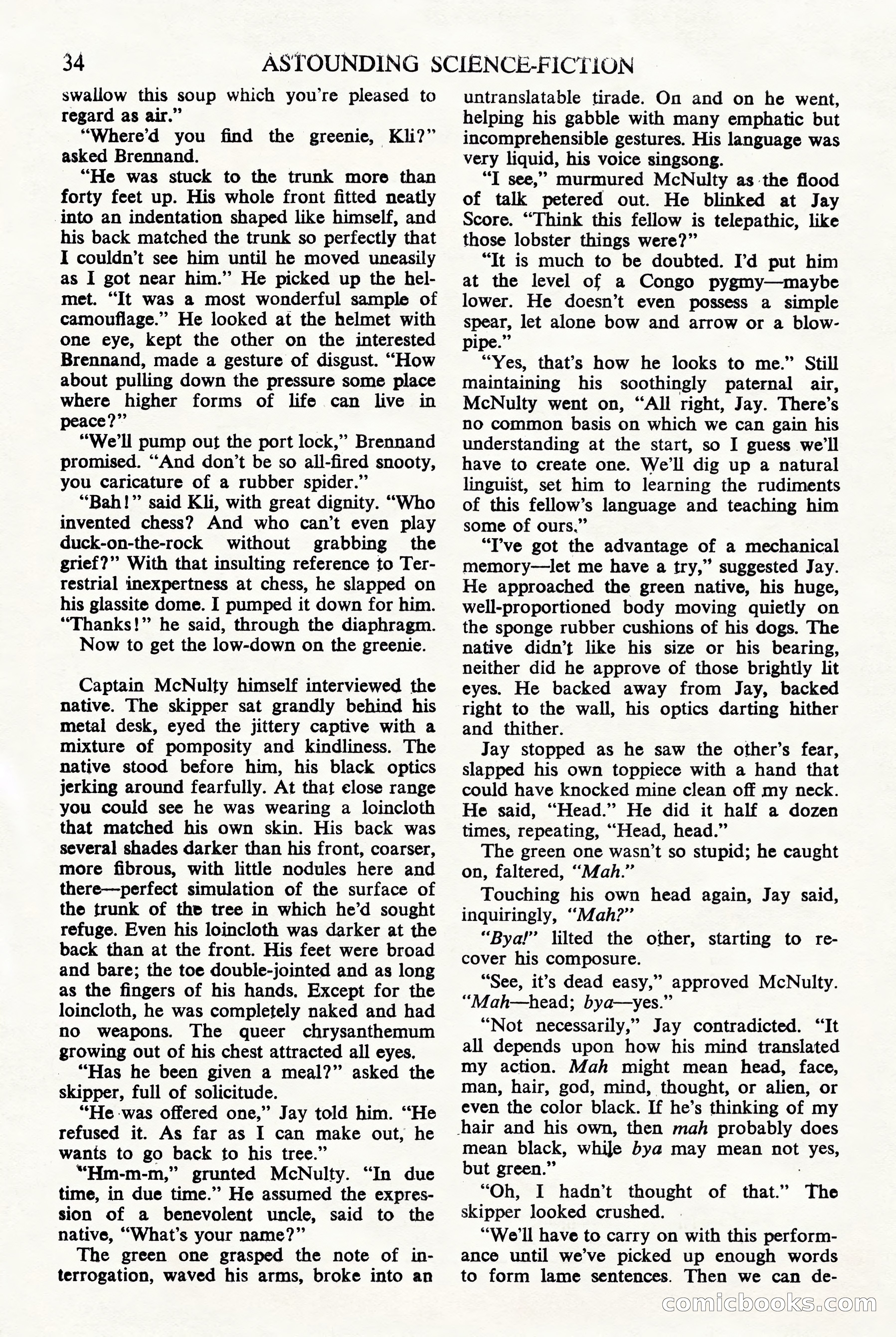
34 swallow this soup which you’re pleased to regard as air.” “Where'd you find the greenie, Kli?” asked Brennand. “He was stuck to the trunk more than forty feet up. His whole front fitted neatly into an indentation shaped like himself, and his back matched the trunk so perfectly that I couldn’t see him until he moved uneasily as I got near him.” He picked up the hel- met. “It was a most wonderful sample of camouflage.” He looked at the helmet with one eye, kept the other on the interested Brennand, made a gesture of disgust. “How about pulling down the pressure some place where higher forms of life can live in peace?” | “We'll pump out the port lock,” Brennand promised. “And don’t be so all-fired snooty, you caricature of a rubber spider.” “Bah!” said Kli, with great dignity. ““Who invented chess? And who can’t even play duck-on-the-rock without grabbing the grief?” With that insulting reference to Ter- restrial inexpertness at chess, he slapped on his glassite dome. I pumped it down for him. “Thanks!” he said, through the diaphragm. Now to get the low-down on the greenie. Captain McNulty himself interviewed the native. The skipper sat grandly behind his metal desk, eyed the jittery captive with a mixture of pomposity and kindliness. The native stood before him, his black optics jerking around fearfully. At that elose range you could see he was wearing a loincloth that matched his own skin. His back was several shades darker than his front, coarser, more fibrous, with little nodules here and there—perfect simulation of the surface of the trunk of the tree in which he’d sought refuge. Even his loincloth was darker at the back than at the front. His feet were broad and bare; the toe double-jointed and as long as the fingers of his hands, Except for the loincloth, he was completely naked and had no weapons. The queer chrysanthemum growing out of his chest attracted all eyes. ““Has he been given a meal?” asked the skipper, full of solicitude. ““He was offered one,” Jay told him. “He refused it. As far as I can make out, he wants to go back to his tree.” “Hm-m-m,” grunted McNulty. “In due time, in due time.’ He assumed the expres- sion of a benevolent uncle, said to the native, “What’s your name?” The green one grasped the note of in- terrogation, waved his arms, broke into an ASTOUNDING SCIENCE-FICTION untranslatable tirade. On and on he went, helping his gabble with many emphatic but incomprehensible gestures. His language was very liquid, his voice singsong. “T see,” murmured McNulty as the flood of talk petered out. He blinked at Jay Score. “Think this fellow is telepathic, like those lobster things were?” “It is much to be doubted. I’d put him at the level of a Congo pygmy—maybe lower. He doesn’t even possess a simple spear, let alone bow and arrow or a blow- pipe.’ “Yes, that’s how he looks to me.” Still maintaining his soothingly paternal air, McNulty went on, “All right, Jay. There’s no common basis on which we can gain his understanding at the start, so I guess we'll have to create one. We'll dig up a natural linguist, set him to learning the rudiments of this fellow’s language and teaching him some of ours.” “T’ve got the advantage of a mechanical memory—let me have a try,” suggested Jay. He approached the green native, his huge, well-proportioned body moving quietly on the sponge rubber cushions of his dogs. The native didn’t like his size or his bearing, neither did he approve of those brightly lit eyes. He backed away from Jay, backed right to the wall, his optics darting hither and thither. Jay stopped as he saw the other’s fear, slapped his own toppiece with a hand that could have knocked mine clean off my neck. He said, “Head.” He did it half a dozen times, repeating, ““Head, head.” The green one wasn’t so stupid; he caught on, faltered, ‘“Mah.” Touching his own head again, Jay said, inguiringly, “Mah?” “Bya!l’ lilted the other, starting to re- cover his composure. “See, it’s dead easy,” “Mah—head; bya—yes.” “Not necessarily,” Jay contradicted. “It all depends upon how his mind translated my action. Mah might mean head, face, man, hair, god, mind, thought, or alien, or even the color black. If he’s thinking of my approved McNulty. hair and his own, then mah probably does mean black, while bya may mean not yes, but green.” “Oh, I hadn’t thought of that.” ‘The skipper looked crushed. “We'll have to carry on with this perform- ance until we’ve picked up enough words to form lame sentences. Then we can de- oO comiclooks (©