
Pulp Fiction, 1944 · page 18 of 68
Astounding Science Fiction (UK Edition) — page 18: what you’re looking at
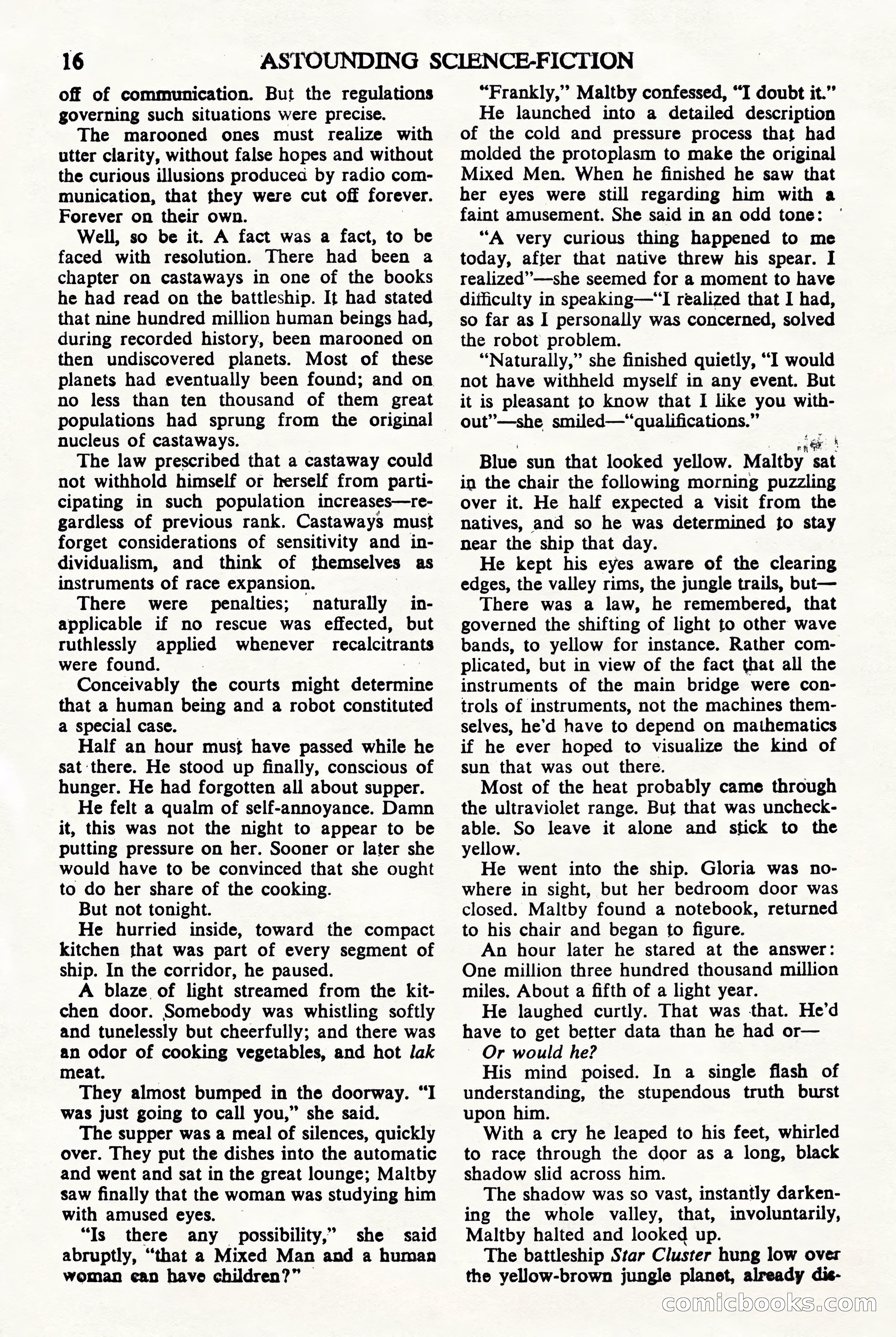
A restored page from Pulp Fiction, 1944. Page through the whole issue in the reader above.
📄 Transcribed text from this page (OCR, searchable)
Machine-transcribed from the original scan — historical spelling and the odd misread are preserved.
16 off of communication. But the regulations governing such situations were precise. The marooned ones must realize with utter clarity, without false hopes and without the curious illusions produced by radio com- munication, that they were cut off forever. Forever on their own. Well, so be it. A fact was a fact, to be faced with resolution. There had been a chapter on castaways in one of the books he had read on the battleship. It had stated that nine hundred million human beings had, during recorded history, been marooned on then undiscovered planets. Most of these planets had eventually been found; and on no less than ten thousand of them great populations had sprung from the original nucleus of castaways. | The law prescribed that a castaway could not withhold himself or herself from parti- cipating in such population increases—re- gardless of previous rank. Castaways must forget considerations of sensitivity and in- dividualism, and think of themselves as instruments of race expansion. There were penalties; naturally in- applicable if no rescue was effected, but ruthlessly applied whenever recalcitrants were found. : Conceivably the courts might detetthine that a human being and a robot constituted a special case. Half an hour must have passed while he sat there. He stood up finally, conscious of hunger. He had forgotten all about supper. He felt a qualm of self-annoyance. Damn it, this was not the night to appear to be putting pressure on her. Sooner or later she would have to be convinced that she ought to do her share of the cooking. But not tonight. He hurried inside, toward the compact kitchen that was part of every segment of ship. In the corridor, he paused. A blaze of light streamed from the kit- chen door. Somebody was whistling softly and tunelessly but cheerfully; and there was an odor of cooking vegetables, and hot lak meat. They almost bumped in the doorway. “I was just going to call you,” she said. The supper was a meal of silences, quickly over. They put the dishes into the automatic and went and sat in the great lounge; Maltby saw finally that the woman was studying him with amused eyes. “Is there any possibility,’ she said abruptly, “that a Mixed Man and a human woman can have children?” | ASTOUNDING SCIENCE-FICTION “Frankly,” Maltby confessed, “I doubt it.” He launched into a detailed description of the cold and pressure process that had molded the protoplasm to make the original Mixed Men. When he finished he saw that her eyes were still regarding him with a faint amusement. She said in an odd tone: “A very curious thing happened to me today, after that native threw his spear. I realized” —she seemed for a moment to have difficulty in speaking—“I realized that I had, so far as 1 personally was concerned, solved the robot problem. “Naturally,” she finished quietly, “I would not have withheld myself in any event. But it is pleasant to know that I like you with- out”—she smiled—*qualifications.” nye f Blue sun that looked yellow. Maltby sat in the chair the following morning puzzling over it. He half expected a visit from the natives, and so he was determined fo stay near the ship that day. He kept his eyes aware of the clearing edges, the valley rims, the jungle trails, but— There was a law, he remembered, that governed the shifting of light to other wave bands, to yellow for instance. Rather com- plicated, but in view of the fact that all the instruments of the main bridge were con- trols of instruments, not the machines them- selves, he’d have to depend on mathematics if he ever hoped to visualize the kind of sun that was out there. Most of the heat probably came through the ultraviolet range. But that was uncheck- able. So leave it alone and stick to the yellow. He went into the ship. Gloria was no- where in sight, but her bedroom door was closed. Maltby found a notebook, returned to his chair and began to figure. An hour later he stared at the answer: One million three hundred thousand million miles. About a fifth of a light year. He laughed curtly. That was that. He’d have to get better data than he had or— ~ Or would he? His mind poised. In a single flash of understanding, the stupendous truth burst upon him. With a cry he leaped to his feet, whirled to race through the door as a long, black shadow slid across him. The shadow was so vast, instantly darken- ing the whole valley, that, involuntarily, Maltby halted and looked up. The battleship Star Cluster hung low over the yellow-brown jungle planet, already dis- comiclooks ©