
Pulp Fiction, 1944 · page 12 of 68
Astounding Science Fiction (UK Edition) — page 12: what you’re looking at
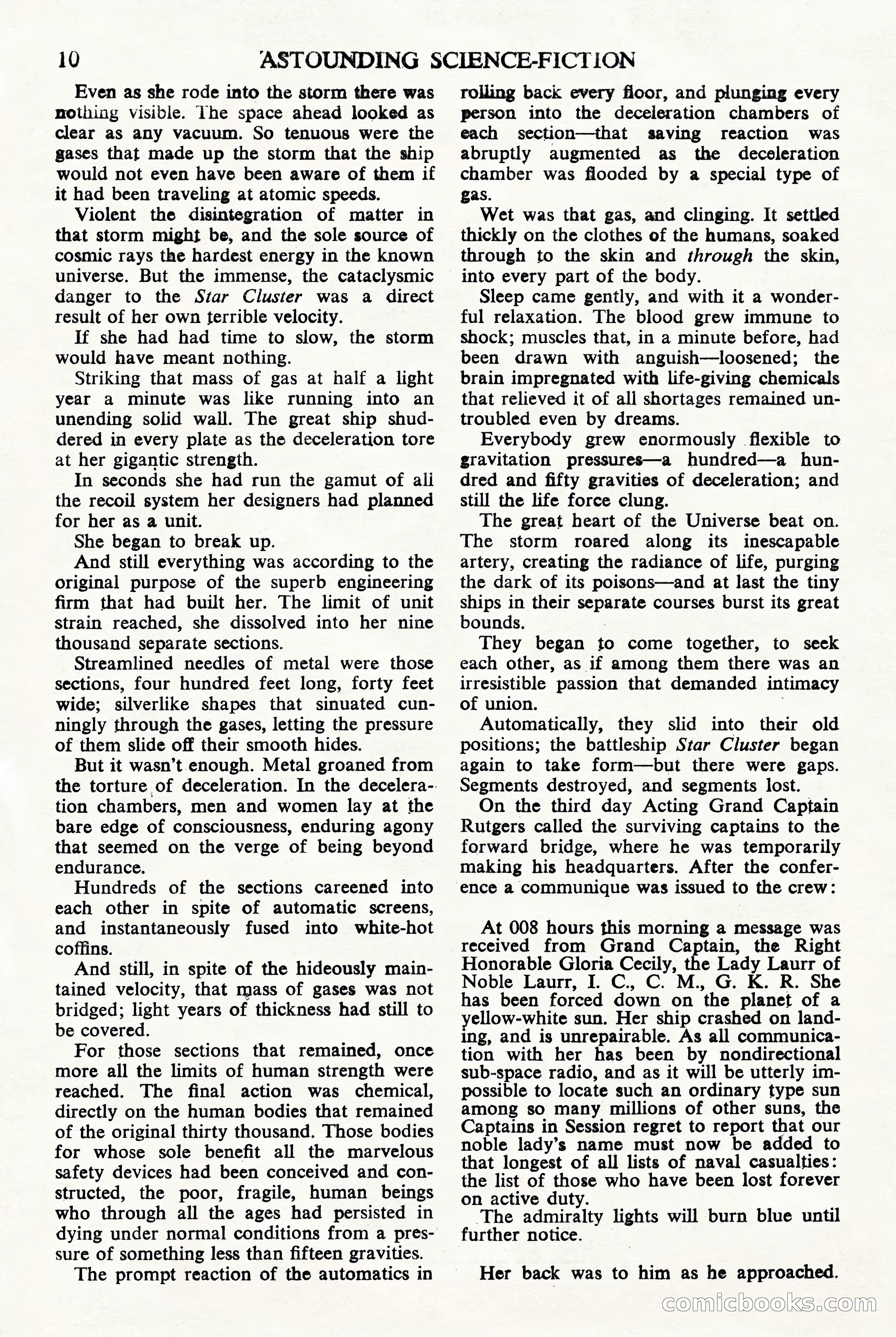
A restored page from Pulp Fiction, 1944. Page through the whole issue in the reader above.
📄 Transcribed text from this page (OCR, searchable)
Machine-transcribed from the original scan — historical spelling and the odd misread are preserved.
10 Even as she rode into the storm there was nothing visible. The space ahead looked as clear as any vacuum. So tenuous were the gases that made up the storm that the ship would not even have been aware of them if it had been traveling at atomic speeds. Violent the disintegration of matter in that storm might be, and the sole source of cosmic rays the hardest energy in the known universe. But the immense, the cataclysmic danger to the Star Cluster was a direct result of her own terrible velocity. If she had had time to slow, the storm would have meant nothing. Striking that mass of gas at half a light year a minute was like running into an unending solid wall. The great ship shud- dered in every plate as the deceleration tore at her gigantic strength. In seconds she had run the gamut of ali the recoil system her designers had planned for her as a unit. She began to break up. And still everything was according to the Original purpose of the superb engineering firm that had built her. The limit of unit strain reached, she dissolved into her nine thousand separate sections. Streamlined needles of metal were those sections, four hundred feet long, forty feet wide; silverlike shapes that sinuated cun- ningly through the gases, letting the pressure of them slide off their smooth hides. But it wasn’t enough. Metal groaned from the torture of deceleration. In the decelera-. tion chambers, men and women lay at the bare edge of consciousness, enduring agony that seemed on the verge of being beyond endurance. Hundreds of the sections careened into each other in spite of automatic screens, and instantaneously fused into white-hot coffins. And still, in spite of the hideously main- tained velocity, that mass of gases was not bridged; light years of thickness had still to be covered. For those sections that remained, once more all the limits of human strength were reached. The final action was chemical, directly on the human bodies that remained of the original thirty thousand. Those bodies for whose sole benefit all the marvelous safety devices had been conceived and con- structed, the poor, fragile, human beings who through all the ages had persisted in dying under normal conditions from a pres- sure of something less than fifteen gravities. The prompt reaction of the automatics in ASTOUNDING SCIENCE-FICTION rolling back every floor, and plunging every person into the deceleration chambers of each section—that saving reaction was abruptly augmented as the deceleration chamber was flooded by a special type of gas. _ Wet was that gas, and clinging. It settled thickly on the clothes of the humans, soaked through to the skin and through the skin, into every part of the body. Sleep came gently, and with it a wonder- ful relaxation. The blood grew immune to shock; muscles that, in a minute before, had been drawn with anguish—loosened; the brain impregnated with life-giving chemicals that relieved it of all shortages remained un- troubled even by dreams. Everybody grew enormously flexible to gravitation pressures—a hundred—a hun- dred and fifty gravities of deceleration; and still the life force clung. The great heart of the Universe beat on. The storm roared along its inescapable artery, creating the radiance of life, purging the dark of its poisons—and at last the tiny ships in their separate courses burst its great bounds. They began a come together, to seek each other, as if among them there was an irresistible passion that demanded intimacy of union. Automatically, they slid into their old positions; the battleship Star Cluster began again to take form—but there were gaps. Segments destroyed, and segments lost. On the third day Acting Grand Captain Rutgers called the surviving captains to the forward bridge, where he was temporarily making his headquarters. After the confer- ence a communique was issued to the crew: At 008 hours this morning a message was received from Grand Captain, the Right Honorable Gloria Cecily, the Lady Laurr of Noble Laurr, I. C., C. M., G. K. R. She has been forced down on the planet of a yellow-white sun. Her ship crashed on land- ing, and is unrepairable. As all communica- tion with her has been by nondirectional sub-space radio, and as it will be utterly im- possible to locate such an ordinary type sun among so many millions of other suns, the Captains in Session regret to report that our noble lady’s name must now be added to that longest of all lists of naval casualties: the list of those who have been lost forever on active duty. The admiralty lights will burn blue until further notice. Her back was to him as he approached. oO comiclooks ©