
Pulp Fiction, 1954 · page 41 of 132
Astounding Science Fiction, British Edition — page 41: what you’re looking at
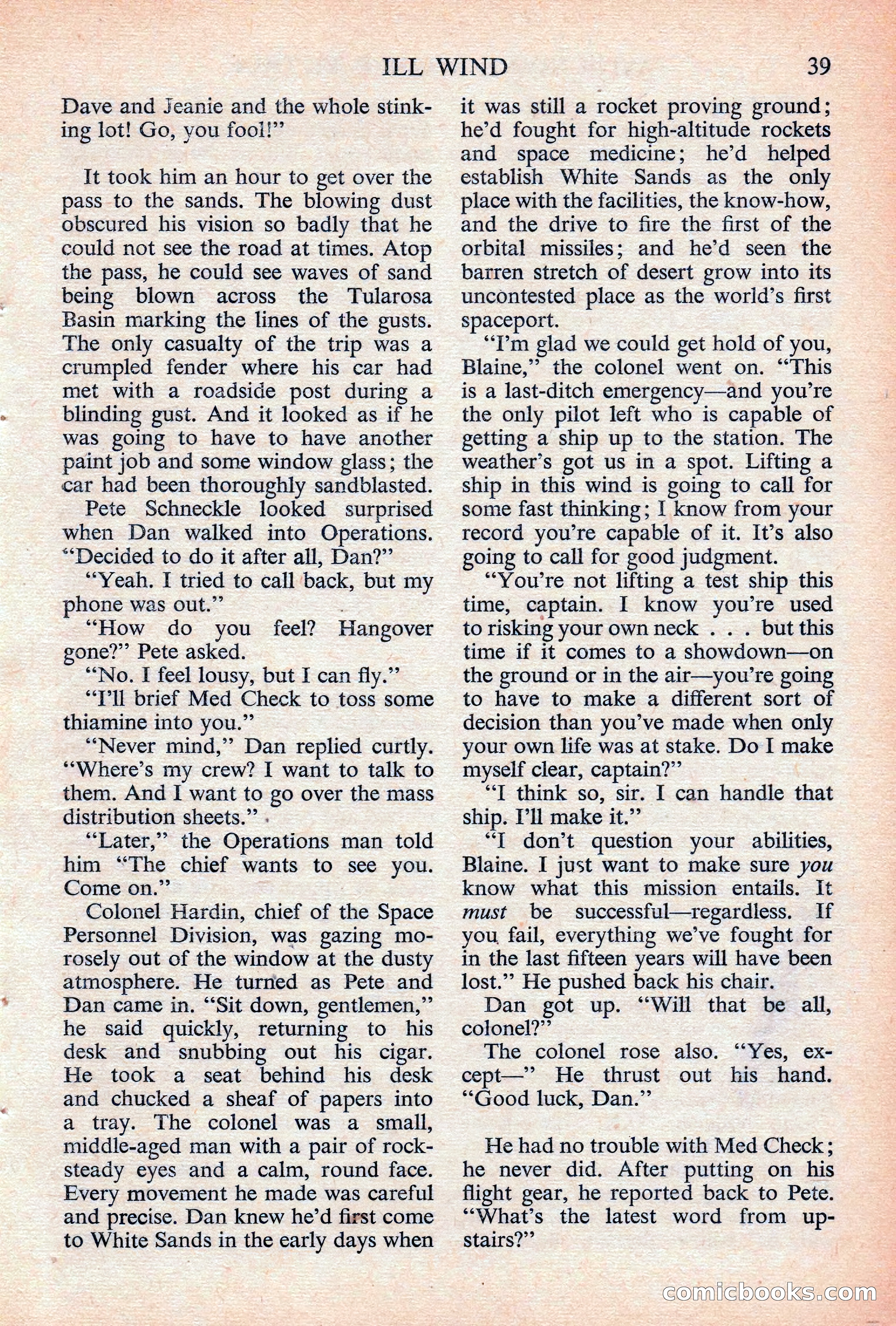
A restored page from Pulp Fiction, 1954. Page through the whole issue in the reader above.
📄 Transcribed text from this page (OCR, searchable)
Machine-transcribed from the original scan — historical spelling and the odd misread are preserved.
ILL WIND 39 Dave and Jeanie and the whole stink- ing lot! Go, you fooi!”’ It took him an hour to get over the pass to the sands. The blowing dust obscured his vision so badly that he could not see the road at times. Atop the pass, he could see waves of sand being blown across the Tularosa Basin marking the lines of the gusts. The only casualty of the trip was a crumpled fender where his car had met with a roadside post during a blinding gust. And it looked as if he was going to have to have another paint job and some window glass; the car had been thoroughly sandblasted. Pete Schneckle looked surprised when Dan walked into Operations. “Decided to do it after all, Dan?” “Yeah. I tried to call back, but my phone was out.” “How do you _ feel? Hangover gone?’ Pete asked. “No. I feel lousy, but I can fly.” “Tl brief Med Check to toss some thiamine into you.” “Never mind,” Dan replied curtly. *“Where’s my crew? I want to talk to them. And I want to go over the mass distribution sheets.” “Later,” the Operations man told him “The chief wants to see you. Come on.” Colonel Hardin, chief of the Space Personnel Division, was gazing mo- rosely out of the window at the dusty atmosphere. He turned as Pete and Dan came in. “Sit down, gentlemen,” he said quickly, returning to his desk and snubbing out his cigar. He took a seat behind his desk and chucked a sheaf of papers into a tray. The colonel was a small, middle-aged man with a pair of rock- steady eyes and a calm, round face. Every movement he made was careful and precise. Dan knew he’d first come to White Sands in the early days when it was still a rocket proving ground; he’d fought for high-altitude rockets and space medicine; he’d helped establish White Sands as the only place with the facilities, the know-how, and the drive to fire the first of the orbital missiles; and he’d seen the barren stretch of desert grow into its uncontested place as the world’s first Spaceport. “I’m glad we could get hold of you, Blaine,’ the colonel went on. “This is a last-ditch emergency—and you're the only pilot left who is capable of getting a ship up to the station. The weather’s got us in a spot. Lifting a ship in this wind is going to call for some fast thinking; 1 know from your record you’re capable of it. It’s also going to call for good judgment. “You're not lifting a test ship this time, captain. I know you're used to risking your own neck . . . but this time if it comes to a showdown—on the ground or in the air—you’re going to have to make a different sort of decision than you’ve made when only your own life was at stake. Do I make myself clear, captain?” “I think so, sir. I can handle that ship. Pll make it.”’ “T don’t question your abilities, Blaine. I just want to make sure you know what this mission entails. It must be successful—regardless. If you fail, everything we’ve fought for in the last fifteen years will have been lost.”” He pushed back his chair. Dan got up. “Will that be all, colonel?” The colonel rose also. “‘Yes, ex- cept—’” He thrust out his hand. “Good luck, Dan.”’ He had no trouble with Med Check; he never did. After putting on his flight gear, he reported back to Pete. “What’s the latest word from up- stairs?” Cconmiclooolks.e@ im