
Pulp Fiction, 1954 · page 24 of 132
Astounding Science Fiction, British Edition — page 24: what you’re looking at
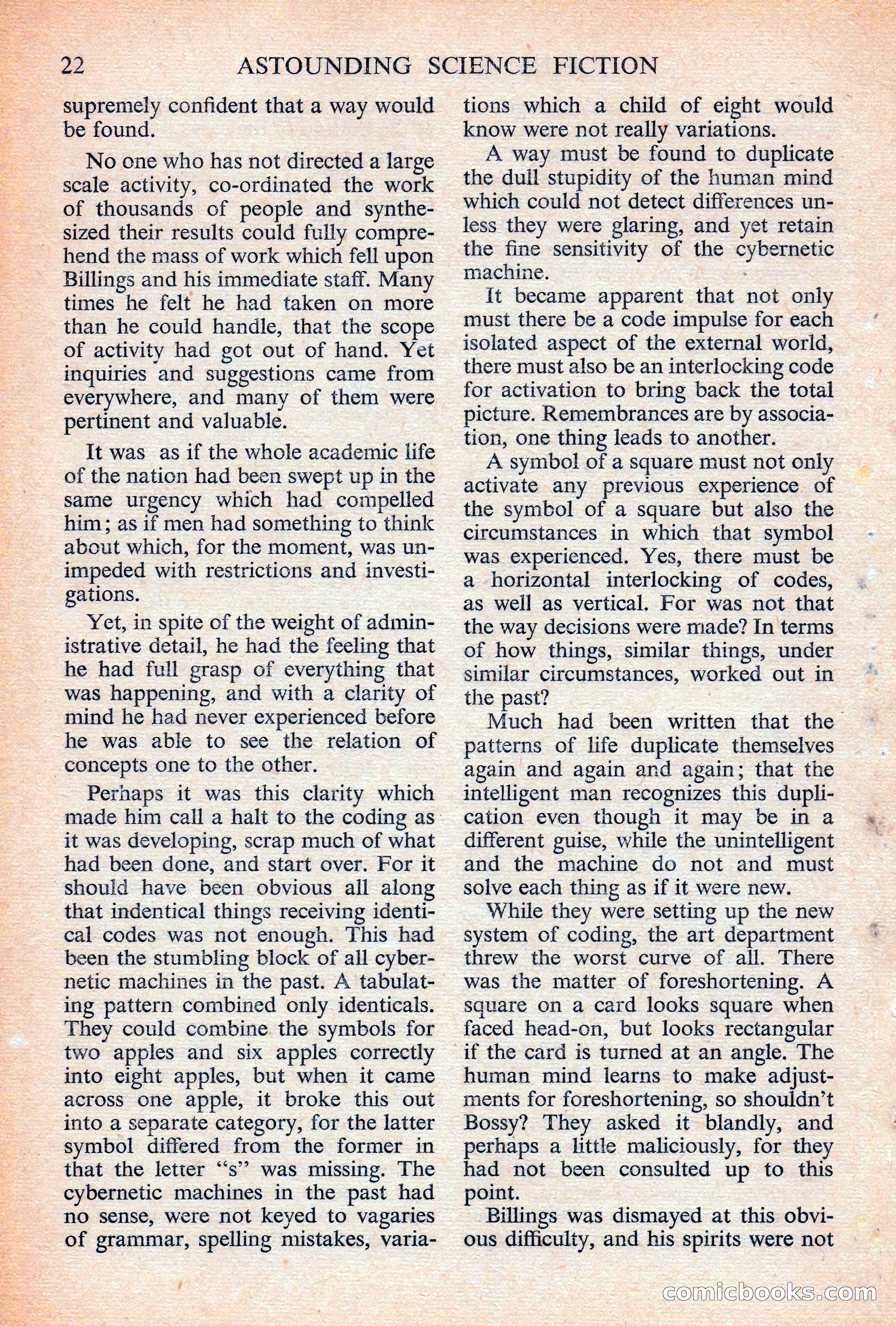
A restored page from Pulp Fiction, 1954. Page through the whole issue in the reader above.
📄 Transcribed text from this page (OCR, searchable)
Machine-transcribed from the original scan — historical spelling and the odd misread are preserved.
22 supremely confident that a way would be found. No one who has not directed a large scale activity, co-ordinated the work of thousands of people and synthe- sized their results could fully compre- hend the mass of work which fell upon Billings and his immediate staff. Many times he felt he had taken on more than he couid handle, that the scope of activity had got out of hand. Yet inquiries and suggestions came from everywhere, and many of them were pertinent and valuable. It was as if the whole academic life of the nation had been swept up in the same urgency which had compelled him; as if men had something to think about which, for the moment, was un- impeded with restrictions and investi- gations. Yet, in spite of the weight of admin- istrative detail, he had the feeling that he had full grasp of everything that was happening, and with a clarity of mind he had never experienced before he was able to see the relation of concepts one to the other. Perhaps it was this clarity which made him call a halt to the coding as: it was developing, scrap much of what had been done, and start over. For it should have been obvious all along that indentical things receiving identi- cal codes was not enough. This had been the stumbling block of all cyber- netic machines in the past. A tabulat- ing pattern combined only identicals. They could combine. the symbols for two apples and six apples correctly into eight apples, but when it came across one apple, it broke this out into a separate category, for the latter symbol differed from the former in that the letter “‘s’’ was missing. The cybernetic machines in the past had no sense, were not keyed to vagaries of grammar, spelling mistakes, varia- ASTOUNDING SCIENCE FICTION tions which a child of eight would know were not really variations. A way must be found to duplicate the dull stupidity of the human mind which could not detect differences un- less they were glaring, and yet retain the fine sensitivity of the efbemene machine. It became apparent that not only must there be a code impulse for each isolated aspect of the external world, there must also be an interlocking code for activation to bring back the total picture. Remembrances are by associa- tion, one thing leads to another. A symbol of a square must not only activate any previous experience of the symbol of a square but also the circumstances in which that symbol was experienced. Yes, there must be a horizontal interlocking of codes, as well as vertical. For was not that the way decisions were made? In terms of how things, similar things, under similar circumstances, worked out in the past? Much had been written that the patterns of life duplicate themselves again and again and again; that the intelligent man recognizes this dupli- cation even thougn it may be in a different guise, while the unintelligent and the machine do not and must solve each thing as if it were new. While they were setting up the new system of coding, the art department threw the worst curve of all. There was the matter of foreshortening. A square on a card looks square when faced head-on, but looks rectangular if the card is turned at an angle. The human mind learns to make adjust- ments for foreshortening, so shouldn’t Bossy? They asked it blandly, and perhaps a little maliciously, for they had not been consulted up to this point. Billings was dismayed at this obvi- ous difficulty, and his spirits were not Cconmiclooolkks.c© im