
Pulp Fiction, 1954 · page 21 of 132
Astounding Science Fiction, British Edition — page 21: what you’re looking at
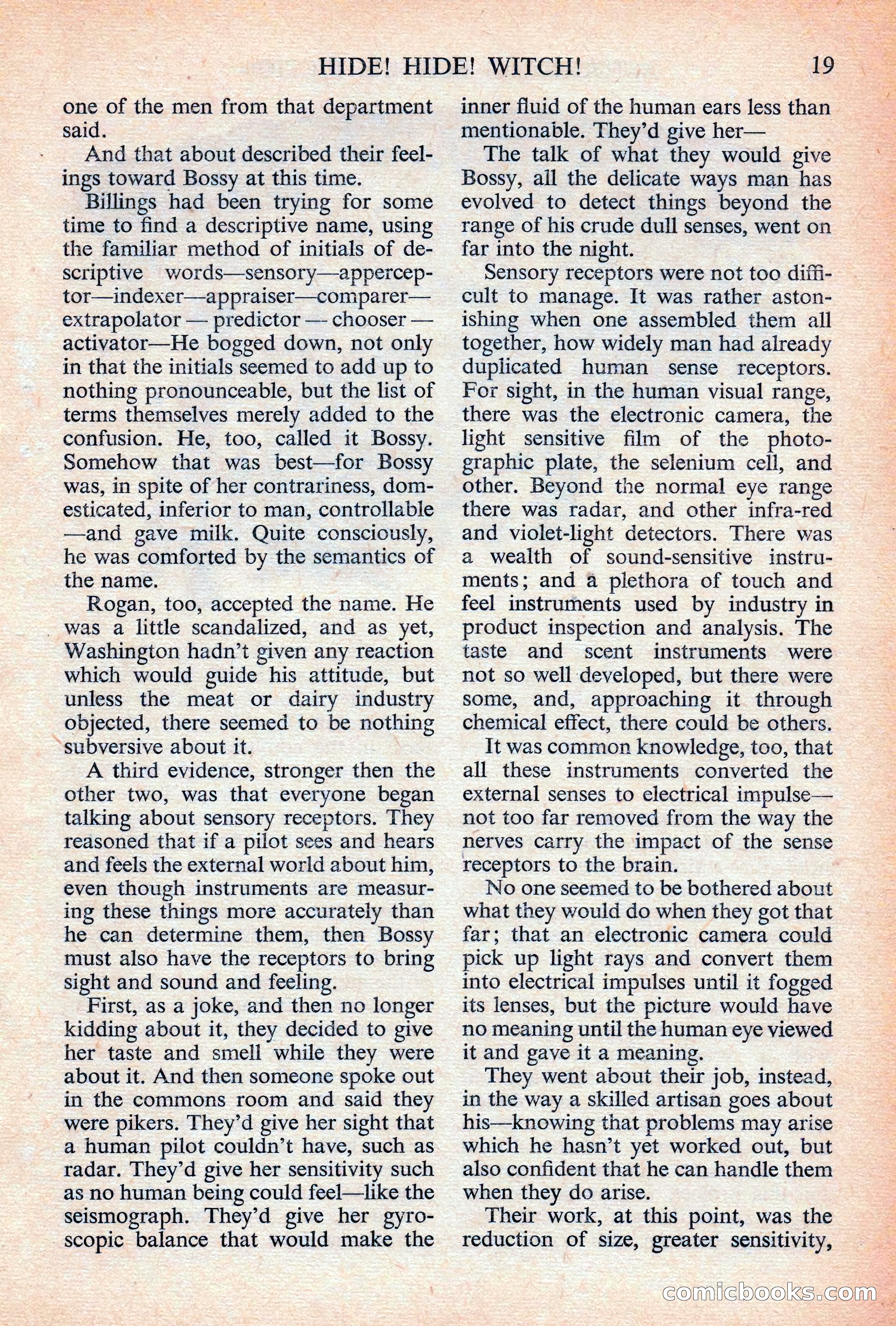
A restored page from Pulp Fiction, 1954. Page through the whole issue in the reader above.
📄 Transcribed text from this page (OCR, searchable)
Machine-transcribed from the original scan — historical spelling and the odd misread are preserved.
HIDE! HIDE! WITCH! 19 one of the men from that department said. And that about described their feel- ings toward Bossy at this time. Billings had been trying for some time to find a descriptive name, using the familiar method of initials of de- scriptive words—sensory—appercep- tor—indexer—appraiser—comparer— extrapolator — predictor — chooser — activator—He bogged down, not only in that the initials seemed to add up to nothing pronounceable, but the list of terms themselves merely added to the confusion. He, too, called it Bossy. Somehow that was best—for Bossy was, in spite of her contrariness, dom- esticated, inferior to man, controllable —and gave milk. Quite consciously, he was comforted by the semantics of the name. Rogan, too, accepted the name. He _ was a little scandalized, and as yet, Washington hadn’t given any reaction which would guide his attitude, but unless the meat or dairy industry objected, there seemed to be nothing ‘subversive about it. A third evidence, stronger then the other two, was that everyone began talking about sensory receptors. They reasoned that if a pilot sees and hears and feels the external world about him, even though instruments are measur- ing these things more accurately than he can determine them, then Bossy must also have the receptors to bring sight and sound and feeling. First, as a joke, and then no longer kidding about it, they decided to give her taste and smell while they were about it. And then someone spoke out in the commons room and said they were pikers. They’d give her sight that a human pilot couldn’t have, such as radar. They’d give her sensitivity such as no human being could feel—like the seismograph. They’d give her gyro- scopic balance that would make the inner fluid of the human ears less than mentionable. They’d give her— The talk of what they would give Bossy, all the delicate ways man has evolved to detect things beyond the range of his crude dull senses, went on far into the night. Sensory receptors were not too diffi- cult to manage. It was rather aston- ishing when one assembled them all together, how widely man had already duplicated human sense receptors. For sight, in the human visual range, there was the electronic camera, the light sensitive film of the photo- graphic plate, the selenium cell, and other. Beyond the normal eye range there was radar, and other infra-red and violet-light detectors. There was a wealth of sound-sensitive instru- ments; and a plethora of touch and feel instruments used by industry in product inspection and analysis. The taste and scent instruments were not so well developed, but there were some, and, approaching it through chemical effect, there could be others. It was common knowledge, too, that all these instruments converted the external senses to electrical impulse— not too far removed from the way the nerves carry the impact of the sense receptors to the brain. No one seemed to be bothered about what they would do when they got that far; that an electronic camera could pick up light rays and convert them into electrical impulses until it fogged its lenses, but the picture would have no meaning until the human eye viewed it and gave it a meaning. They went about their job, instead, in the way a skilled artisan goes about his—knowing that problems may arise which he hasn’t yet worked out, but also confident that he can handle them when they do arise. Their work, at this point, was the reduction of size, greater sensitivity, Cconmicloookks.e©