
Pulp Fiction, 1954 · page 68 of 132
Astounding Science Fiction, British Edition — page 68: what you’re looking at
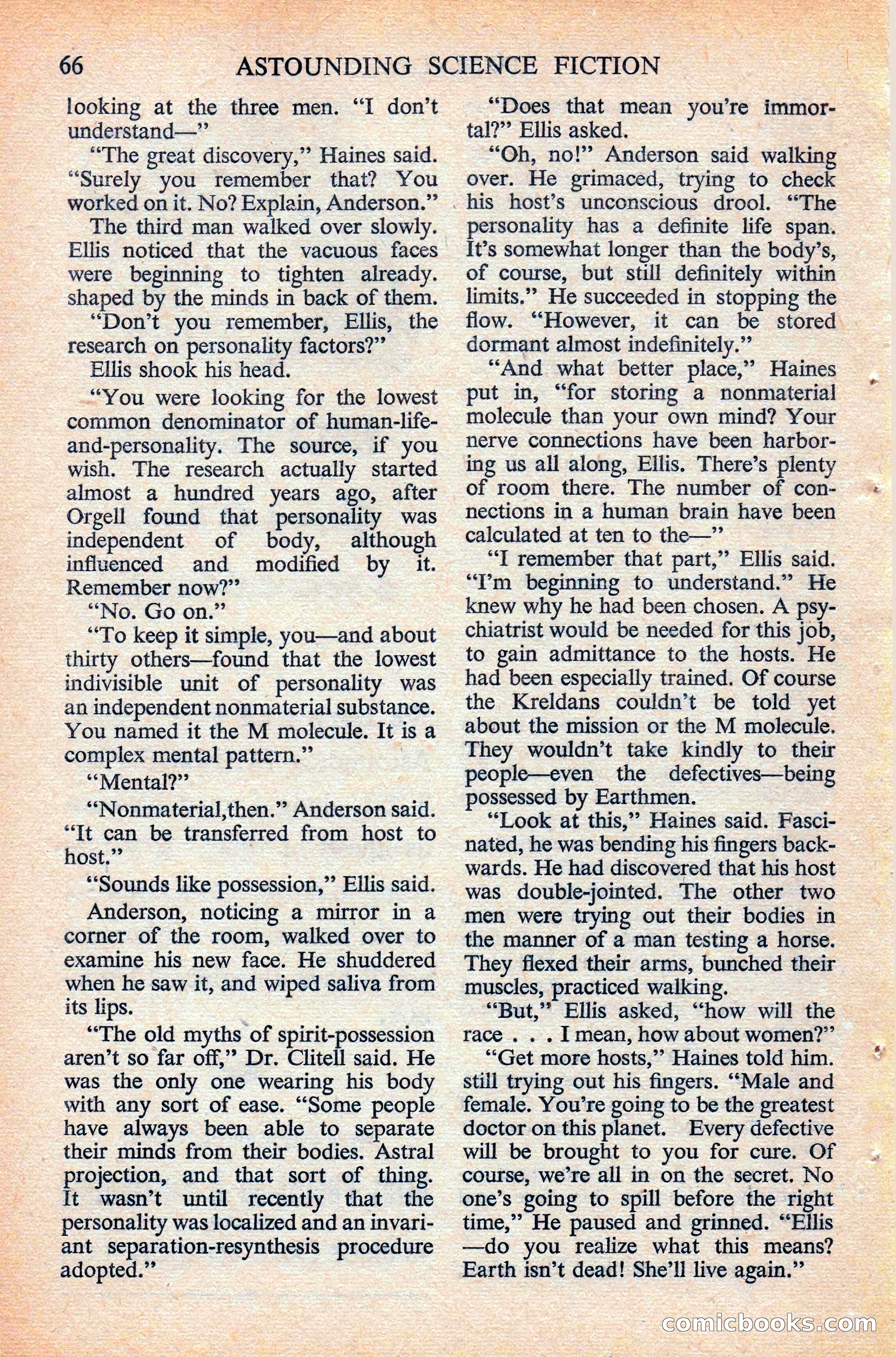
A restored page from Pulp Fiction, 1954. Page through the whole issue in the reader above.
📄 Transcribed text from this page (OCR, searchable)
Machine-transcribed from the original scan — historical spelling and the odd misread are preserved.
66 ASTOUNDING SCIENCE FICTION looking at the three men. “I don’t understand—” “The great discovery,” Haines said. “Surely you remember that? You worked on it. No? Explain, Anderson.” The third man walked over slowly. Ellis noticed that the vacuous faces were beginning to tighten already. shaped by the minds in back of them. “Don’t you remember, Ellis, the research on personality factors?”’ Ellis shook his head. “You were looking for the lowest common denominator of human-life- and-personality. The source, if you wish. The research actually started almost a hundred years ago, after Orgell found that personality was independent of body, although influenced and modified by it. Remember now?” “No. Go on.” “To keep it simple, you—and about thirty others—found that the lowest indivisible unit of personality was an independent nonmaterial substance. You named it the M molecule. It is a complex mental pattern.” | “Mental?” ““Nonmaterial,then.’’ Anderson said. “It can be transferred from host to ~ host.” “Sounds like possession,”’ Ellis said. Anderson, noticing a mirror in a corner of the room, walked over to examine his new face. He shuddered when he saw it, and wiped saliva from its lips. “The old myths of spirit-possession aren’t so far off,’? Dr. Clitell said. He was the only one wearing his body with any sort of ease. “Some people have always been able to separate their minds from their bodies. Astral projection, and that sort of thing. It wasn’t until recently that the personality was localized and an invari- ant separation-resynthesis procedure adopted.” “Does that mean you’re immor- tal?” Ellis asked. “Oh, no!” Anderson said walking over. He grimaced, trying to check his host’s unconscious drool. ‘“*The personality has a definite life span. It’s somewhat longer than the body’s, of course, but still definitely within limits.” He succeeded in stopping the flow. “‘However, it can be stored dormant almost indefinitely.” “And what better place,’ Haines put in, “for storing a nonmaterial molecule than your own mind? Your nerve connections have been harbor- ing us all along, Ellis. There’s plenty of room there. The number of con- nections in a human brain have been calculated at ten to the—”’ “‘T remember that part,” Ellis said. “l’m beginning to understand.” He knew why he had been chosen. A psy- chiatrist would be needed for this job, to gain admittance to the hosts. He had been especially trained. Of course the Kreldans couldn’t be told yet about the mission or the M molecule. They wouldn’t take kindly to their people—even the defectives—being possessed by Earthmen. “Look at this,” Haines said. Fasci- nated, he was bending his fingers back- wards. He had discovered that his host was double-jointed. The other two men were trying out their bodies in the manner of a man testing a horse. They flexed their arms, bunched their muscles, practiced walking. “But,” Ellis asked, “how will the race... 1mean, how about women?”’ ““Get more hosts,’’ Haines told him. still trying out his fingers. ““Male and female. You’re going to be the greatest doctor on this planet. Every defective will be brought to you for cure. Of course, we’re all in on the secret. No one’s going to spill before the right time,’ He paused and grinned. “Ellis —do you realize what this means? Earth isn’t dead! She’ll live again.” Comichookssco mM