
Pulp Fiction, 1954 · page 66 of 132
Astounding Science Fiction, British Edition — page 66: what you’re looking at
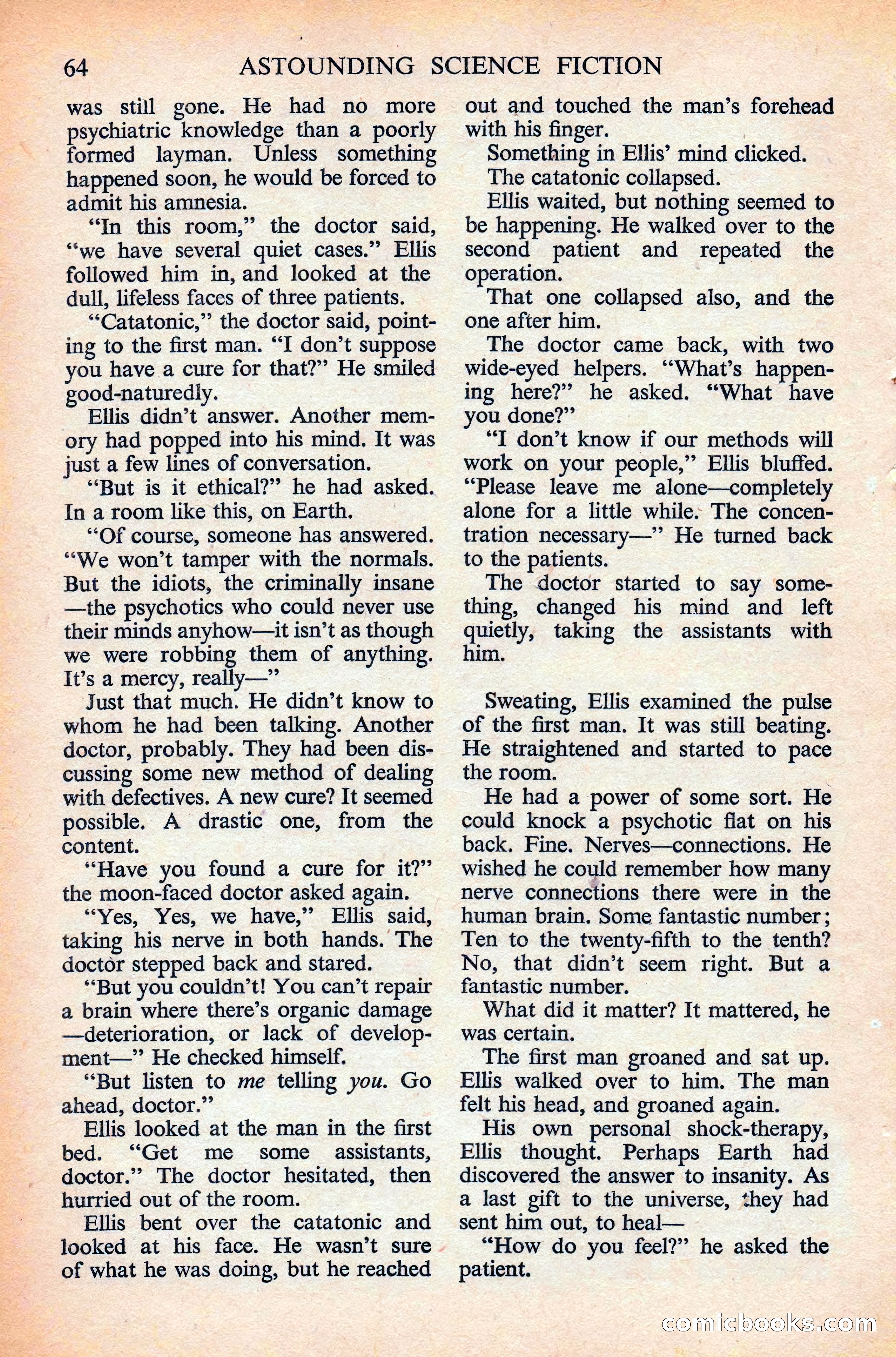
A restored page from Pulp Fiction, 1954. Page through the whole issue in the reader above.
📄 Transcribed text from this page (OCR, searchable)
Machine-transcribed from the original scan — historical spelling and the odd misread are preserved.
64 ASTOUNDING SCIENCE FICTION was still gone. He had no more psychiatric knowledge than a poorly formed layman. Unless something happened soon, he would be forced to admit his amnesia. “In this room,” the doctor said, ‘“‘we have several quiet cases.” Ellis followed him in, and looked at the dull, lifeless faces of three patients. ‘“‘Catatonic,” the doctor said, point- ing to the first man. “I don’t suppose you have a cure for that?’ He smiled good-naturedly. Ellis didn’t answer. Another mem- ory had popped into his mind. It was just a few lines of conversation. “But is it ethical?” he had asked. In a room like this, on Earth. ““Of course, someone has answered. “We won’t tamper with the normals. But the idiots, the criminally insane —the psychotics who could never use their minds anyhow—t isn’t as though we were robbing them of anything. It’s a mercy, really—”’ Just that much. He didn’t know to whom he had been talking. Another doctor, probably. They had been dis- cussing some new method of dealing with defectives. A new cure? It seemed possible. A drastic one, from the content. “Have you found a cure for it?” the moon-faced doctor asked again. “Yes, Yes, we have,” Ellis said, taking his nerve in both hands. The doctor stepped back and stared. “But you couldn’t! You can’t repair a brain where there’s organic damage —deterioration, or lack of develop- ment—” He checked himself. ‘But listen to me telling you. Go ahead, doctor.”’ Ellis looked at the man in the first bed. ‘Get me some assistants, doctor.”’ The doctor hesitated, then hurried out of the room. Ellis bent over the catatonic and looked at his face. He wasn’t sure of what he was doing, but he reached out and touched the man’s forehead with his finger. , Something in Ellis’ mind clicked. The catatonic collapsed. Ellis waited, but nothing seemed to be happening. He walked over to the second patient and repeated the operation. That one collapsed also, and the one after him. The doctor came back, with two wide-eyed helpers. “What’s happen- ing here?” he asked. “What have you done?” “T don’t know if our methods will work on your people,” Ellis bluffed. ‘Please leave me alone—completely alone for a little while. The concen- tration necessary—” He turned back to the patients. The doctor started to say some- thing, changed his mind and left quietly, taking the assistants with him. Sweating, Ellis examined the pulse of the first man. It was still beating. He straightened and started to pace the room. | He had a power of some sort. He could knock a psychotic flat on his back. Fine. Nerves—connections. He wished he could remember how many nerve connections there were in the human brain. Some fantastic number ; Ten to the twenty-fifth to the tenth? No, that didn’t seem right. But a fantastic number. What did it matter? It mattered, he was certain. The first man groaned and sat up. Ellis walked over to him. The man felt his head, and groaned again. His own personal shock-therapy, Ellis thought. Perhaps Earth had discovered the answer to insanity. As a last gift to the universe, they had sent him out, to heal— ‘““How do you feel?’ he asked the patient. connicloooks.c@ iim