
Pulp Fiction, 1954 · page 60 of 132
Astounding Science Fiction, British Edition — page 60: what you’re looking at
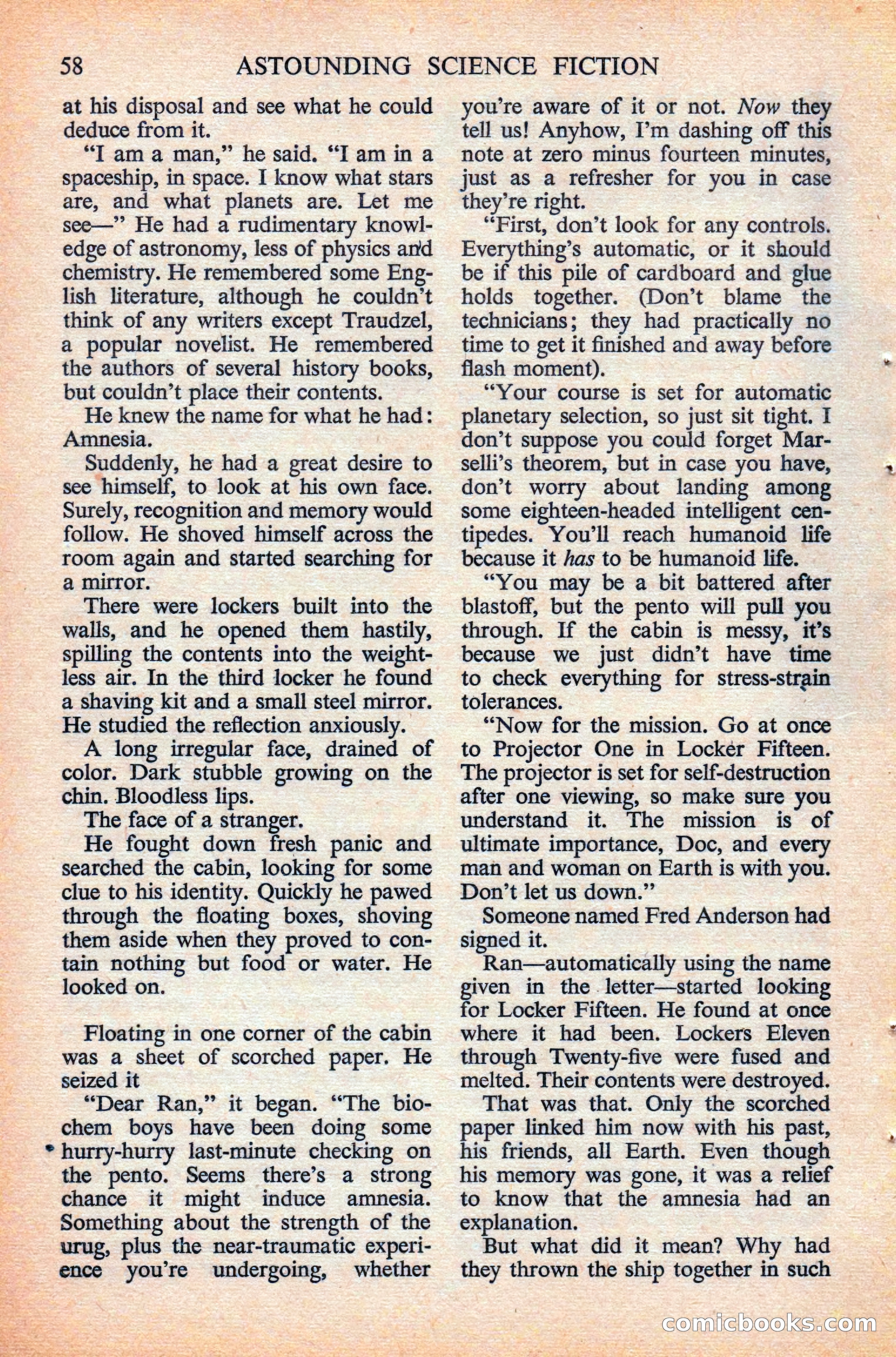
A restored page from Pulp Fiction, 1954. Page through the whole issue in the reader above.
📄 Transcribed text from this page (OCR, searchable)
Machine-transcribed from the original scan — historical spelling and the odd misread are preserved.
58 ASTOUNDING SCIENCE FICTION at his disposal and see what he could deduce from it. “IT am a man,” he said. “I am in a spaceship, in space. I know what stars are, and what planets are. Let me see—” He had a rudimentary knowl- edge of astronomy, less of physics and chemistry. He remembered some Eng- lish literature, although he couldn't think of any writers except Traudzel, a popular novelist. He remembered the authors of several history books, but couldn’t place their contents. He knew the name for what he had: Amnesia. Suddenly, he had a great desire to see himself, to look at his own face. Surely, recognition and memory would follow. He shoved himself across the room again and started searching for a mirror. There were lockers built into the walls, and he opened them hastily, spilling the contents into the weight- less air. In the third locker he found a shaving kit and a small steel mirror. He studied the reflection anxiously. A long irregular face, drained of color. Dark stubble growing on the chin. Bloodless lips. The face of a stranger. He fought down fresh panic and searched the cabin, looking for some clue to his identity. Quickly he pawed through the floating boxes, shoving them aside when they proved to con- tain nothing but food or water. He looked on. Floating in one corner of the cabin was a sheet of scorched paper. He seized it “Dear Ran,” it began. “The bio- chem boys have been doing some * hurry-hurry last-minute checking on the pento. Seems there’s a strong chance it might induce amnesia. Something about the strength of the urug, plus the near-traumatic experi- ence you're undergoing, whether you're aware of it or not. Now they tell us! Anyhow, I’m dashing off this note at zero minus fourteen minutes, just as a refresher for you in case they’re right. “First, don’t look for any controls. Everything’s automatic, or it should be if this pile of cardboard and glue holds together. (Don’t blame the technicians; they had practically no time to get it finished and away before flash moment). “Your course is set for automatic planetary selection, so just sit tight. I don’t suppose you could forget Mar- selli’s theorem, but in case you have, don’t worry about landing among some eighteen-headed intelligent cen- tipedes. You'll reach humanoid life because it has to be humanoid life. “You may be a bit battered after blastoff, but the pento will pull you through. If the cabin is messy, it’s because we just didn’t have time to check everything for stress-strain tolerances. “Now for the mission. Go at once to Projector One in Locker Fifteen. The projector is set for self-destruction after one viewing, so make sure you understand it. The mission is of ultimate importance, Doc, and every man and woman on Earth is with you. Don’t let us down.” Someone named Fred Anderson had signed it. Ran—automatically using the name given in the. letter—started looking for Locker Fifteen. He found at once where it had been. Lockers Eleven through Twenty-five were fused and melted. Their contents were destroyed. That was that. Only the scorched paper linked him now with his past, his friends, all Earth. Even though his memory was gone, it was a relief to know that the amnesia had an explanation. But what did it mean? Why had they thrown the ship together in such EComichooksco im