
Pulp Fiction, 1954 · page 56 of 132
Astounding Science Fiction, British Edition — page 56: what you’re looking at
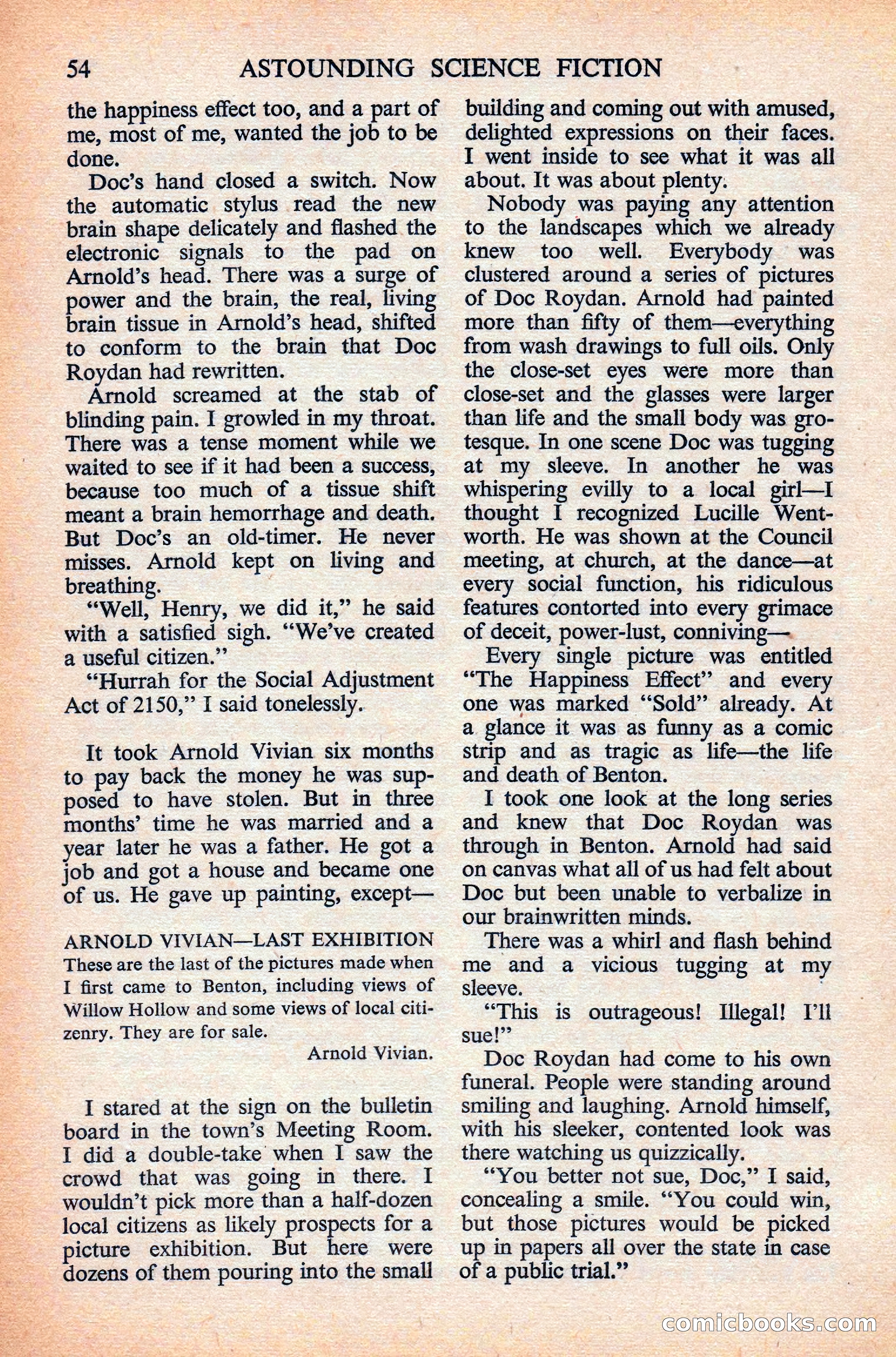
A restored page from Pulp Fiction, 1954. Page through the whole issue in the reader above.
📄 Transcribed text from this page (OCR, searchable)
Machine-transcribed from the original scan — historical spelling and the odd misread are preserved.
34 ASTOUNDING SCIENCE FICTION the happiness effect too, and a part of me, most of me, wanted the job to be done. Doc’s hand closed a switch. Now the automatic stylus read the new brain shape delicately and flashed the electronic signals to the pad on Arnold’s head. There was a surge of power and the brain, the real, living brain tissue in Arnold’s head, shifted to conform to the brain that Doc Roydan had rewritten. Arnold screamed at the stab of blinding pain. I growled in my throat. There was a tense moment while we waited to see if it had been a success, because too much of a tissue shift meant a brain hemorrhage and death. But Doc’s an old-timer. He never misses. Arnold kept on living and breathing. “Well, Henry, we did it,” he said with a satisfied sigh. ““We’ve created a useful citizen.” “Hurrah for the Social Adjustment Act of 2150,” I said tonelessly. It took Arnold Vivian six months to pay back the money he was sup- posed to have stolen. But in three months’ time he was married and a year later he was a father. He got a job and got a house and became one of us. He gave up painting, except— ARNOLD VIVIAN—LAST EXHIBITION These are the last of the pictures made when I first came to Benton, including views of Willow Hollow and some views of local citi- zenry. They are for sale. Arnold Vivian, I stared at the sign on the bulletin board in the town’s Meeting Room. I did a double-take when I saw the crowd that was going in there. I wouldn’t pick more than a half-dozen local citizens as likely prospects for a picture exhibition. But here were dozens of them pouring into the small building and coming out with amused, delighted expressions on their faces. I went inside to see what it was all about. It was about plenty. Nobody was paying any attention to the landscapes which we already knew too well. Everybody was clustered around a series of pictures of Doc Roydan. Arnold had painted more than fifty of them—everything from wash drawings to full oils. Only the close-set eyes were more than close-set and the glasses were larger than life and the small body was gro- tesque. In one scene Doc was tugging at my sleeve. In another he was whispering evilly to a local girl—I thought I recognized Lucille Went- worth. He was shown at the Council meeting, at church, at the dance—at every social function, his ridiculous features contorted into every grimace of deceit, power-lust, conniving—. Every single picture was entitled “The Happiness Effect’ and every one was marked “Sold” already. At a glance it was as funny as a comic strip and as tragic as life—the life and death of Benton. I took one look at the long series and knew that Doc Roydan was through in Benton. Arnold had said on canvas what all of us had felt about Doc but been unable to verbalize in our brainwritten minds. There was a whirl and flash behind me and a vicious tugging at my sleeve. “This is outrageous! Illegal! I'll sue!” Doc Roydan had come to his own funeral. People were standing around smiling and laughing. Arnold himself, with his sleeker, contented look was there watching us quizzically. ““You better not sue, Doc,” I said, concealing a smile. “You could win, but those pictures would be picked up in papers all over the state in case of a public trial.” Conmiclooolks.e@ im