
Pulp Fiction, 1954 · page 54 of 132
Astounding Science Fiction, British Edition — page 54: what you’re looking at
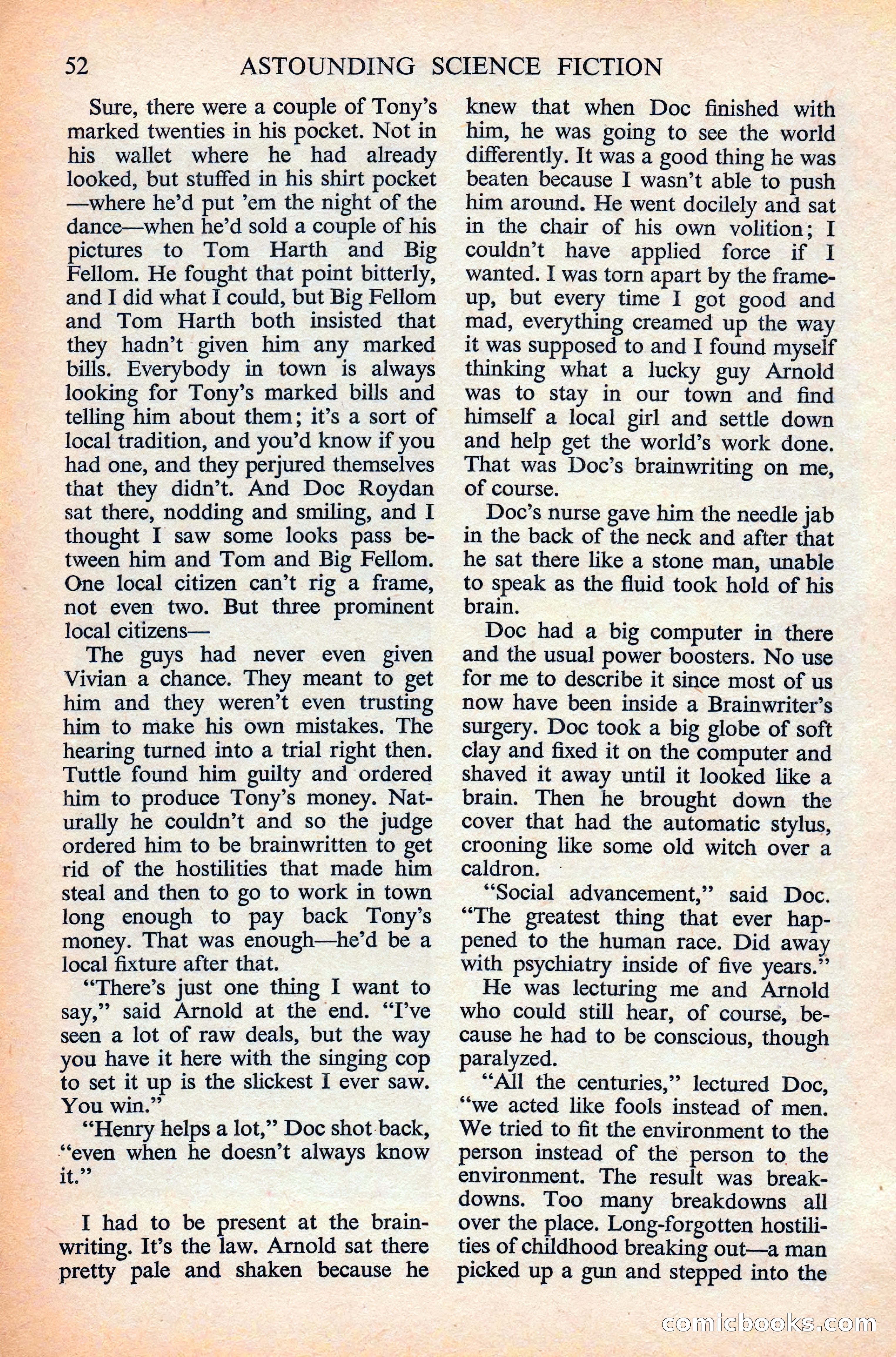
A restored page from Pulp Fiction, 1954. Page through the whole issue in the reader above.
📄 Transcribed text from this page (OCR, searchable)
Machine-transcribed from the original scan — historical spelling and the odd misread are preserved.
52 ASTOUNDING SCIENCE FICTION Sure, there were a couple of Tony’s marked twenties in his pocket. Not in his wallet where he had already looked, but stuffed in his shirt pocket —where he’d put ’em the night of the dance—when he’d sold a couple of his pictures to Tom Harth and Big Fellom. He fought that point bitterly, and I did what I could, but Big Fellom and Tom Harth both insisted that they hadn’t given him any marked bills. Everybody in town is always looking for Tony’s marked bills and telling him about them; it’s a sort of local tradition, and you’d know if you had one, and they perjured themselves that they didn’t. And Doc Roydan sat there, nodding and smiling, and I thought I saw some looks pass be- tween him and Tom and Big Fellom. One local citizen can’t rig a frame, not even two. But three prominent local citizens— The guys had never even given Vivian a chance. They meant to get him and they weren’t even trusting him to make his own mistakes. The hearing turned into a trial right then. Tuttle found him guilty and ordered him to produce Tony’s money. Nat- urally he couldn’t and so the judge ordered him to be brainwritten to get rid of the hostilities that made him steal and then to go to work in town long enough to pay back Tony’s money. That was enough—he’d be a local fixture after that. “There’s just one thing I want to say,” said Arnold at the end. “I’ve seen a lot of raw deals, but the way you have it here with the singing cop to set it up is the slickest I ever saw. You win.” “Henry helps a lot,” Doc shot back, “even when he doesn’t always know it.” I had to be present at the brain- writing. It’s the law. Arnold sat there pretty pale and shaken because he knew that when Doc finished with him, he was going to see the world differently. It was a good thing he was beaten because I wasn’t able to push him around. He went docilely and sat in the chair of his own volition; I couldn’t have applied force if I wanted. I was torn apart by the frame- up, but every time I got good and mad, everything creamed up the way it was supposed to and I found myself thinking what a lucky guy Arnold was to stay in our town and find himself a local girl and settle down and help get the world’s work done. That was Doc’s brainwriting on me, of course. Doc’s nurse gave him the needle jab in the back of the neck and after that he sat there like a stone man, unable to speak as the fluid took hold of his brain. | Doc had a big computer in there and the usual power boosters. No use for me to describe it since most of us now have been inside a Brainwriter’s surgery. Doc took a big globe of soft clay and fixed it on the computer and Shaved it away until it looked like a brain. Then he brought down the cover that had the automatic stylus, crooning like some old witch over a caldron. “Social advancement,’ said Doc. “The greatest thing that ever hap- pened to the human race. Did away with psychiatry inside of five years.” He was lecturing me and Arnold who could still hear, of course, be- cause he had to be conscious, though paralyzed. : “All the centuries,”’ lectured Doc, “we acted like fools instead of men. We tried to fit the environment to the person instead of the person to the environment. The result was break- downs. Too many breakdowns all over the place. Long-forgotten hostili- ties of childhood breaking out—a man picked up a gun and stepped into the Conmielooolkks.c© im