
Pulp Fiction, 1954 · page 51 of 132
Astounding Science Fiction, British Edition — page 51: what you’re looking at
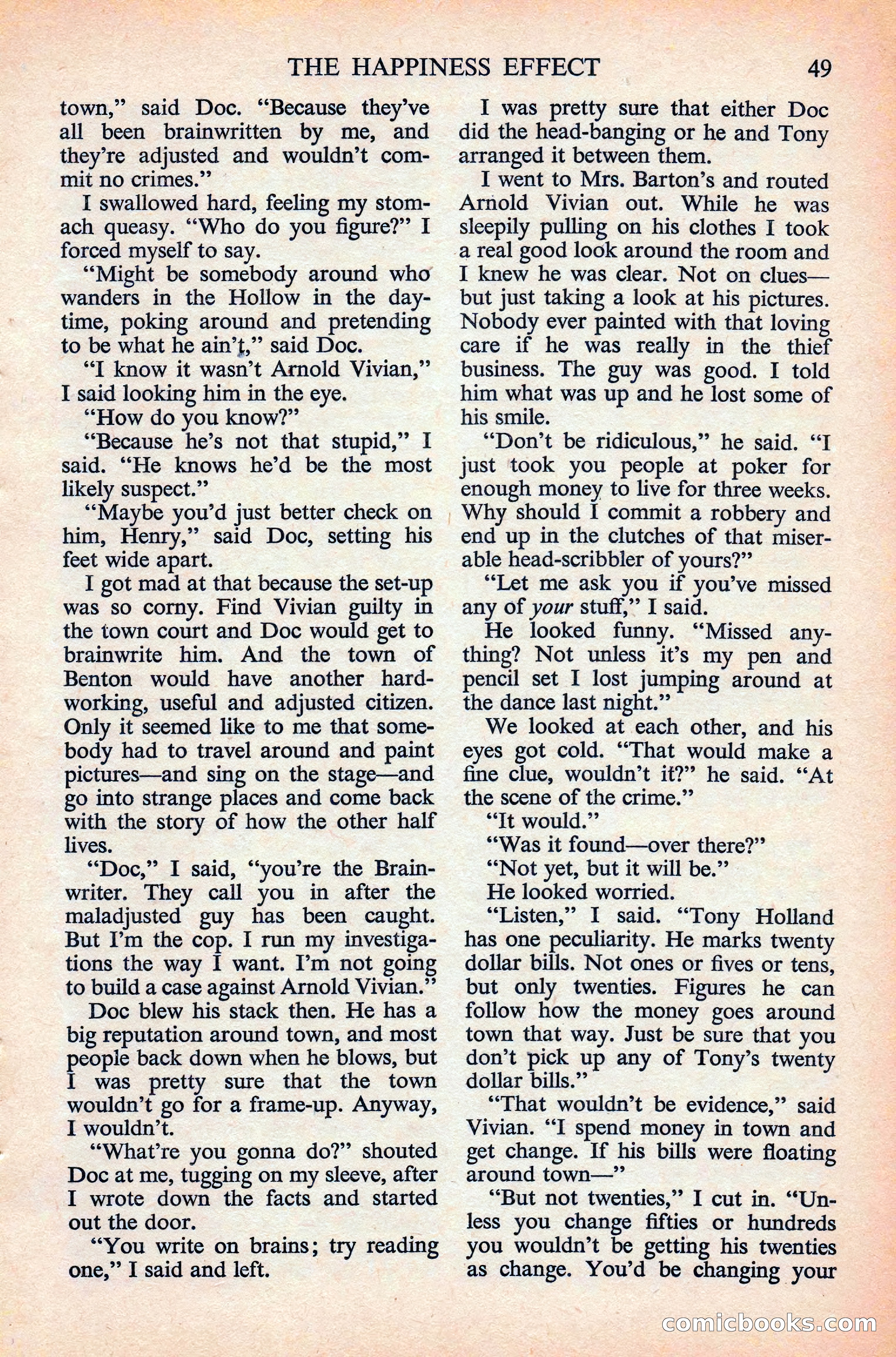
A restored page from Pulp Fiction, 1954. Page through the whole issue in the reader above.
📄 Transcribed text from this page (OCR, searchable)
Machine-transcribed from the original scan — historical spelling and the odd misread are preserved.
THE HAPPINESS EFFECT town,” said Doc. “Because they’ve all been brainwritten by me, and they’re adjusted and wouldn’t com- mit no crimes.” I swallowed hard, feeling my stom- ach queasy. “Who do you figure?’ I forced myself to say. “Might be somebody around who wanders in the Hollow in the day- time, poking around and pretending to be what he ain’t,”’ said Doc. “IT know it wasn’t Arnold Vivian,” I said looking him in the eye. ““How do you know?” “Because he’s not that stupid,” I said. “He knows he’d be the most likely suspect.” “Maybe you’d just better check on him, Henry,” said Doc, setting his feet wide apart. I got mad at that because the set-up was so corny. Find Vivian guilty in the town court and Doc would get to brainwrite him. And the town of Benton would have another hard- working, useful and adjusted citizen. Only it seemed like to me that some- body had to travel around and paint pictures—and sing on the stage—and go into strange places and come back with the story of how the other half lives. “Doc,” I said, “‘you’re the Brain- writer. They call you in after the maladjusted guy has been caught. But I’m the cop. I run my investiga- tions the way I want. I’m not going to build a case against Arnold Vivian.” Doc blew his stack then. He has a big reputation around town, and most peopie back down when he blows, but I was pretty sure that the town wouldn’t go for a frame-up. Anyway, I wouldn’t. “What're you gonna do?’’ shouted Doc at me, tugging on my sleeve, after I wrote down the facts and started out the door. “You write on brains; try reading one,”’ I said and left. 49 I was pretty sure that either Doc did the head-banging or he and Tony arranged it between them. I went to Mrs. Barton’s and routed Arnold Vivian out. While he was sleepily pulling on his clothes I took a real good look around the room and I knew he was clear. Not on clues— but just taking a look at his pictures. Nobody ever painted with that loving care if he was really in the thief business. The guy was good. I told him what was up and he lost some of his smile. “Don’t be ridiculous,” he said. “I just took you people at poker for enough money to live for three weeks. _ Why should I commit a robbery and end up in the clutches of that miser- able head-scribbler of yours?” “Let me ask you if you’ve missed any of your stuff,” I said. He looked funny. “Missed any- thing? Not unless it’s my pen and pencil set I lost jumping around at the dance last night.” We looked at each other, and his eyes got cold. “That would make a fine clue, wouldn’t it?” he said. “At the scene of the crime.” “It would.” “Was it found—over there?’’ “Not yet, but it will be.” He looked worried. “Listen,” I said. “Tony Holland has one peculiarity. He marks twenty dollar bills. Not ones or fives or tens, but only twenties. Figures he can follow how the money goes around town that way. Just be sure that you don’t pick up any of Tony’s twen dollar bills.” : : = “That wouldn’t be evidence,” said Vivian. “I spend money in town and get change. If his bills were floating around town—”’ “But not twenties,” I cut in. “Un- less you change fifties or hundreds you wouldn’t be getting his twenties as change. You’d be changing your Comichooksico im