
Pulp Fiction, 1954 · page 49 of 132
Astounding Science Fiction, British Edition — page 49: what you’re looking at
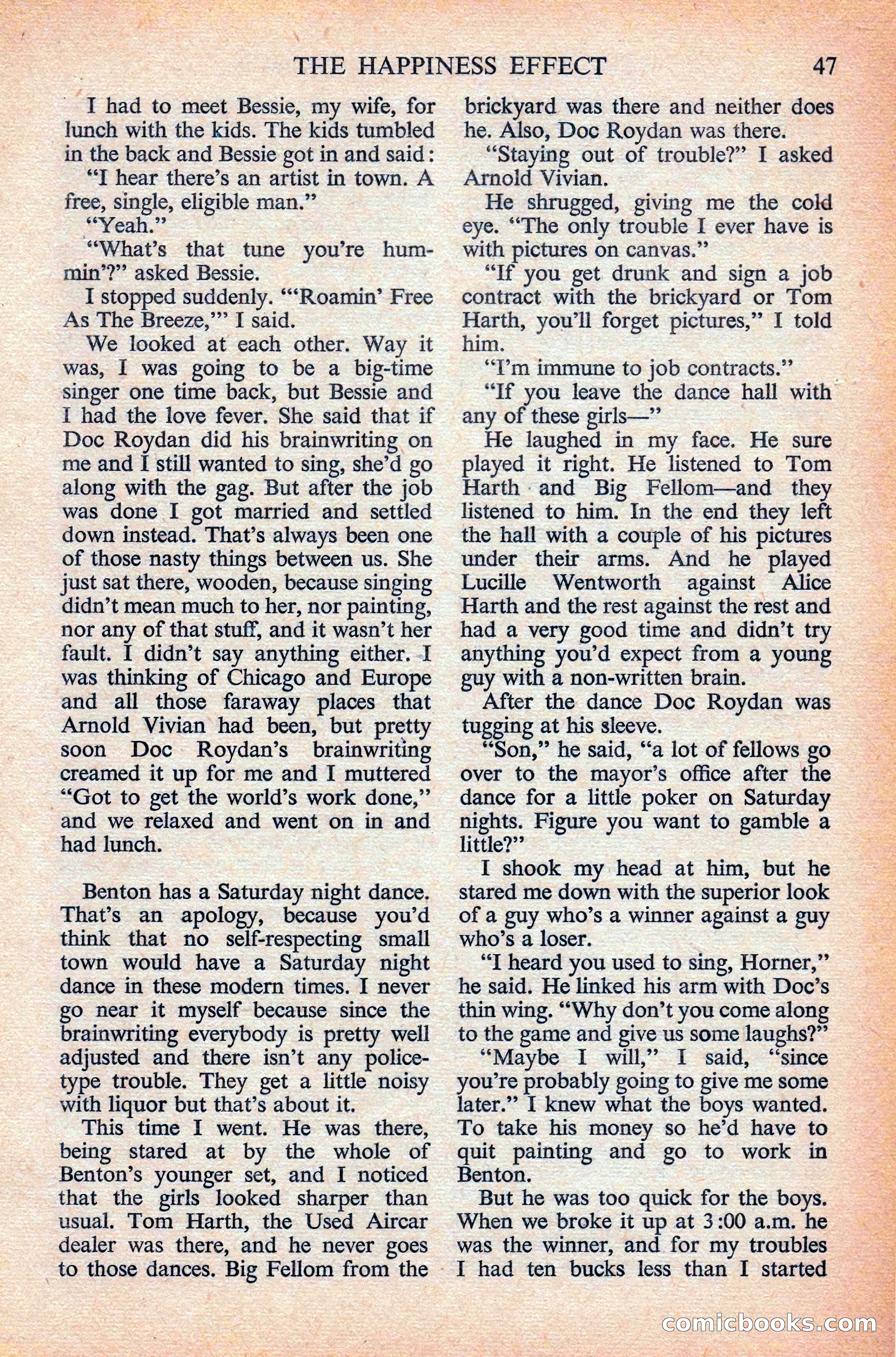
A restored page from Pulp Fiction, 1954. Page through the whole issue in the reader above.
📄 Transcribed text from this page (OCR, searchable)
Machine-transcribed from the original scan — historical spelling and the odd misread are preserved.
THE HAPPINESS EFFECT I had to meet Bessie, my wife, for lunch with the kids. The kids tumbled in the back and Bessie got in and said: “I hear there’s an artist in town. A free, single, eligible man.” *Yeah.” “What’s that tune you’re hum- min’? asked Bessie. I stopped suddenly. ““Roamin’ Free As The Breeze,’”’ I said. We looked at each other. Way it was, I was going to be a big-time singer one time back, but Bessie and I had the love fever. She said that if Doc Roydan did his brainwriting on me and I still wanted to sing, she’d go along with the gag. But after the job was done I got married and settled down instead. That’s always been one of those nasty things between us. She just sat there, wooden, because singing didn’t mean much to her, nor painting, nor any of that stuff, and it wasn’t her fault. I didn’t say anything either. I was thinking of Chicago and Europe and all those faraway places that Arnold Vivian had been, but pretty soon Doc Roydan’s brainwriting creamed it up for me and I muttered “Got to get the world’s work done,”’ and we relaxed and went on in and had lunch. Benton has a Saturday night dance. That’s an apology, because you'd think that no self-respecting small town would have a Saturday night dance in these modern times. I never go near it myself because since the brainwriting everybody is pretty well adjusted and there isn’t any police- type trouble. They get a little noisy with liquor but that’s about it. This time I went. He was there, being stared at by the whole of Benton’s younger set, and I noticed that the girls looked sharper than usual. Tom Harth, the Used Aircar dealer was there, and he never goes to those dances. Big Fellom from the 47 brickyard was there and neither does he. Also, Doc Roydan was there. “Staying out of trouble?” I asked Arnold Vivian. He shrugged, giving me the cold eye. ““The only trouble I ever have is with pictures on canvas.” “If you get drunk and sign a job contract with the brickyard or Tom Harth, you'll forget pictures,”’ I told him. ‘‘’m immune to job contracts.” “If you leave the dance hall with any of these girls—”’ He laughed in my face. He sure played it right. He listened to Tom Harth and Big Fellom—and they listened to him. In the end they left the hall with a couple of his pictures under their arms. And he played Lucille Wentworth against Alice Harth and the rest against the rest and had a very good time and didn’t try anything you’d expect from a young y with a non-written brain. After the dance Doc Roydan was tugging at his sleeve. “Son,” he said, “a lot of fellows go over to the mayor’s office after the dance for a little poker on Saturday nights. Figure you want to gamble a little?” I shook my head at him, but he stared me down with the superior look of a guy who’s a winner against a guy who’s a loser. “I heard you used to sing, Horner,” he said. He linked his arm with Doc’s thin wing. ““Why don’t you come along to the game and give us some laughs?” “Maybe I will,” I said, “since you’re probably going to give me some later.”” I knew what the boys wanted. To take his money so he’d have to quit painting and go to work in Benton. But he was too quick for the boys. When we broke it up at 3:00 a.m. he was the winner, and for my troubles I had ten bucks less than I started pieisg ds COMMEOOKS COM =