
Pulp Fiction, 1954 · page 45 of 132
Astounding Science Fiction, British Edition — page 45: what you’re looking at
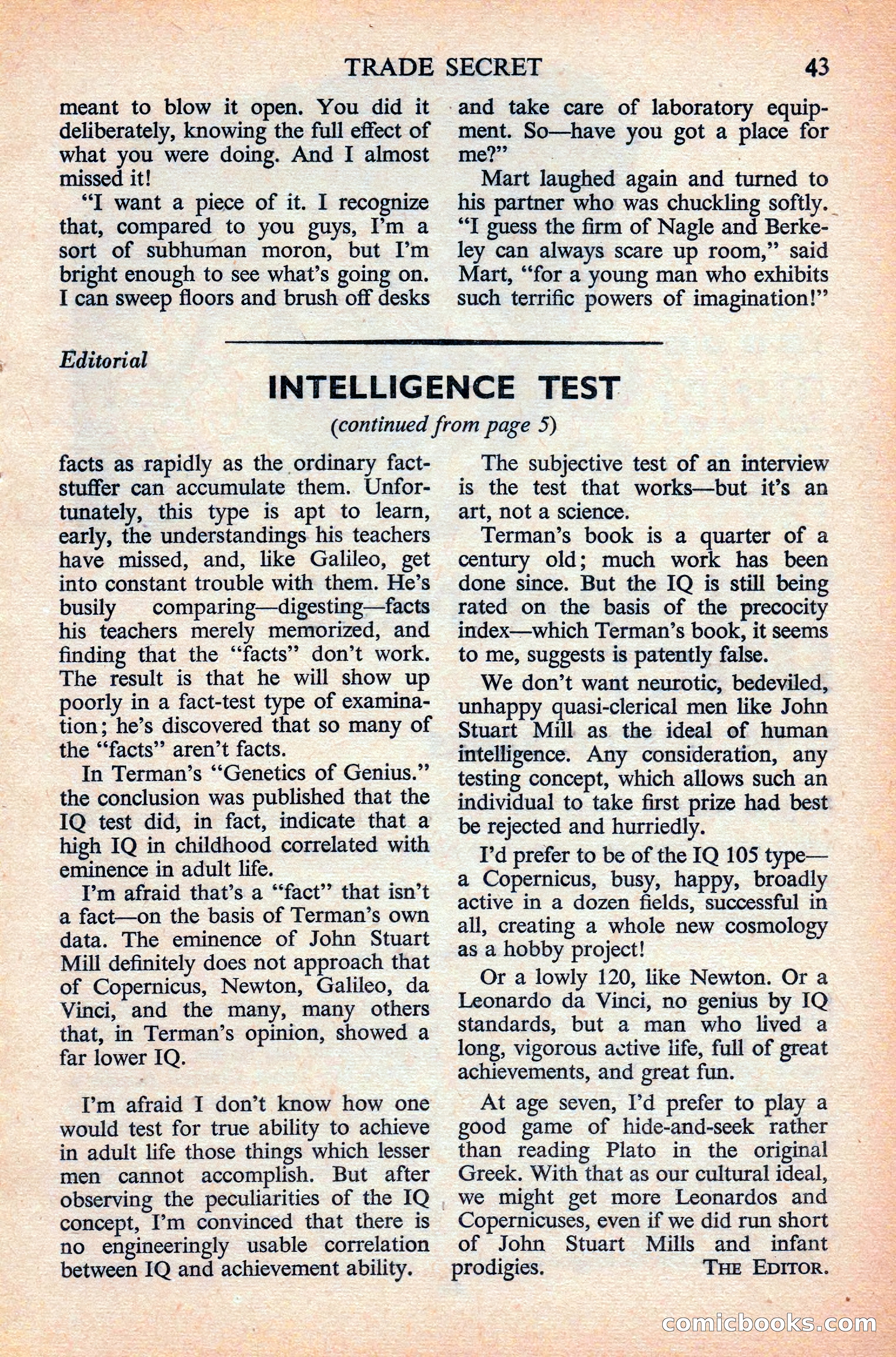
A restored page from Pulp Fiction, 1954. Page through the whole issue in the reader above.
📄 Transcribed text from this page (OCR, searchable)
Machine-transcribed from the original scan — historical spelling and the odd misread are preserved.
TRADE SECRET meant to blow it open. You did it deliberately, knowing the full effect of what you were doing. And I almost missed it! “I want a piece of it. I recognize that, compared to you guys, I’m a sort of subhuman moron, but I’m bright enough to see what’s going on. I can sweep floors and brush off desks 43 ‘and take care of laboratory equip- ment. So—have you got a place for © me?” : Mart laughed again and turned to his “I guess the firm of Nagle and Berke- ley can always scare up room,” said Mart, “for a young man who exhibits such terrific powers of imagination!” Editorial INTELLIGENCE TEST (continued from page 5) facts as rapidly as the ordinary fact- stuffer can accumulate them. Unfor- tunately, this type is apt to learn, early, the understandings his teachers have missed, and, like Galileo, get into constant trouble with them. He’s busily | comparing—digesting—facts his teachers merely memorized, and finding that the “facts”? don’t work. The result is that he will show up poorly in a fact-test type of examina- tion; he’s discovered that so many of the “facts” aren’t facts. In Terman’s ‘“‘Genetics of Genius.” the conclusion was published that the IQ test did, in fact, indicate that a high IQ in childhood correlated with eminence in adult life. I’m afraid that’s a “‘fact’’ that isn’t a fact—on the basis of Terman’s own data. The eminence of John Stuart Mill definitely does not approach that of Copernicus, Newton, Galileo, da Vinci, and the many, many others that, in Terman’s opinion, showed a far lower IQ. I’m afraid I don’t know how one would test for true ability to achieve in adult life those things which lesser men cannot accomplish. But after observing the peculiarities of the IQ | concept, I’m convinced that there is no engineeringly usable correlation between IQ and achievement ability. The subjective test of an interview is the test that works—but it’s an art, not a science. Terman’s book is a quarter of a century old; much work has been done since. But the IQ is still being rated on the basis of the precocity index—which Terman’s book, it seems to me, suggests is patently false. We don’t want neurotic, bedeviled, unhappy quasi-clerical men like John Stuart Mill as the ideal of human intelligence. Any consideration, any testing concept, which allows such an individual to take first prize had best be rejected and hurriedly. I'd prefer to be of the IQ 105 type— a Copernicus, busy, happy, broadly active in a dozen fields, successful in all, creating a whole new cosmology as a hobby project! Or a lowly 120, like Newton. Or a Leonardo da Vinci, no genius by IQ standards, but a man who lived a long, vigorous active life, full of great achievements, and great fun. At age seven, I’d prefer to play a good game of hide-and-seek rather than reading Plato in the original Greek. With that as our cultural ideal, we might get more Leonardos and Copernicuses, even if we did run short of John Stuart Mills and infant prodigies. THE EpirTor. partner who was chuckling softly. EComichookssco = |