
Pulp Fiction, 1954 · page 117 of 132
Astounding Science Fiction, British Edition — page 117: what you’re looking at
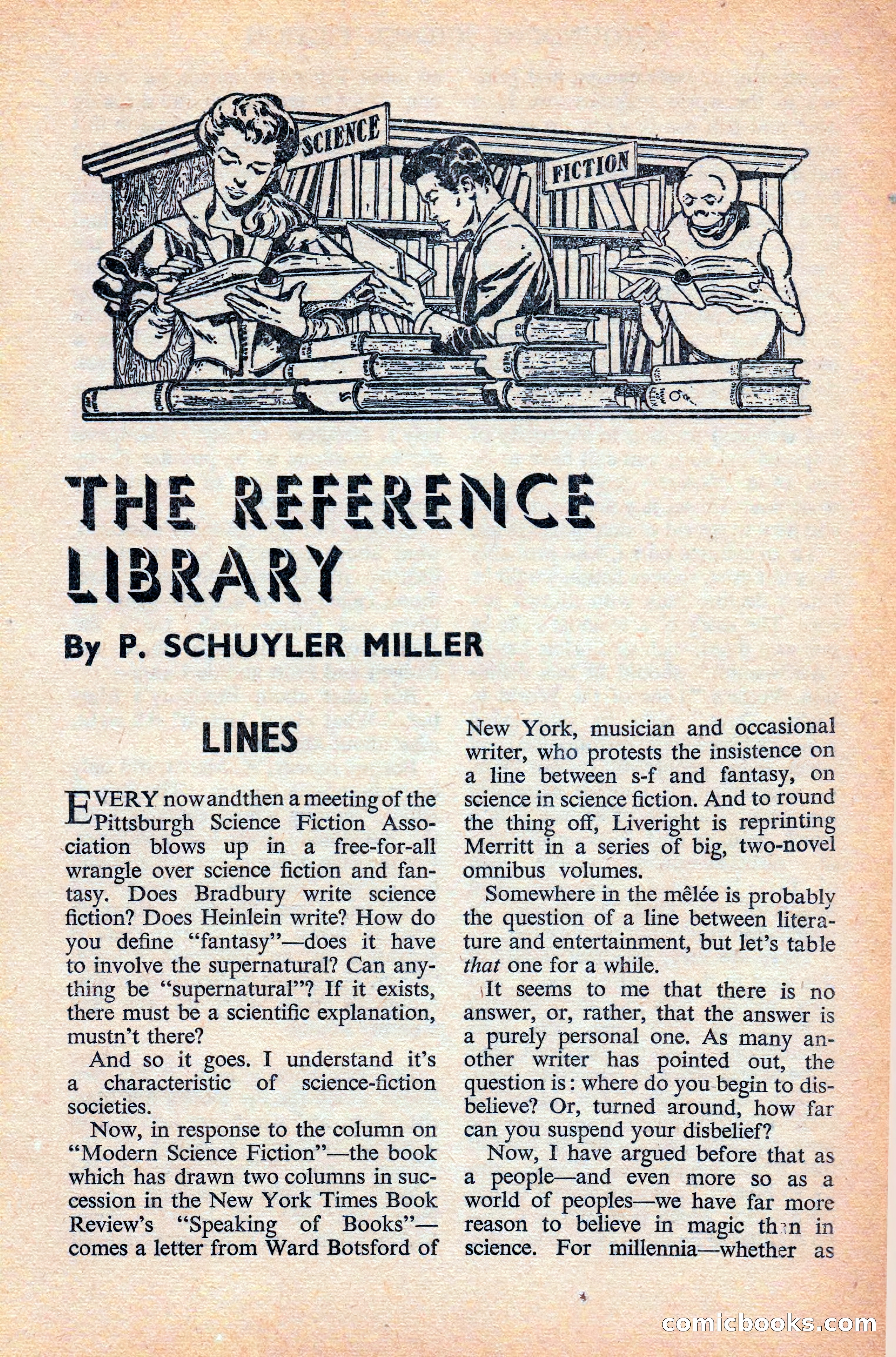
A restored page from Pulp Fiction, 1954. Page through the whole issue in the reader above.
📄 Transcribed text from this page (OCR, searchable)
Machine-transcribed from the original scan — historical spelling and the odd misread are preserved.
TrlE REFE LIBRARY rad v1 By P. SCHUYLER MILLER LINES Bi YERY nowandthen a meeting of the Pittsburgh Science Fiction Asso- ciation blows up in a free-for-all wrangle over science fiction and fan- tasy. Does Bradbury write science fiction? Does Heinlein write? How do you define “fantasy”—does it have to involve the supernatural? Can any- thing be “supernatural”? If it exists, there must be a scientific explanation, mustn't there? And so it goes. I understand it’s a characteristic of science-fiction societies. Now, in response to the column on “Modern Science Fiction’”—the book which has drawn two columns in suc- cession in the New York Times Book Review’s “Speaking of Books’— comes a letter from Ward Botsford of New York, musician and occasional writer, who protests the insistence on a line between s-f and fantasy, on science in science fiction. And to round the thing off, Liveright is reprinting Merritt in a series of big, two-novel omnibus volumes. Somewhere in the mélée is probably the question of a line between litera- ture and entertainment, but let’s table that one for a while. It seems to me that there is no answer, or, rather, that the answer is a purely personal one. As many an- other writer has pointed out, the question is: where do you begin to dis- believe? Or, turned around, how far can you suspend your disbelief? Now, I have argued before that as a people—and even more so as a world of peoples—we have far more reason to believe in magic then in science. For millennia—whether as 4 EOMmichooks: co te 4, *