
Pulp Fiction, 1954 · page 99 of 133
Astounding Science Fiction (British Edition) — page 99: what you’re looking at
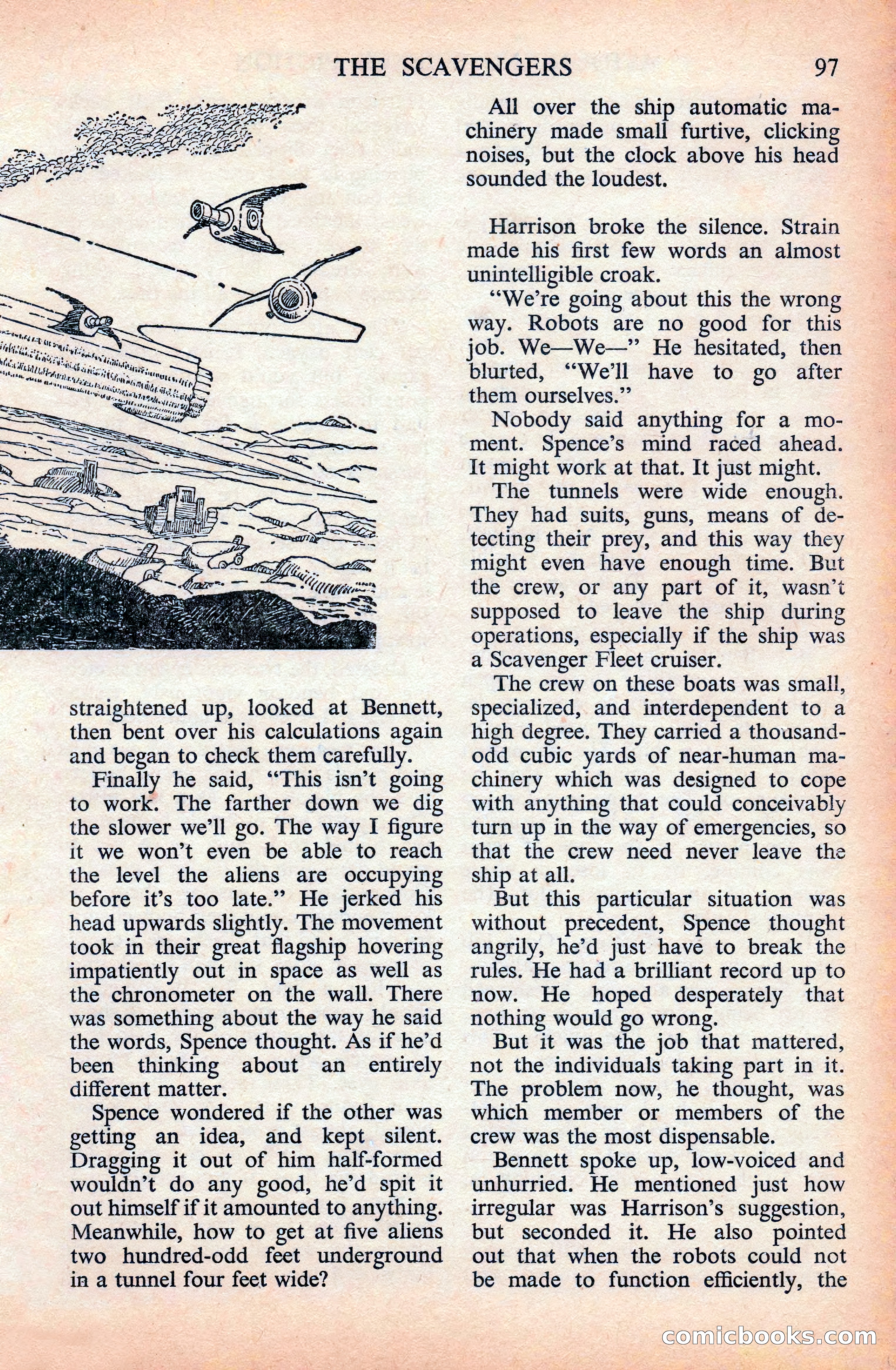
A restored page from Pulp Fiction, 1954. Page through the whole issue in the reader above.
📄 Transcribed text from this page (OCR, searchable)
Machine-transcribed from the original scan — historical spelling and the odd misread are preserved.
THE Yoav a “es 6 8ae, aa Bo ays co straightened up, looked at Bennett, then bent over his calculations again and began to check them carefully. Finally he said, “This isn’t going to work. The farther down we dig the slower we'll go. The way I figure it we won’t even be able to reach the level the aliens are occupying before it’s too late.” He jerked his head upwards slightly. The movement took in their great flagship hovering impatiently out in space as well as the chronometer on the wall. There was something about the way he said the words, Spence thought. As if he’d been thinking about an_ entirely different matter. Spence wondered if the other was getting an idea, and kept silent. Dragging it out of him half-formed wouldn’t do any good, he’d spit it out himself if it amounted to anything. Meanwhile, how to get at five aliens two hundred-odd feet underground in a tunnel four feet wide? SCAVENGERS 97 All over the ship automatic ma- chinery made small furtive, clicking noises, but the clock above his head sounded the loudest. : Harrison broke the silence. Strain made his first few words an almost unintelligible croak. “We're going about this the wrong way. Robots are no good for this job. We—We—” He hesitated, then blurted, “We'll have to go after them ourselves.” Nobody said anything for a mo- ment. Spence’s mind raced ahead. It might work at that. It just might. The tunnels were wide enough. They had suits, guns, means of de- tecting their prey, and this way they might even have enough time. But the crew, or any part of it, wasn’t supposed to leave the ship during operations, especially if the ship was a Scavenger Fleet cruiser. The crew on these boats was small, specialized, and interdependent to a high degree. They carried a thousand- odd cubic yards of near-human ma- chinery which was designed to cope with anything that could conceivably turn up in the way of emergencies, so that the crew need never leave the ship at all. But this particular situation was without precedent, Spence thought angrily, he’d just have to break the rules. He had a brilliant record up to now. He hoped desperately that nothing would go wrong. But it was the job that mattered, not the individuals taking part in it. The problem now, he thought, was which member or members of the crew was the most dispensable. Bennett spoke up, low-voiced and unhurried. He mentioned just how irregular was Harrison’s suggestion, but seconded it. He also pointed out that when the robots could not be made to function efficiently, the EComichooksico im