
Pulp Fiction, 1954 · page 94 of 133
Astounding Science Fiction (British Edition) — page 94: what you’re looking at
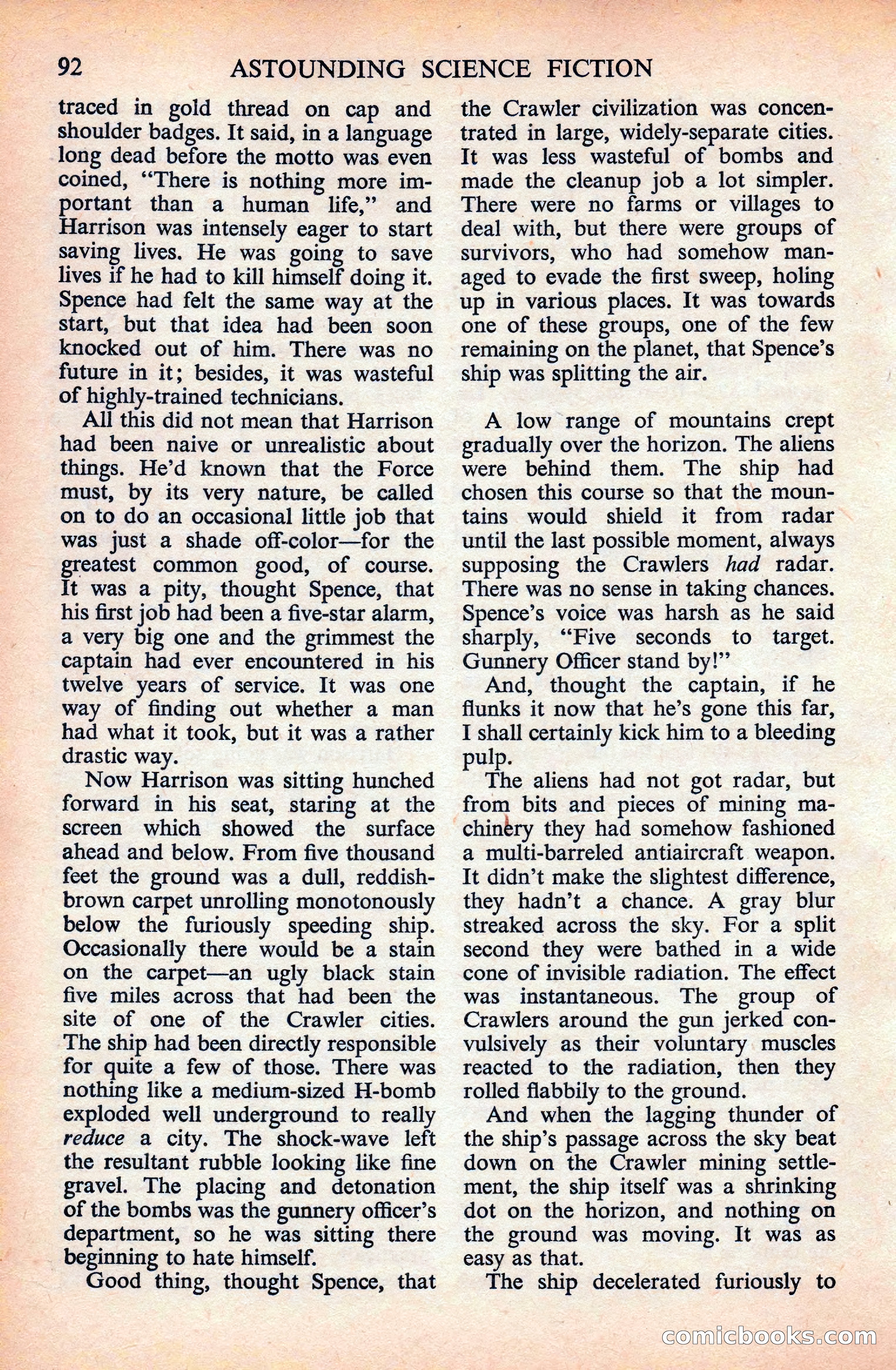
A restored page from Pulp Fiction, 1954. Page through the whole issue in the reader above.
📄 Transcribed text from this page (OCR, searchable)
Machine-transcribed from the original scan — historical spelling and the odd misread are preserved.
92 ASTOUNDING SCIENCE FICTION traced in gold thread on cap and shoulder badges. It said, in a language long dead before the motto was even coined, “There is nothing more im- portant than a human life,’ and Harrison was intensely eager to start saving lives. He was going to save lives if he had to kill himself doing it. Spence had felt the same way at the start, but that idea had been soon knocked out of him. There was no future in it; besides, it was wasteful of highly-trained technicians. All this did not mean that Harrison had been naive or unrealistic about things. He’d known that the Force must, by its very nature, be called on to do an occasional little job that was just a shade off-color—for the greatest common good, of course. It was a pity, thought Spence, that his first job had been a five-star alarm, a very big one and the grimmest the captain had ever encountered in his twelve years of service. It was one way of finding out whether a man had what it took, but it was a rather drastic way. Now Harrison was sitting hunched forward in his seat, staring at the screen which showed the surface ahead and below. From five thousand feet the ground was a dull, reddish- brown carpet unrolling monotonously below the furiously speeding ship. Occasionally there would be a stain on the carpet—an ugly black stain five miles across that had been the site of one of the Crawler cities. The ship had been directly responsible for quite a few of those. There was nothing like a medium-sized H-bomb exploded well underground to really reduce a city. The shock-wave left the resultant rubble looking like fine gravel. The placing and detonation of the bombs was the gunnery officer’s department, so he was sitting there beginning to hate himself. Good thing, thought Spence, that the Crawler civilization was concen- trated in large, widely-separate cities. It was less wasteful of bombs and made the cleanup job a lot simpler. There were no farms or villages to deal with, but there were groups of survivors, who had somehow map- aged to evade the first sweep, holing up in various places. It was towards one of these groups, one of the few remaining on the planet, that Spence’s ship was splitting the air. A low range of mountains crept gradually over the horizon. The aliens were behind them. The ship had chosen this course so that the moun- tains would shield it from radar until the last possible moment, always supposing the Crawlers had radar. There was no sense in taking chances. Spence’s voice was harsh as he said sharply, “Five seconds to target. Gunnery Officer stand by!”’ And, thought the captain, if he flunks it now that he’s gone this far, I shall certainly kick him to a bleeding pulp. The aliens had not got radar, but from bits and pieces of mining ma- chinery they had somehow fashioned a multi-barreled antiaircraft weapon. It didn’t make the slightest difference, they hadn’t a chance. A gray blur streaked across the sky. For a split second they were bathed in a wide cone of invisible radiation. The effect was instantaneous. The group of Crawlers around the gun jerked con- vulsively as their voluntary muscles reacted to the radiation, then they rolled flabbily to the ground. And when the lagging thunder of the ship’s passage across the sky beat down on the Crawler mining settle- ment, the ship itself was a shrinking dot on the horizon, and nothing on the ground was moving. It was as easy as that. The ship decelerated furiously to CoOmichooks.co im