
Pulp Fiction, 1954 · page 74 of 133
Astounding Science Fiction (British Edition) — page 74: what you’re looking at
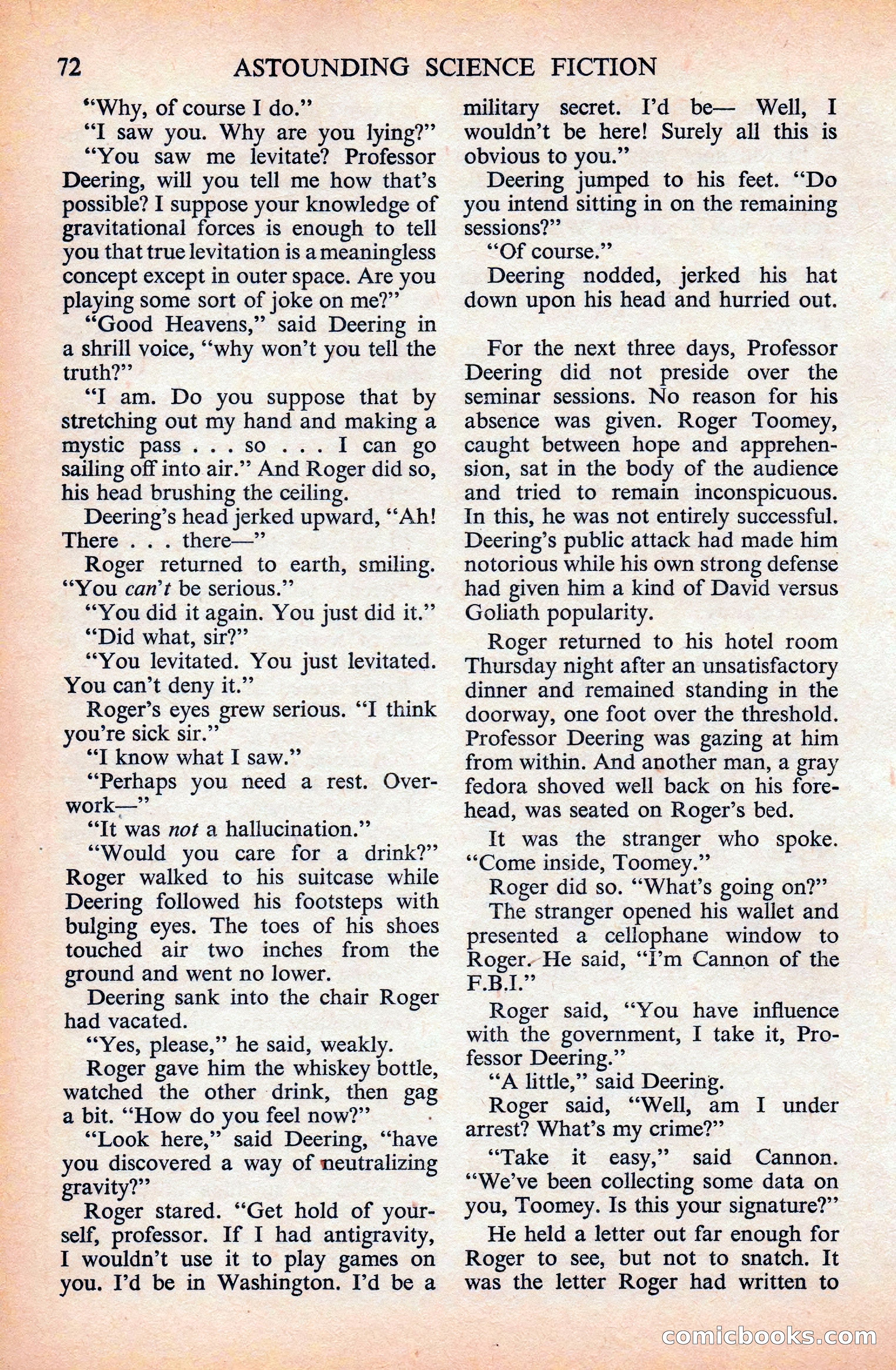
A restored page from Pulp Fiction, 1954. Page through the whole issue in the reader above.
📄 Transcribed text from this page (OCR, searchable)
Machine-transcribed from the original scan — historical spelling and the odd misread are preserved.
72 “Why, of course I do.” “I saw you. Why are you lying?’ “You saw me levitate? Professor Deering, will you tell me how that’s possible? I suppose your knowledge of gravitational forces is enough to tell you that true levitation is a meaningless concept except in outer space. Are you playing some sort of joke on me?” *“Good Heavens,” said Deering in a shrill voice, ‘“‘why won’t you tell the truth?’ “I am. Do you suppose that by stretching out my hand and making a mystic pass ...so ... I can go sailing off into air.’’ And Roger did so, his head brushing the ceiling. Deering’s head jerked upward, “Ah! There... ...-there—” Roger returned to earth, smiling. “You can’t be serious.” “You did it again. You just did it.” “Did what, sir?’ “You levitated. You just levitated. You can’t deny it.” Roger’s eyes grew serious. “I think you're sick sir.” “I know what I saw.” “Perhaps you need a rest. Over- work—”’ “It was not a hallucination.” “Would you care for a drink?” Roger walked to his suitcase while Deering followed his footsteps with bulging eyes. The toes of his shoes touched air two inches from the ground and went no lower. Deering sank into the chair Roger had vacated. “Yes, please,”’ he said, weakly. Roger gave him the whiskey bottle, watched the other drink, then bag a bit. ‘““How do you feel now?” “Look here,” said Deering, “have you discovered a way of neutralizing gravity?” Roger stared. “Get hold of your- self, professor. If I had antigravity, I wouldn’t use it to play games on you. I’d be in Washington. I’d be a ASTOUNDING SCIENCE FICTION military secret. I’d be— Well, I wouldn’t be here! Surely all this is obvious to you.” Deering jumped to his feet. ““Do you intend sitting in on the remaining sessions?” “Of course.” Deering nodded, jerked his hat down upon his head and hurried out. For the next three days, Professor Deering did not preside over the seminar sessions. No reason for his absence was given. Roger Toomey, caught between hope and apprehen- sion, sat in the body of the audience and tried to remain inconspicuous. In this, he was not entirely successful. Deering’ s public attack had made him notorious while his own strong defense had given him a kind of David versus Goliath popularity. Roger returned to his hotel room Thursday night after an unsatisfactory dinner and remained standing in the doorway, one foot over the threshold. Professor Deering was gazing at him from within. And another man, a gray fedora shoved well back on his fore- head, was seated on Roger’s bed. It was the stranger who spoke. ““Come inside, Toomey.” Roger did so. ““What’s going on?” The stranger opened his wallet and presented a cellophane window to Roger. He said, “I’m Cannon of the F.B.I.” Roger said, “You have influence with the government, I take it, Pro- fessor Deering.” “A little,” said Deering. Roger said, “Well, am I under arrest? What’s my crime?” “Take it easy,” said Cannon. ““We’ve been collecting some data on you, Toomey. Is this your signature?” He held a letter out far enough for Roger to see, but not to snatch. It was the letter Roger had written to Gomi im EhDooksnGco