
Pulp Fiction, 1954 · page 60 of 133
Astounding Science Fiction (British Edition) — page 60: what you’re looking at
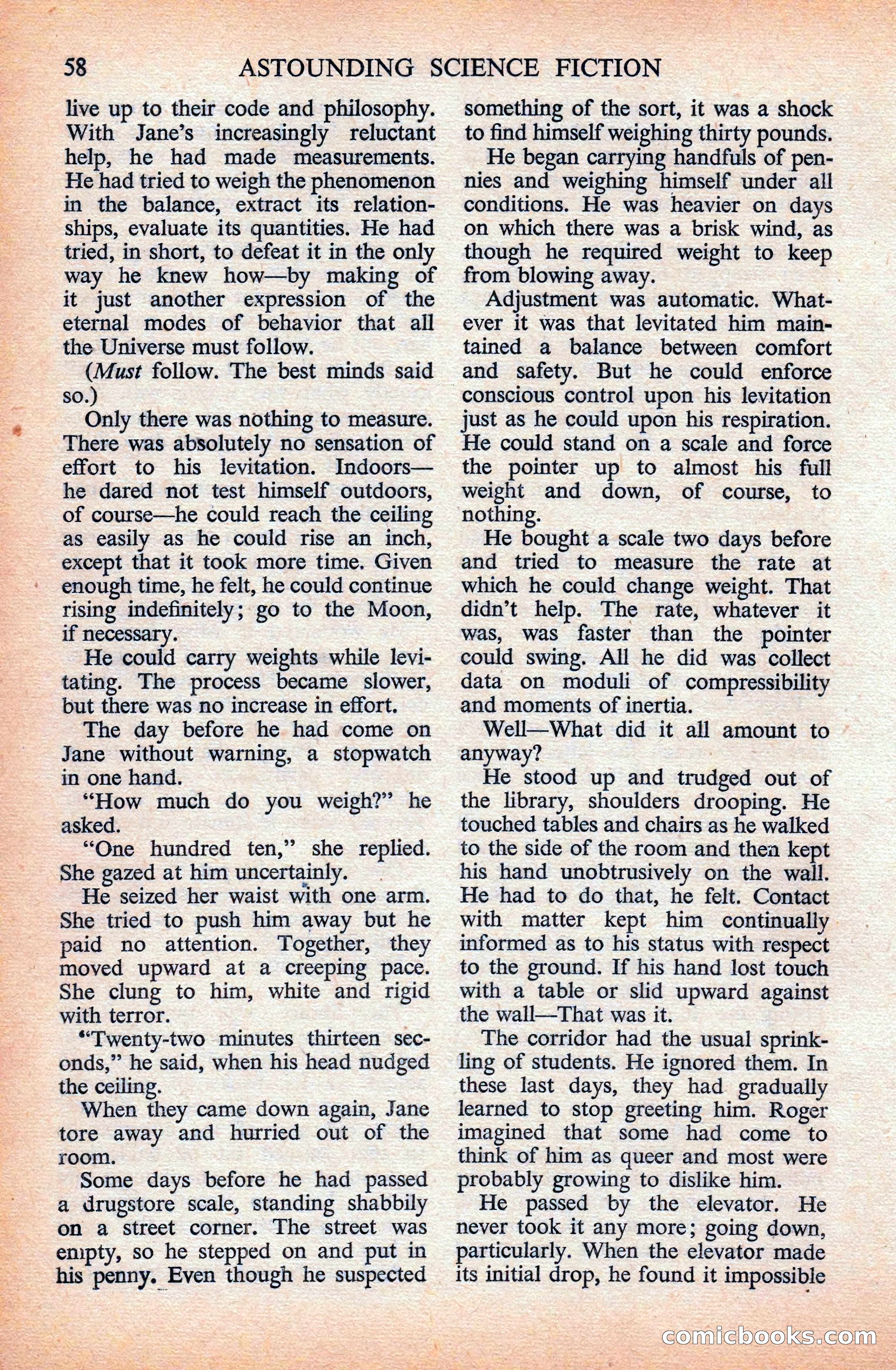
A restored page from Pulp Fiction, 1954. Page through the whole issue in the reader above.
📄 Transcribed text from this page (OCR, searchable)
Machine-transcribed from the original scan — historical spelling and the odd misread are preserved.
38 ASTOUNDING SCIENCE FICTION live up to their code and philosophy. With Jane’s increasingly reluctant help, he had made measurements. He had tried to weigh the phenomenon in the balance, extract its relation- ships, evaluate its quantities. He had tried, in short, to defeat it in the only way he knew how—by making of it just another expression of the eternal modes of behavior that all the Universe must follow. (Must follow. The best minds said SO.) Only there was nothing to measure. There was absolutely no sensation of effort to his levitation. Indoors— he dared not test himself outdoors, of course—he could reach the ceiling as easily as he could rise an inch, except that it took more time. Given enough time, he felt, he could continue rising indefinitely; go to the Moon, if necessary. He could carry weights while levi- tating. The process became slower, but there was no increase in effort. The day before he had come on Jane without warning, a stopwatch in one hand. “How much do you weigh?” he asked. “One hundred ten,” she replied. She gazed at him uncertainly. He seized her waist with one arm. She tried to push him away but he paid no attention. Together, they moved upward at a creeping pace. She clung to him, white and rigid with terror. “Twenty-two minutes thirteen sec- onds,” he said, when his head nudged the ceiling. When they came down again, Jane tore away and hurried out of the room. Some days before he had passed a drugstore scale, standing shabbily on a street corner. The street was empty, so he stepped on and put in his penny. Even though he suspected something of the sort, it was a shock to find himself weighing thirty pounds. He began carrying handfuls of pen- nies and weighing himself under all conditions. He was heavier on days on which there was a brisk wind, as though he required weight to keep from blowing away. Adjustment was automatic. What- ever it was that levitated him main- tained a balance between comfort and safety. But he could enforce conscious control upon his levitation just as he could upon his respiration. He could stand on a scale and force the pointer up to almost his full weight and down, of course, to nothing. He bought a scale two days before and tried to measure the rate at which he could change weight. That didn’t help. The rate, whatever it was, was faster than the pointer could swing. All he did was collect data on moduli of compressibility and moments of inertia. Well—What did it all amount to anyway? He stood up and trudged out of the library, shoulders drooping. He touched tables and chairs as he walked to the side of the room and thea kept his hand unobtrusively on the wall. He had to do that, he felt. Contact with matter kept him continually informed as to his status with respect to the ground. If his hand lost touch with a table or slid upward against the wall—That was it. The corridor had the usual sprink- ling of students. He ignored them. In these last days, they had gradually learned to stop greeting him. Roger imagined that some had come to think of him as queer and most were probably growing to dislike him. He passed by the elevator. He never took it any more; going down, particularly. When the elevator made its initial drop, he found it impossible im EComichbookssco