
Pulp Fiction, 1954 · page 55 of 133
Astounding Science Fiction (British Edition) — page 55: what you’re looking at
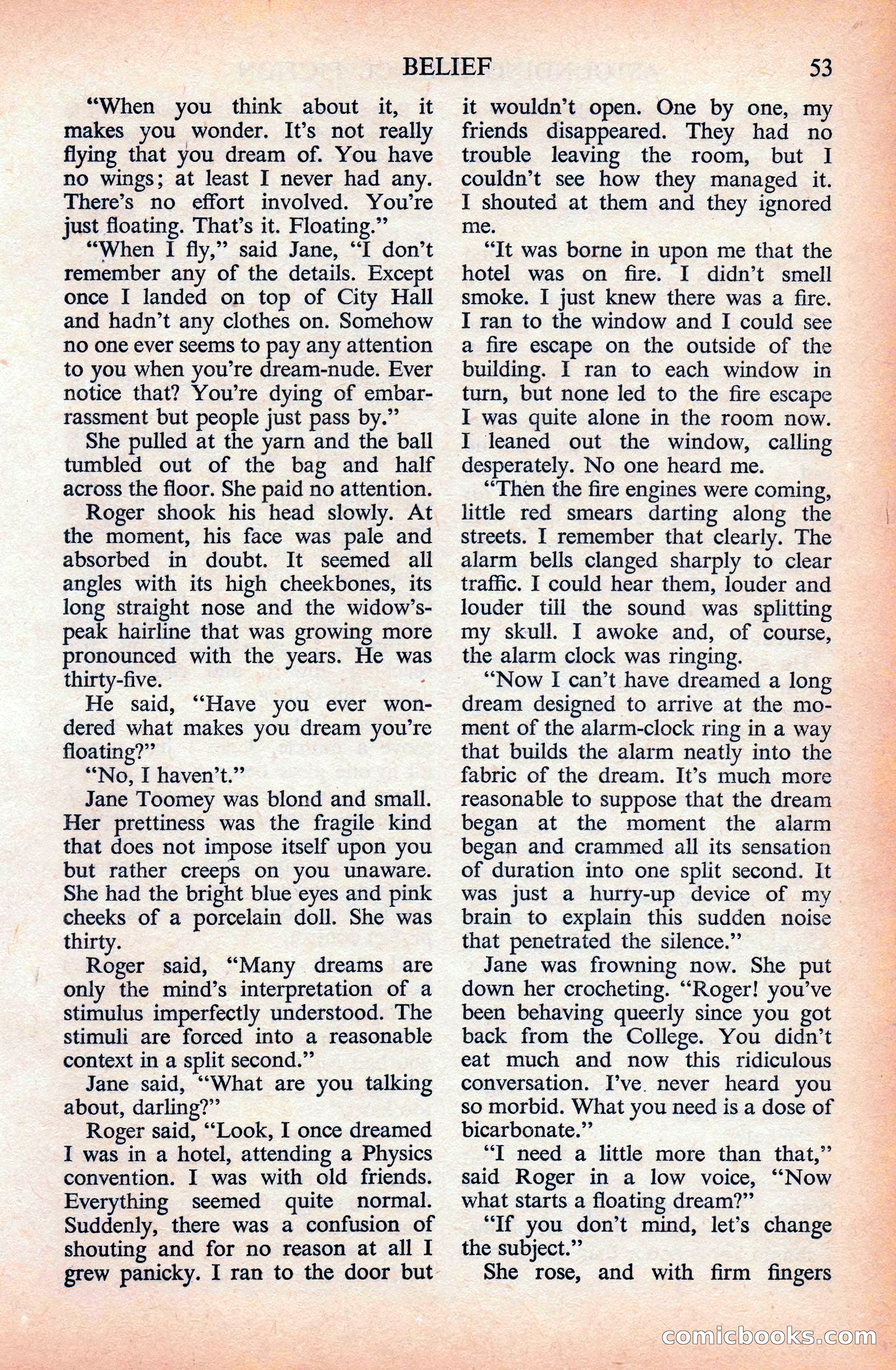
A restored page from Pulp Fiction, 1954. Page through the whole issue in the reader above.
📄 Transcribed text from this page (OCR, searchable)
Machine-transcribed from the original scan — historical spelling and the odd misread are preserved.
BELIEF 53 “When you think about it, it makes you wonder. It’s not really flying that you dream of. You have no wings; at least I never had any. There’s no effort involved. You're just floating. That’s it. Floating.” “When I fly,” said Jane, “I don’t remember any of the details. Except once I landed on top of City Hall and hadn’t any clothes on. Somehow no one ever seems to pay any attention to you when you’re dream-nude. Ever notice that? You’re dying of embar- rassment but people just pass by.” She pulled at the yarn and the ball tumbled out of the bag and half across the floor. She paid no attention. Roger shook his head slowly. At the moment, his face was pale and absorbed in doubt. It seemed all angles with its high cheekbones, its long straight nose and the widow’s- peak hairline that was growing more pronounced with the years. He was thirty-five. He said, “Have you ever won- dered what makes you dream you're floating?” “No, I haven’t.” Jane Toomey was blond and small. Her prettiness was the fragile kind that does not impose itself upon you but rather creeps on you unaware. She had the bright blue eyes and pink cheeks of a porcelain doll. She was thirty. Roger said, “Many dreams are only the mind’s interpretation of a stimulus imperfectly understood. The stimuli are forced into a reasonable context in a split second.” Jane said, ‘““What are you talking about, darling?” Roger said, “Look, I once dreamed I was in a hotel, attending a Physics convention. I was with old friends. Everything seemed quite normal. Suddenly, there was a confusion of shouting and for no reason at all I grew panicky. I ran to the door but it wouldn’t open. One by one, my friends disappeared. They had no trouble leaving the room, but I couldn’t see how they managed it. I shouted at them and they ignored me. “It was borne in upon me that the hotel was on fire. I didn’t smell smoke. I just knew there was a fire. I ran to the window and I could see a fire escape on the outside of the building. I ran to each window in turn, but none led to the fire escape I was quite alone in the room now. I leaned out the window, calling desperately. No one heard me. “Then the fire engines were coming, little red smears darting along the streets. I remember that clearly. The alarm bells clanged sharply to clear traffic. I could hear them, louder and louder till the sound was splitting my skull. I awoke and, of course, the alarm clock was ringing. “Now I can’t have dreamed a long dream designed to arrive at the mo- ment of the alarm-clock ring in a way that builds the alarm neatly into the fabric of the dream. It’s much more reasonable to suppose that the dream began at the moment the alarm began and crammed all its sensation of duration into one split second. It was just a hurry-up device of my brain to explain this sudden noise that penetrated the silence.” Jane was frowning now. She put down her crocheting. “Roger! you’ve been behaving queerly since you got back from the College. You didn’t eat much and now this ridiculous conversation. I’ve. never heard you so morbid. What you need is a dose of bicarbonate.” “TIT need a little more than that,” said Roger in a low voice, “Now what starts a floating dream?” “If you don’t mind, let’s change the subject.” She rose, and with firm fingers COnMIE OOS .e© m