
Pulp Fiction, 1954 · page 52 of 133
Astounding Science Fiction (British Edition) — page 52: what you’re looking at
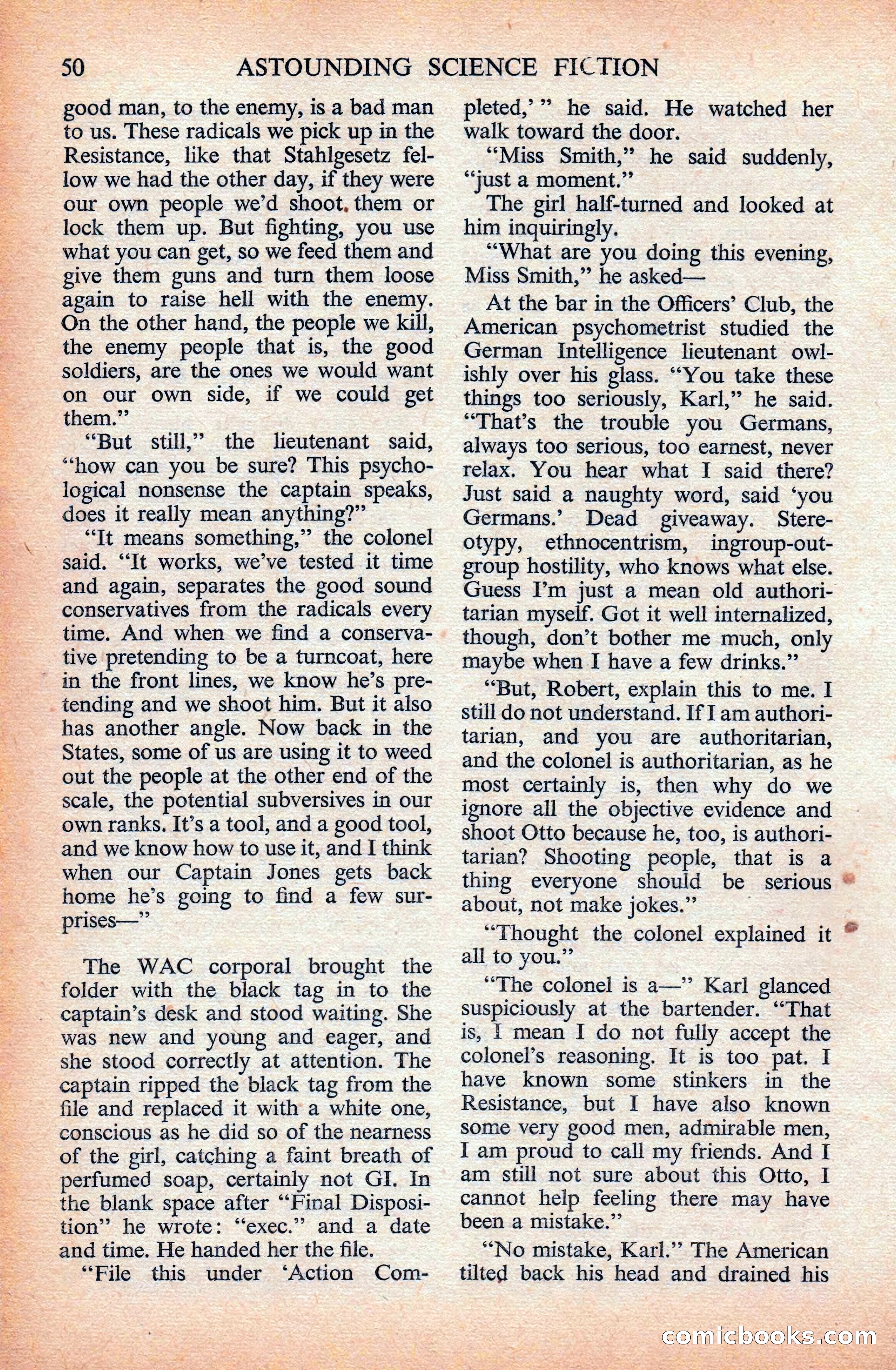
A restored page from Pulp Fiction, 1954. Page through the whole issue in the reader above.
📄 Transcribed text from this page (OCR, searchable)
Machine-transcribed from the original scan — historical spelling and the odd misread are preserved.
Petit 50 ASTOUNDING SCIENCE FICTION good man, to the enemy, is a bad man to us. These radicals we pick up in the Resistance, like that Stahlgesetz fel- low we had the other day, if they were our own people we’d shoot, them or lock them up. But fighting, you use what you can get, so we feed them and give them guns and turn them loose again to raise hell with the enemy. On the other hand, the people we kill, the enemy people that is, the good soldiers, are the ones we would want on our own side, if we could get them.” “But still,’ the lieutenant said, “how can you be sure? This psycho- logical nonsense the captain speaks, does it really mean anything?” “It means something,” the colonel said. “‘It works, we’ve tested it time and again, separates the good sound conservatives from the radicals every time. And when we find a conserva- tive pretending to be a turncoat, here - in the front lines, we know he’s pre- tending and we shoot him. But it also has another angle. Now back in the States, some of us are using it to weed out the people at the other end of the scale, the potential subversives in our own ranks. It’s a tool, and a good tool, and we know how to use it, and I think when our Captain Jones gets back home he’s going to find a few sur- prises—”’ The WAC corporal brought the folder with the black tag in to the - captain’s desk and stood waiting. She was new and young and eager, and she stood correctly at attention. The captain ripped the black tag from the file and replaced it with a white one, conscious as he did so of the nearness of the girl, catching a faint breath of perfumed soap, certainly not GI. In the blank space after “Final Disposi- tion’? he wrote: “‘exec.’’ and a date and time. He handed her the file. “File this under ‘Action Com- pleted,’’”’ he said. He watched her walk toward the door. “Miss Smith,” he said suddenly, “just a moment.” The girl half-turned and looked at him inquiringly. “What are you doing this evening, Miss Smith,” he asked— At the bar in the Officers’ Club, the American psychometrist studied the German Intelligence lieutenant owl- ishly over his glass. ‘““You take these things too seriously, Karl,” he said. “That’s the trouble you Germans, always too serious, too earnest, never relax. You hear what I said there? Just said a naughty word, said ‘you Germans.’ Dead giveaway. Stere- otypy, ethnocentrism, ingroup-out- group hostility, who knows what else. Guess I’m just a mean old authori- tarian myself. Got it well internalized, though, don’t bother me much, only maybe when I have a few drinks.” “But, Robert, explain this to me. I still do not understand. If I am authori- tarian, and you are authoritarian, and the colonel is authoritarian, as he most certainly is, then why do we ignore all the objective evidence and shoot Otto because he, too, is authori- tarian? Shooting people, that is a thing everyone should be serious © about, not make jokes.” “Thought the colonel explained it all to you.” “The colonel is a—’’ Karl glanced suspiciously at the bartender. ‘‘That is, I mean I do not fully accept the colonel’s reasoning. It is too pat. I have known some stinkers in the Resistance, but I have also known some very good men, admirable men, I am proud to call my friends. And I am still not sure about this Otto, I cannot help feeling there may have been a mistake.” *“No mistake, Karl.’’ The American tilted back his head and drained his GOMIGHOOKS_GO mee