
Pulp Fiction, 1954 · page 48 of 133
Astounding Science Fiction (British Edition) — page 48: what you’re looking at
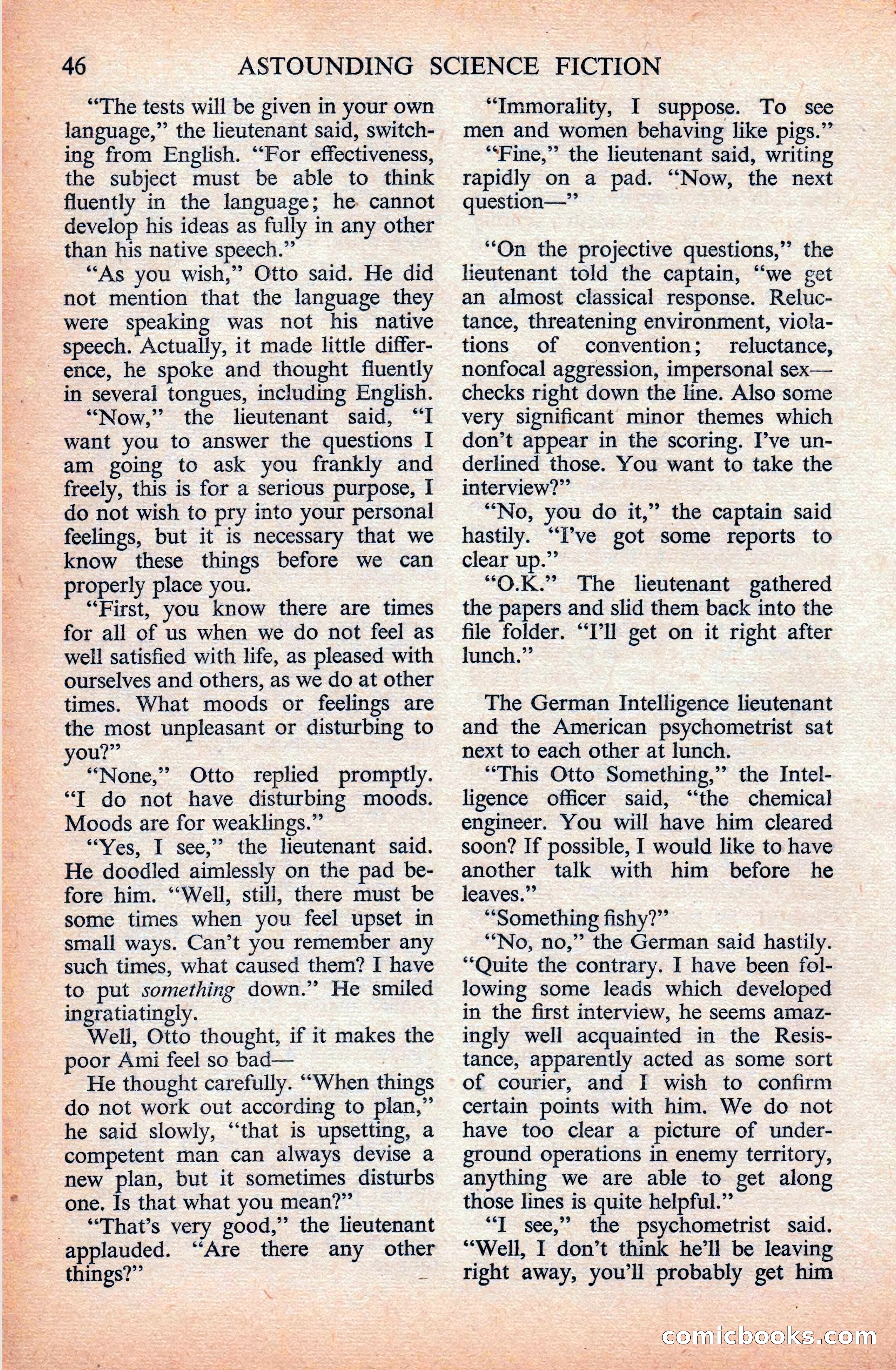
A restored page from Pulp Fiction, 1954. Page through the whole issue in the reader above.
📄 Transcribed text from this page (OCR, searchable)
Machine-transcribed from the original scan — historical spelling and the odd misread are preserved.
46 ASTOUNDING SCIENCE FICTION “The tests will be given in your own language,” the lieutenant said, switch- ing from English. “For effectiveness, the subject must be able to think fluently in the language; he. cannot develop his ideas as fully in any other than his native speech.” “As you wish,” Otto said. He did not mention that the language they were speaking was not his native speech. Actually, it made little differ- ence, he spoke and thought fluently in several tongues, including English. ‘‘Now,” the lieutenant said, “I want you to answer the questions I am going to ask you frankly and freely, this is for a serious purpose, I do not wish to pry into your personal feelings, but it is necessary that we know these things before we can properly place you. “First, you know there are times for all of us when we do not feel as well satisfied with life, as pleased with ourselves and others, as we do at other times. What moods or feelings are the most unpleasant or disturbing to you?” “None,” Otto replied promptly. “T do not have disturbing moods. Moods are for weaklings.” “Yes, I see,” the lieutenant said. He doodled aimlessly on the pad be- fore him. ‘‘Well, still, there must be some times when you feel upset in small ways. Can’t you remember any such times, what caused them? I have to put something down.” He smiled ingratiatingly. Well, Otto thought, if it makes the poor Ami feel so bad— 7 He thought carefully. ““When things do not work out according to plan,” he said slowly, “that is upsetting, a competent man can always devise a new plan, but it sometimes disturbs one, Is that what you mean?” _ “That’s very good,” the lieutenant applauded. “Are there any other things?” s “Immorality, I suppose. To sce men and women behaving like pigs.” ‘‘Fine,” the lieutenant said, writing rapidly on a pad. “Now, the next question—”’ “On the projective questions,”’ the lieutenant told the captain, “we get an almost classical response. Reluc- tance, threatening environment, viola- tions of convention; reluctance, nonfocal aggression, impersonal sex— checks right down the line. Also some very significant minor themes which don’t appear in the scoring. I’ve un- derlined those. You want to take the interview?” “No, you do it,” the captain said hastily. “I’ve got some reports to clear up.” “O.K.” The lieutenant gathered the papers and slid them back into the file folder. “Ill get on it right after Junch.” The German Intelligence lieutenant and the American psychometrist sat next to each other at lunch. “This Otto Something,” the Intel- ligence officer said, “the chemical engineer. You will have him cleared soon? If possible, I would like to have another talk with him before he leaves.” “Something fishy?” “No, no,” the German said hastily. “Quite the contrary. I have been fol- lowing some leads which developed in the first interview, he seems amaz- ingly well acquainted in the Resis- tance, apparently acted as some sort of courier, and I wish to confirm certain points with him. We do not have too clear a picture of under- ground operations in enemy territory, anything we are able to get along those lines is quite helpful.” “I see,” the psychometrist said. “Well, I don’t think he'll be leaving right away, you'll probably get him ag com (El ooo) KS (eC) Bn