
Pulp Fiction, 1954 · page 46 of 133
Astounding Science Fiction (British Edition) — page 46: what you’re looking at
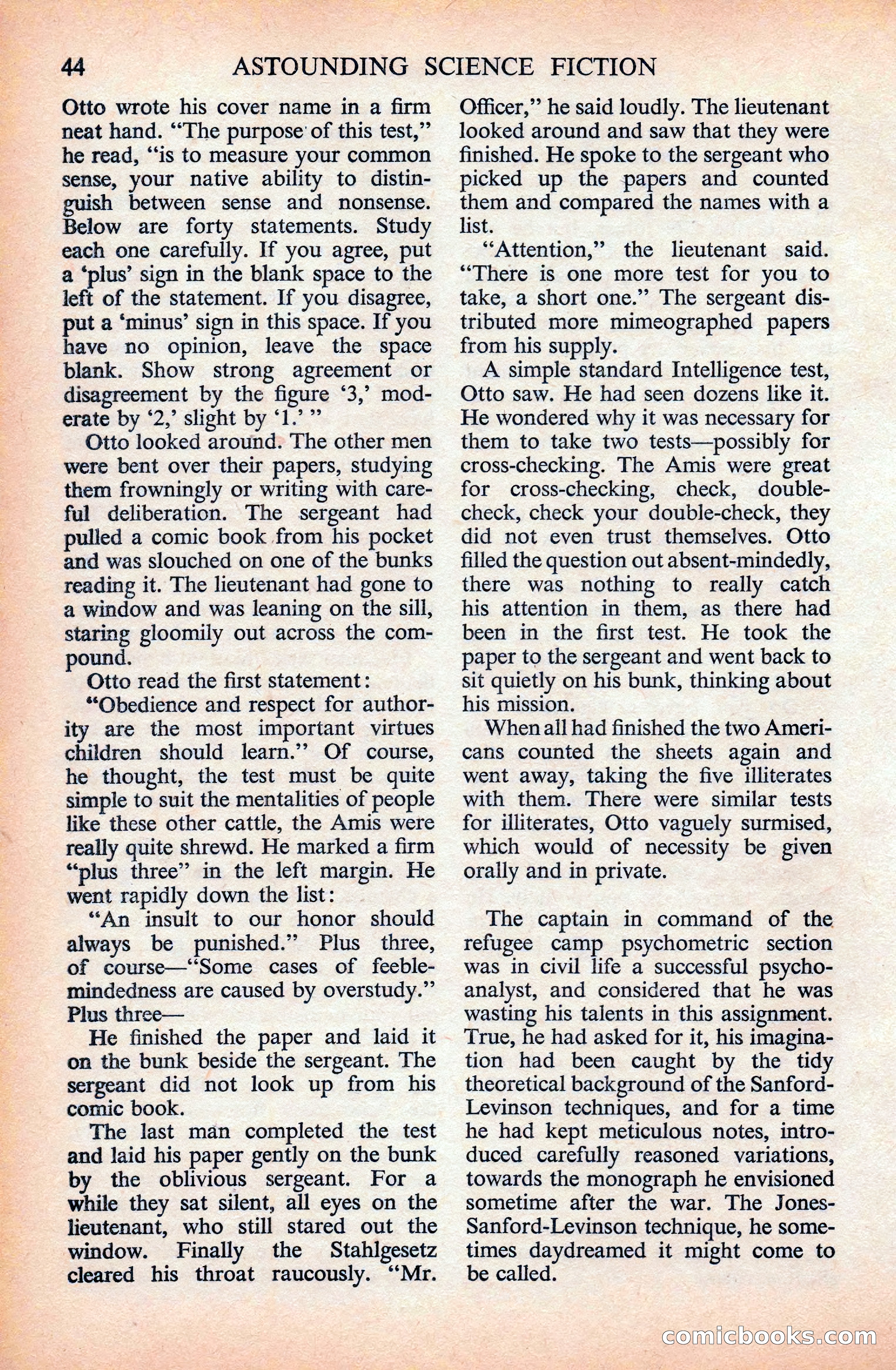
A restored page from Pulp Fiction, 1954. Page through the whole issue in the reader above.
📄 Transcribed text from this page (OCR, searchable)
Machine-transcribed from the original scan — historical spelling and the odd misread are preserved.
44 Otto wrote his cover name in a firm neat hand. ““The purpose’ of this test,” he read, “‘is to measure your common sense, your native ability to distin- guish between sense and nonsense. Below are forty statements. Study each one carefully. If you agree, put a ‘plus’ sign in the blank space to the left of the statement. If you disagree, put a ‘minus’ sign in this space. If you have no opinion, leave the space blank. Show strong agreement or disagreement by the figure ‘3,’ mod- erate by ‘2,’ slight by ‘1.’ ” Otto looked around. The other men were bent over their papers, studying them frowningly or writing with care- ful deliberation. The sergeant had pulled a comic book from his pocket and was slouched on one of the bunks reading it. The lieutenant had gone to a window and was leaning on the sill, staring gloomily out across the com- pound. Otto read the first statement: “Obedience and respect for author- ity are the most important virtues children should learn.’’ Of course, he thought, the test must be quite simple to suit the mentalities of people like these other cattle, the Amis were really quite shrewd. He marked a firm “plus three” in the left margin. He went rapidly down the list: “An insult to our honor should always be punished.” Plus three, of course—‘‘Some cases of feeble- mindedness are caused by overstudy.”’ Plus three— He finished the paper and laid it on the bunk beside the sergeant. The sergeant did not look up from his comic book. The last man completed the test and laid his paper gently on the bunk by the oblivious sergeant. For a while they sat silent, all eyes on the lieutenant, who still stared out the window. Finally the Stahlgesetz cleared his throat raucously. “Mr. ASTOUNDING SCIENCE FICTION Officer,” he said loudly. The lieutenant looked around and saw that they were finished. He spoke to the sergeant who picked up the papers and counted them and compared the names with a list. “Attention,” the lieutenant said. “There is one more test for you to take, a short one.”’ The sergeant dis- tributed more mimeographed papers from his supply. A simple standard Intelligence test, Otto saw. He had seen dozens like it. He wondered why it was necessary for them to take two tests—possibly for cross-checking. The Amis were great for cross-checking, check, double- check, check your double-check, they did not even trust themselves. Otto filled the question out absent-mindedly, there was nothing to really catch his attention in them, as there had been in the first test. He took the paper to the sergeant and went back to sit quietly on his bunk, thinking about his mission. When all had finished the two Ameri- cans counted the sheets again and went away, taking the five illiterates with them. There were similar tests for illiterates, Otto vaguely surmised, which would of necessity be given orally and in private. The captain in command of the refugee camp psychometric section was in civil life a successful psycho- analyst, and considered that he was wasting his talents in this assignment. True, he had asked for it, his imagina- tion had been caught by the tidy theoretical background of the Sanford- Levinson techniques, and for a time he had kept meticulous notes, intro- duced carefully reasoned variations, towards the monograph he envisioned sometime after the war. The Jones- Sanford-Levinson technique, he some- times daydreamed it might come to be called. Comichooks co im