
Pulp Fiction, 1954 · page 44 of 133
Astounding Science Fiction (British Edition) — page 44: what you’re looking at
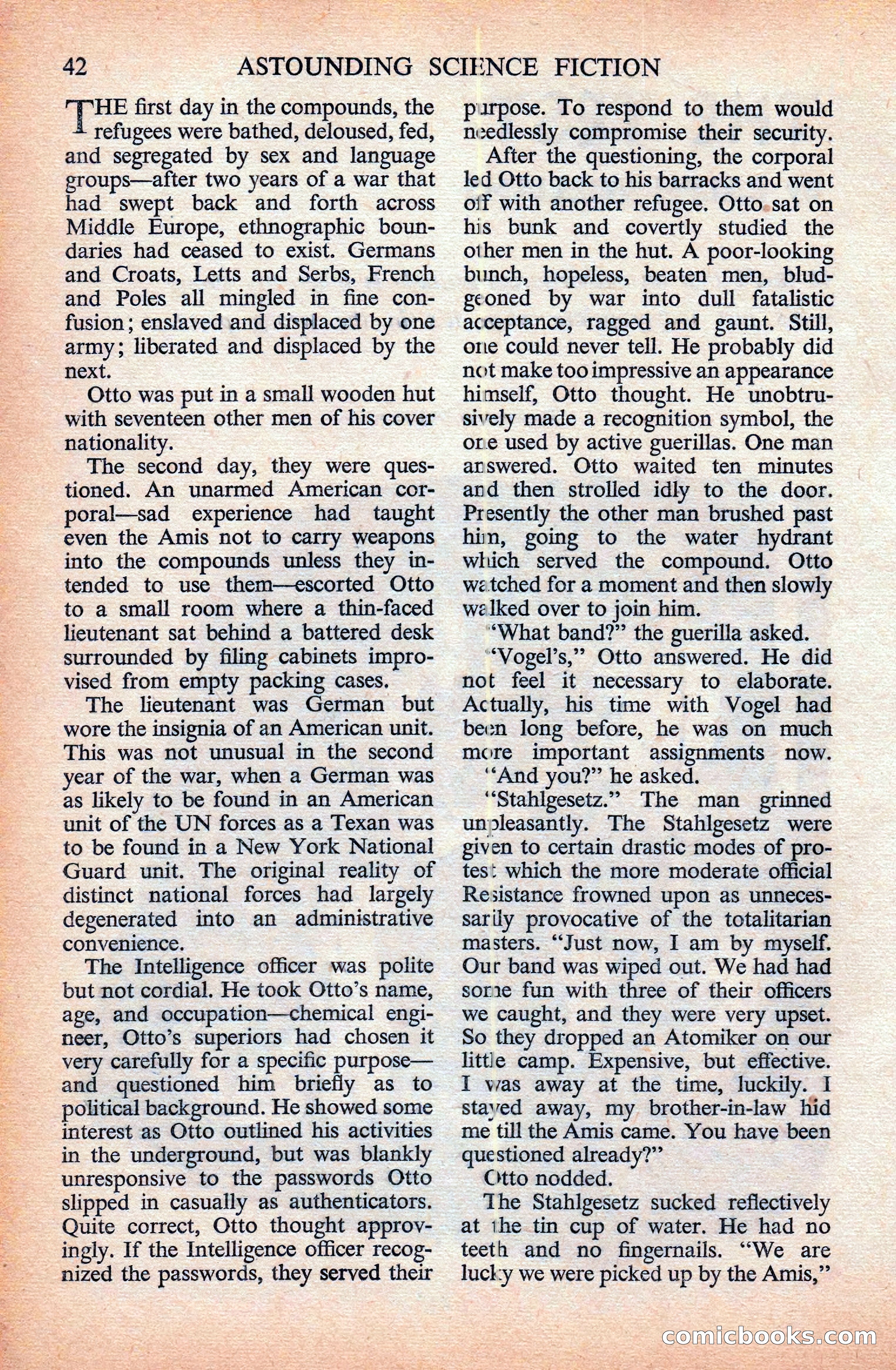
A restored page from Pulp Fiction, 1954. Page through the whole issue in the reader above.
📄 Transcribed text from this page (OCR, searchable)
Machine-transcribed from the original scan — historical spelling and the odd misread are preserved.
42 ASTOUNDING SCIENCE FICTION Agee first day in the compounds, the refugees were bathed, deloused, fed, and segregated by sex and language groups—after two years of a war that had swept back and forth across Middle Europe, ethnographic boun- daries had ceased to exist. Germans and Croats, Letts and Serbs, French and Poles all mingled in fine con- fusion; enslaved and displaced by one army; liberated and displaced by the next. Otto was put in a small wooden hut with seventeen other men of his cover nationality. The second day, they were ques- tioned. An unarmed American cor- poral—sad experience had taught even the Amis not to carry weapons into the compounds unless they in- tended to use them—escorted Otto to a small room where a thin-faced lieutenant sat behind a battered desk surrounded by filing cabinets impro- vised from empty packing cases, The lieutenant was German but wore the insignia of an American unit. This was not unusual in the second year of the war, when a German was as likely to be found in an American unit of the UN forces as a Texan was to be found in a New York National Guard unit. The original reality of distinct national forces had largely degenerated into an administrative convenience. The Intelligence officer was polite but not cordial. He took Otto’s name, age, and occupation—chemical engi- neer, Otto’s superiors had chosen it very carefully for a specific purpose— and questioned him briefly as to political background. He showed some interest as Otto outlined his activities in the underground, but was blankly unresponsive to the passwords Otto slipped in casually as authenticators. Quite correct, Otto thought approy- ingly. If the Intelligence officer recog- nized the passwords, they served their purpose. To respond to them would needlessly compromise their security. After the questioning, the corporal led Otto back to his barracks and went oif with another refugee. Otto.sat on his bunk and covertly studied the other men in the hut. A poor-looking bunch, hopeless, beaten men, blud- geoned by war into dull fatalistic acceptance, ragged and gaunt. Still, one could never tell. He probably did not make too impressive an appearance himself, Otto thought. He unobtru- sively made a recognition symbol, the one used by active guerillas. One man answered. Otto waited ten minutes and then strolled idly to the door. Presently the other man brushed past hin, going to the water hydrant which served the compound. Otto wetched for a moment and then slowly walked over to join him. “What band?” the guerilla asked. “Vogel’s,”” Otto answered. He did not feel it necessary to elaborate. Actually, his time with Vogel had been long before, he was on much more important assignments now. ‘And you?” he asked. “Stahigesetz.” The man _ grinned unpleasantly. The Stahlgesetz were given to certain drastic modes of pro- test which the more moderate official Resistance frowned upon as unneces- sarily provocative of the totalitarian masters. “Just now, I am by myself. Our band was wiped out. We had had some fun with three of their officers we caught, and they were very upset. So they dropped an Atomiker on our little camp. Expensive, but effective. I was away at the time, luckily. I stayed away, my brother-in-law hid me till the Amis came. You have been questioned already?” Otto nodded. The Stahlgesetz sucked reflectively at the tin cup of water. He had no teeth and no fingernails. ““We are lucky we were picked up by the Amis,” im] comichooks.com