
Pulp Fiction, 1954 · page 42 of 133
Astounding Science Fiction (British Edition) — page 42: what you’re looking at
A restored page from Pulp Fiction, 1954. Page through the whole issue in the reader above.
📄 Transcribed text from this page (OCR, searchable)
Machine-transcribed from the original scan — historical spelling and the odd misread are preserved.
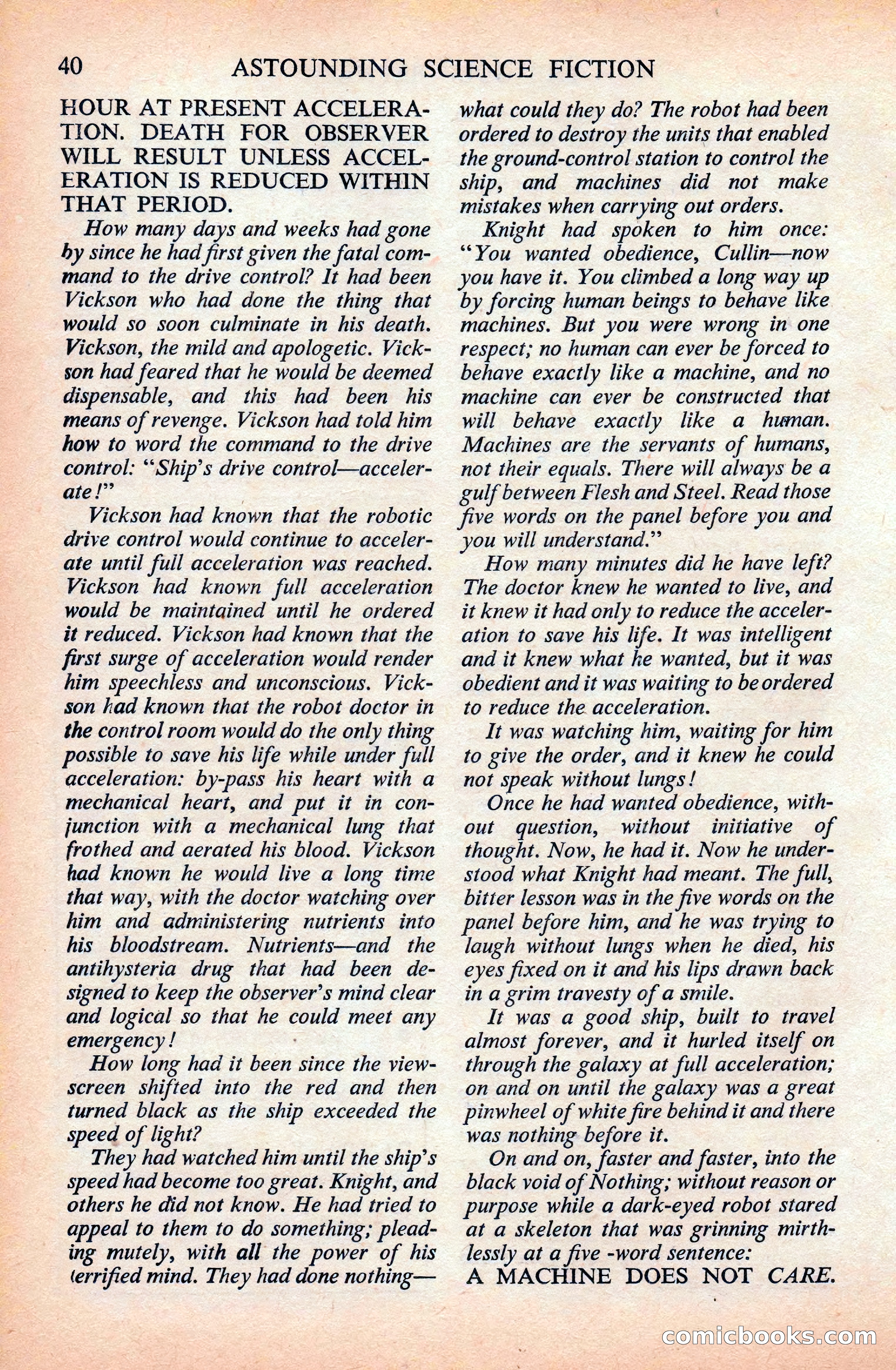
40 HOUR AT PRESENT ACCELERA- TION. DEATH FOR OBSERVER WILL RESULT UNLESS ACCEL- ERATION IS REDUCED WITHIN THAT PERIOD. How many days and weeks had gone by since he had first given the fatal com- mand to the drive control? It had been Vickson who had done the thing that would so soon culminate in his death. Vickson, the mild and apologetic. Vick- son had feared that he would be deemed dispensable, and this had been his means of revenge. Vickson had told him how to word the command to the drive control: ““Ship’s drive control—acceler- ate!” Vickson had known that the robotic drive control would continue to acceler- ate until full acceleration was reached. Vickson had known full acceleration would be maintained until he ordered it reduced. Vickson had known that the first surge of acceleration would render him speechless and unconscious. Vick- son had known that the robot doctor in the control room would do the only thing possible to save his life while under full acceleration: by-pass his heart with a mechanical heart, and put it in con- junction with a mechanical lung that frothed and aerated his blood. Vickson had known he would live a long time that way, with the doctor watching over him and administering nutrients into his bloodstream. Nutrients—and the antihysteria drug that had been de- signed to keep the observer’s mind clear and logical so that he could meet any emergency ! How long had it been since the view- screen shifted into the red and then turned black as the ship exceeded the speed of light? They had watched him until the ship’s speed had become too great. Knight, and others he did not know. He had tried to appeal to them to do something, plead- ing mutely, with all the power of his (errified mind. They had done nothing— ASTOUNDING SCIENCE FICTION what could they do? The robot had been ordered to destroy the units that enabled the ground-control station to control the ship, and machines did not make mistakes when carrying out orders. Knight had spoken to him once: ‘“*You wanted obedience, Cullin—now you have it. You climbed a long way up by forcing human beings to behave like machines. But you were wrong in one respect; no human can ever be forced to behave exactly like a machine, and no machine can ever be constructed that will behave exactly like a human. Machines are the servants of humans, not their equals. There will always be a gulf between Flesh and Steel. Read those five words on the panel before you and you will understand.” How many minutes did he have left? The doctor knew he wanted to live, and it knew it had only to reduce the acceler- ation to save his life. It was intelligent and it knew what he wanted, but it was obedient and it was waiting to be ordered to reduce the acceleration. It was watching him, waiting for him to give the order, and it knew he could not speak without lungs! Once he had wanted obedience, with- out question, without initiative of thought. Now, he had it. Now he under- stood what Knight had meant. The full, bitter lesson was in the five words on the panel before him, and he was trying to laugh without lungs when he died, his eyes fixed on it and his lips drawn back in a grim travesty of a smile. It was a good ship, built to travel almost forever, and it hurled itself on through the galaxy at full acceleration; on and on until the galaxy was a great pinwheel of white fire behind it and there was nothing before it. On and on, faster and faster, into the black void of Nothing; without reason or purpose while a dark-eyed robot stared at a skeleton that was grinning mirth- lessly at a five -word sentence: A MACHINE DOES NOT CARE. EComichoo CSCO) im