
Pulp Fiction, 1954 · page 40 of 133
Astounding Science Fiction (British Edition) — page 40: what you’re looking at
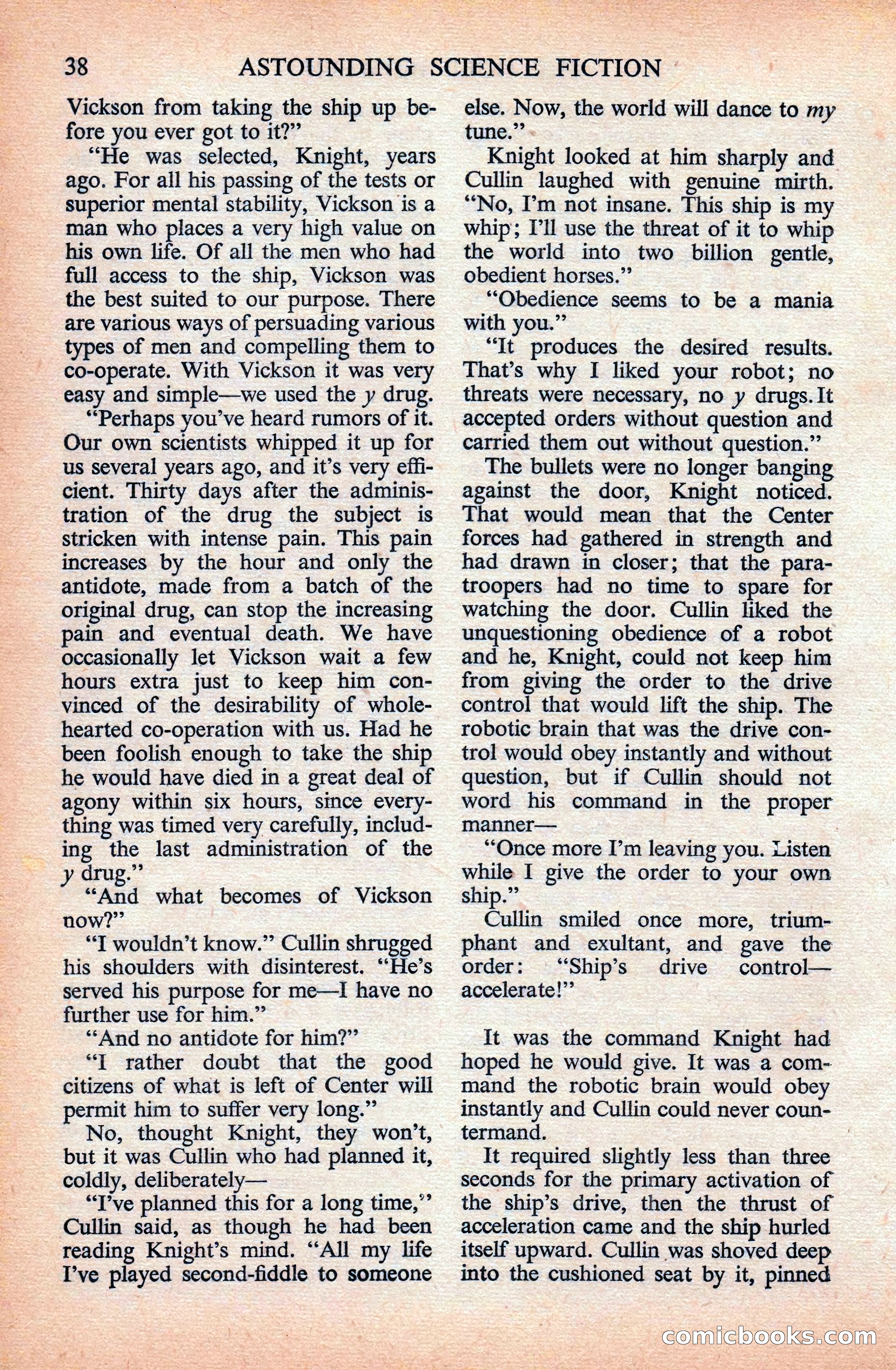
A restored page from Pulp Fiction, 1954. Page through the whole issue in the reader above.
📄 Transcribed text from this page (OCR, searchable)
Machine-transcribed from the original scan — historical spelling and the odd misread are preserved.
38 ASTOUNDING SCIENCE FICTION © Vickson from taking the ship up be- fore you ever got to it?” “He was selected, Knight, years ago. For all his passing of the tests or superior mental stability, Vickson is a man who places a very high value on his own life. Of all the men who had full access to the ship, Vickson was the best suited to our purpose. There are various ways of persuading various types of men and compelling them to co-operate. With Vickson it was very easy and simple—we used the y drug. “Perhaps you’ve heard rumors of it. Our own scientists whipped it up for us several years ago, and it’s very effi- cient. Thirty days after the adminis- tration of the drug the subject is stricken with intense pain. This pain increases by the hour and only the antidote, made from a batch of the original drug, can stop the increasing pain and eventual death. We have occasionally let Vickson wait a few hours extra just to keep him con- vinced of the desirability of whole- hearted co-operation with us. Had he been foolish enough to take the ship he would have died in a great deal of agony within six hours, since every- thing was timed very carefully, includ- ing the last administration of the drug.” “And what becomes of Vickson now?” “T wouldn’t know.” Cullin shrugged his shoulders with disinterest. ‘‘He’s served his purpose for me—I have no further use for him.” ‘And no antidote for him?” “I rather doubt that the good citizens of what is left of Center will permit him to suffer very long.” No, thought Knight, they won't, but it was Cullin who had planned it, coldly, deliberately— “I’ve planned this for a long time,” Cullin said, as though he had been reading Knight’s mind. “All my life I’ve played second-fiddle to someone else. Now, the world will dance to my tune.” Knight looked at him sharply and Cullin laughed with genuine mirth. ‘No, I’m not insane. This ship is my whip; Pll use the threat of it to whip the world into two billion gentle, obedient horses.” “Obedience seems to be a mania with you.” “It produces the desired results. That’s why I liked your robot; no threats were necessary, no y drugs. It accepted orders without question and carried them out without question.” The bullets were no longer banging against the door, Knight noticed. That would mean that the Center forces had gathered in strength and had drawn in closer; that the para- troopers had no time to spare for watching the door. Cullin liked the unquestioning obedience of a robot and he, Knight, could not keep him from giving the order to the drive control that would lift the ship. The robotic brain that was the drive con- trol would obey instantly and without question, but if Cullin should not word his command in the proper manner— “Once more I’m leaving you. Listen while I give the order to your own ship.” Cullin smiled once more, trium- phant and exultant, and gave the order: “Ship’s drive control— accelerate!”’ It was the command Knight had hoped he would give. It was a com- mand the robotic brain would obey instantly and Cullin could never coun- termand. It required slightly less than three seconds for the primary activation of the ship’s drive, then the thrust of acceleration came and the ship hurled itself upward. Cullin was shoved deep into the cushioned seat by it, pinned im EComichbooksco